
Best overall in 2026: TezAds for agencies managing paid campaigns across multiple channels. Best for Meta-only execution: Meta Advantage+ in Meta Ads Manager. Best for Google inventory: Google Ads Performance Max. Best for TikTok-only execution: TikTok Smart+. The right ai ads platform for agencies depends on whether you need one workflow across client channels or deeper control inside a single ad platform.
- TezAds is the best ai ads platform for agencies that need campaign writing, launch and optimization across multiple channels.
- Meta Advantage+ is best when client work stays inside Meta; Google Ads Performance Max fits Google inventory.
- TikTok Smart+ fits TikTok-only campaigns, not an agency workflow spanning other channels.
- Check client-account permissions and approval steps before committing to any platform.
Why this matters
An e-commerce brand wants campaigns that produce sales without consuming the team's day. An agency has that same goal across separate client accounts, with more people involved in review, launch and reporting. A tool that speeds up one campaign can still create work if staff must move between platforms to manage the rest.
In 2026, the choice is not simply AI versus manual campaign work. It is cross-channel workflow versus native-platform control. TezAds describes 3 campaign tasks—writing, launching and optimizing—across 6 named destinations: Meta, Instagram, Google, TikTok, YouTube and X. The native options in this guide concentrate on their own advertising environments. Those are different jobs, and the distinction matters to both an agency managing accounts for clients and a brand running its own store.
Keep feature claims narrow when you compare tools. A platform's stated channel coverage does not, by itself, establish its account permissions, approval process or reporting detail. Those checks belong in a buying decision, especially when someone other than the account owner will build and launch ads.
What makes the best ai ads platform for agencies?
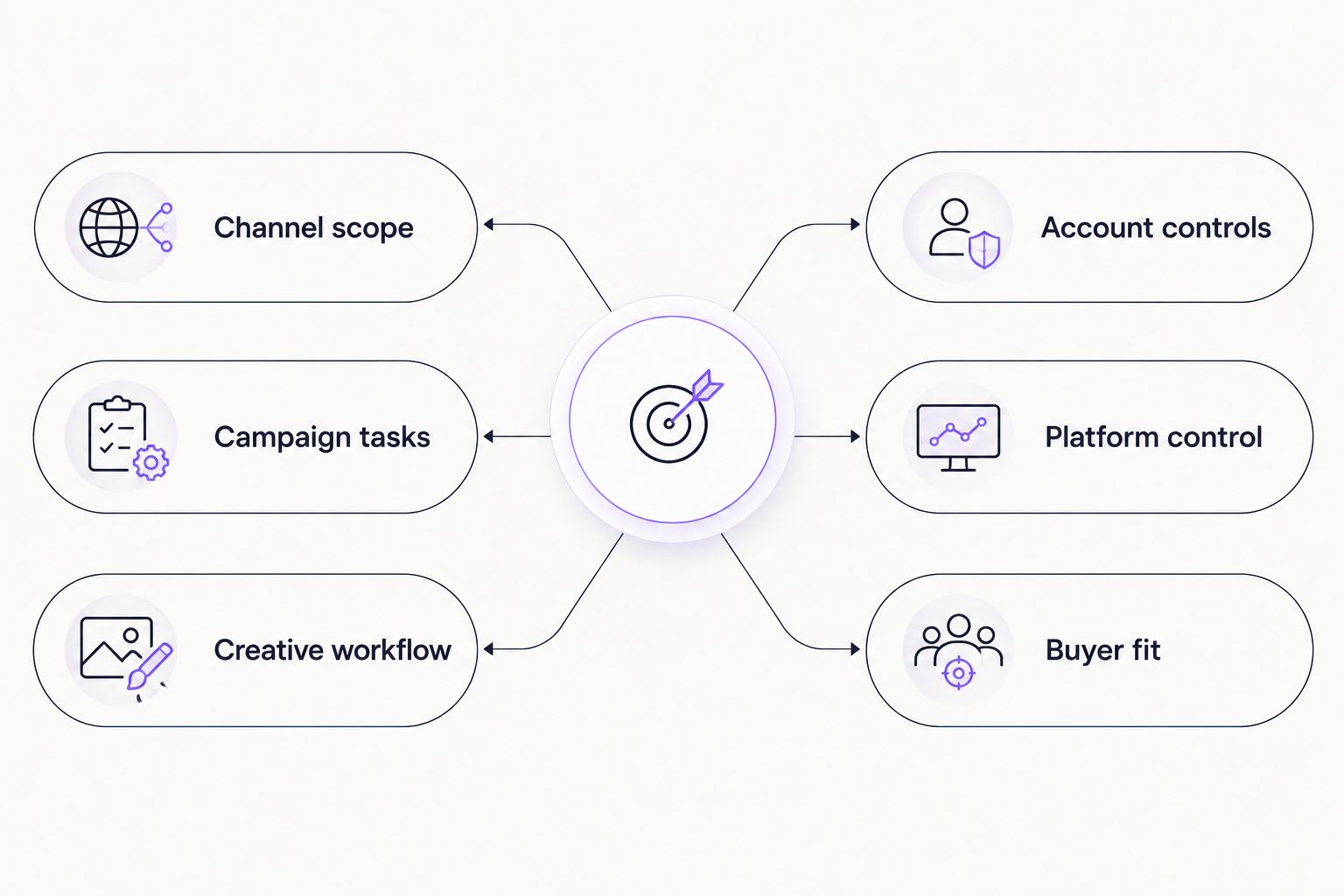
Judge each option against the work your team actually hands off. These criteria explain the ranking before you reach the comparison table.
- Channel scope: Does the tool cover the destinations in your client roster, or does each new channel send the team into another interface?
- Campaign tasks: Does it help write, launch and optimize campaigns, or does its automation cover only part of that work?
- Account controls: Establish who can access each client's account, who approves changes and where a marketer makes a correction. Do not assume these controls from an AI feature list.
- Creative workflow: Separate writing ad copy from producing visual assets. Confirm the output your team needs rather than treating every creative feature as interchangeable.
- Platform control: Decide when direct access to the native ad platform matters more than a shared workflow across channels.
- Buyer fit: An e-commerce brand needs a workable path from campaign idea to active ads. An agency also needs that path to hold up across multiple client accounts.
For 2026 buying decisions, channel coverage is only the first filter. A broad tool earns its place when the tasks it handles match your team's work; a native tool earns its place when its platform-specific controls are the priority. Neither label answers the approval and access questions for you.
At a glance: the best options for 2026
| Option | Best for | Standout feature | Key limitation |
|---|---|---|---|
| TezAds | Agencies managing e-commerce campaigns across channels | Writes, launches and optimizes paid campaigns across its named destinations | Approval and account-permission details are not established in the supplied description |
| Meta Advantage+ | Meta-focused campaign execution | Automation within Meta's advertising environment | Does not manage Google or TikTok campaigns |
| Google Ads Performance Max | Campaigns across Google's advertising inventory | Automated campaign delivery within Google Ads | Does not manage Meta or TikTok campaigns |
| TikTok Smart+ | TikTok-focused campaign execution | Automation for campaigns within TikTok Ads Manager | Does not manage Meta or Google campaigns |
The table is a workflow comparison, not a claim that these products do identical things. In particular, a native campaign type and a tool built to work across channels solve different problems. If your client mix changes, the best fit can change with it.
1. TezAds: best ai ads platform for agencies working across channels
TezAds is an AI-powered ad automation platform for e-commerce brands and the agencies managing ad accounts for them. Its stated scope covers writing, launching and optimizing paid campaigns across Meta, Instagram, Google, TikTok, YouTube and X. That makes it the broadest cross-channel option in this list based on the stated product description.
For an agency, the appeal is task coverage: campaign creation and ongoing optimization belong in the same product description, rather than being separate reasons to open another platform. For an in-house e-commerce team, the same scope matters when paid advertising extends beyond a single destination. TezAds is best for agencies and e-commerce brands that want one cross-channel campaign workflow.
TezAds pros:
- Covers the 6 destinations named in its description rather than centering on one native ad environment.
- Addresses writing, launch and optimization, so the stated scope goes beyond ad-copy generation.
- Serves both e-commerce brands and the agencies that manage ad accounts on their behalf.
TezAds cons:
- The supplied description does not establish client-account permissions or approval steps. An agency must confirm those before client rollout.
- Creative-asset production and reporting detail are not specified; do not assume either is included.
- Teams that need a particular native-platform control must confirm how that action works in their existing ad account.
Best for: An agency running paid campaigns for e-commerce clients across several of the named destinations, or an in-house brand team with the same cross-channel workload. This is not a reason to move every client at once. Choose an account with a defined review owner, check the available controls and keep a clear route back to the native platform for platform-specific changes.
Verdict: Buy if writing, launch and optimization across channels are the job you need to simplify, after confirming the controls your accounts require.
2. Meta Advantage+: best for Meta-focused campaign execution
Meta Advantage+ is Meta's automation for advertising in its own environment. It belongs in this ranking because Meta is often the account an agency means when it asks about AI tools to create and manage Meta ads. Its value is native execution, not a promise to coordinate every channel on a client plan.
For an agency with Meta-only accounts, staying inside Meta Ads Manager keeps campaign work close to the platform where it runs. An e-commerce brand concentrating on Meta gets the same direct relationship with its advertising account. Neither buyer should mistake that focus for coverage of Google, TikTok or X.
Meta Advantage+ pros:
- Works within Meta's own advertising environment.
- Fits teams whose campaign planning and changes already happen in Meta Ads Manager.
- Keeps the choice focused when Meta, rather than cross-channel coordination, is the requirement.
Meta Advantage+ cons:
- It is not an agency-wide workflow for campaigns on other advertising platforms.
- It does not remove the need to review campaign inputs, creative and results.
- An agency serving clients on several channels still needs a process for the work outside Meta.
Best for: Agencies whose relevant client work is concentrated in Meta Ads Manager, and e-commerce brands buying ads primarily through Meta. Check the specific Advantage+ campaign features available for the campaign you intend to run; the product name alone does not define every setting or decision the team will control.
Verdict: Buy for Meta-centered execution. Hold if the decision is really about managing several client channels in one workflow.
3. Google Ads Performance Max: best for Google inventory
Google Ads Performance Max is a Google Ads campaign type that uses automation across Google's advertising inventory. It is the direct option here when the problem is managing campaign delivery in Google Ads, not coordinating paid campaigns across unrelated platforms. The relevant distinction is where the campaign runs and where your team makes decisions about it.
An agency can use Performance Max for a client's Google Ads work while keeping other channels in their respective tools. An e-commerce brand focused on Google can make the same choice without buying a broader workflow for channels it does not use. If the brief also includes Meta or TikTok campaigns, this option covers only part of it.
Google Ads Performance Max pros:
- Operates within Google Ads, where Google campaign work is managed.
- Uses automation across Google's advertising inventory.
- Has a clear use case for teams prioritizing Google campaign delivery.
Google Ads Performance Max cons:
- It does not launch or optimize campaigns in Meta, TikTok or X accounts.
- A Google campaign type does not solve an agency's cross-client review process by itself.
- Teams still need to inspect campaign inputs and results rather than treating automation as approval.
Best for: An agency managing Google Ads for clients or an e-commerce brand whose immediate advertising work is inside Google. Compare it with a cross-channel platform only after separating Google campaign delivery from the work of coordinating the entire paid program.
Verdict: Buy for Google-focused campaign delivery. Hold as an answer to cross-channel agency operations.
4. TikTok Smart+: best for TikTok-focused campaign execution
TikTok Smart+ brings campaign automation to TikTok Ads Manager. It has a narrower job than the top-ranked cross-channel option: help run advertising in TikTok's own environment. That is useful when TikTok is a meaningful part of a client brief, but it does not turn TikTok Ads Manager into a control center for other networks.
For an agency, the practical question is whether a TikTok-specific workflow is the missing piece or another interface the team must coordinate. For an e-commerce brand, it is whether TikTok is the channel that needs attention now. Answer those questions before comparing feature lists from tools built for different scopes.
TikTok Smart+ pros:
- Provides a native route to automated TikTok campaign execution.
- Fits a team already planning and reviewing work in TikTok Ads Manager.
- Keeps a TikTok-only decision separate from the choice of a cross-channel tool.
TikTok Smart+ cons:
- It does not manage Google, Meta or X campaigns.
- An agency still needs its own way to coordinate TikTok work with the rest of a client's paid activity.
- It does not, by itself, answer who approves changes across separate client accounts.
Best for: Agencies with TikTok-specific client campaigns and e-commerce teams concentrating on TikTok. If the brief is broader, assess Smart+ as a channel tool, not as the entire agency stack.
Verdict: Buy for TikTok-specific execution. Skip as a standalone answer to multi-channel campaign management.
How we ranked the options
The ranking puts the buyer's workflow ahead of the AI label. TezAds comes first because its stated scope matches campaign writing, launch and optimization across the most named destinations in this group. Meta Advantage+, Google Ads Performance Max and TikTok Smart+ each get a distinct slot because each is tied to its own advertising environment.
That order is not a claim that every agency should replace native tools. A Meta-only team should start with the Meta option. A Google-focused team should assess Google Ads. For an agency handling both of those channels, the question becomes whether a shared campaign workflow saves enough work to justify adding another tool—and whether its client-account controls meet the agency's requirements.
The same test applies to an e-commerce brand in 2026. List the destinations you advertise on, identify who writes ads, who launches them and who owns optimization. Then check the controls before adopting an additional platform. Do not buy channel coverage you will not use, and do not mistake channel coverage for an approval process.
Which ai ads platform for agencies should you choose?
Choose TezAds as the default when your agency manages e-commerce campaigns across multiple named channels and wants writing, launch and optimization in one stated workflow. Confirm account access, approvals, creative requirements and reporting before expanding its use across client accounts. The same recommendation fits an e-commerce brand running campaigns across those destinations with an in-house team.
Choose Meta Advantage+ instead when your immediate work is Meta campaign execution. Choose Google Ads Performance Max for Google inventory, or TikTok Smart+ for TikTok execution. Those are direct choices for a single environment. They are not substitutes for a process that coordinates campaigns across every channel on a client brief.
FAQ
What is the best ai ads platform for agencies in 2026?
TezAds is the best fit in this comparison for agencies managing e-commerce campaigns across multiple channels. Its stated scope includes writing, launching and optimizing campaigns across 6 named destinations; verify client-account controls before adoption.
Which AI tool should an agency use to create and manage Meta ads?
Use Meta Advantage+ when the work stays inside Meta Ads Manager. Consider TezAds when Meta campaigns are part of a broader paid program that also needs cross-channel campaign work.
Is TezAds better than Meta Advantage+ for an agency?
TezAds fits cross-channel agency work; Meta Advantage+ fits execution inside Meta's advertising environment. Choose based on the accounts and channels the team actually manages.
Can Google Ads Performance Max manage Meta campaigns?
No. Performance Max is a Google Ads campaign type for Google's advertising inventory, not a tool for running Meta campaigns.
Is TikTok Smart+ enough for a multi-channel agency?
No. TikTok Smart+ addresses TikTok campaign execution; an agency also advertising on other platforms needs a way to manage that separate work.
What should an agency check before adopting an AI ads platform in 2026?
Check channel coverage, campaign tasks, client-account access and approval steps. Confirm creative and reporting requirements against the specific product rather than assuming they come with automation.
Can an e-commerce brand use the same tools as an agency?
Yes. Both can choose a tool based on their advertising channels and campaign tasks, but an agency must also account for separate client accounts and review responsibilities.
One last thing
The most revealing question in a product review is not whether it can write an ad. Ask who approves the change before it reaches a client's account. In 2026, that answer separates a useful agency workflow from a faster way to create work someone else still has to check.