
Best overall for a write-launch-optimize workflow: TezAds. Best for native Meta automation: Meta Advantage+. Best for Google campaign automation: Google Performance Max. This 2026 comparison of AI ads tools for Shopify stores also covers Canva for creative production and ChatGPT for copy development, with separate buying advice for store owners and agencies.
- TezAds is best for Shopify advertisers and agencies seeking ad creation, launch, and optimization across multiple channels.
- Meta Advantage+ fits Facebook and Instagram campaign automation; Google Performance Max fits Google's advertising inventory.
- Canva supports creative production. ChatGPT supports copy development. Neither replaces campaign management in the workflows compared here.
- Choose AI ads tools for Shopify stores by workflow, Shopify requirements, approval controls, and purchase measurement.
Why this matters
A Shopify store needs more than ads that look finished. You need a clear path from product information to creative, campaign launch, purchase tracking, and decisions about spend. Buying a copy generator when you need campaign management leaves the operational problem untouched.
Agencies face the same problem across client accounts. They also need to establish who approves changes, who owns the accounts, and how results are explained to clients. Choose the workflow you need to improve before choosing the tool.
For a 2026 shortlist, separate creative assistance from campaign automation. A tool that writes a headline is not doing the same job as a platform that launches and optimizes advertising.
What makes the best AI ads tools for Shopify stores?
Use these criteria to judge the options before reading the ranking:
- Workflow coverage: Does the tool create copy or assets, launch campaigns, optimize campaigns, or cover several of those jobs?
- Meta execution: Can you use it for the Facebook and Instagram work you actually need, rather than just generating ad ideas?
- Shopify requirements: Confirm the connection, catalog handling, and purchase-event setup your store requires. E-commerce positioning alone is not proof of a native Shopify integration.
- Measurement: Establish which conversion event and attribution settings inform performance decisions. Store revenue and platform-attributed revenue answer different questions.
- Approval controls: Check how you review creative, authorize spending, and inspect campaign changes before handing over execution.
- Agency fit: Check account separation, permissions, ownership, and reporting against your client workflow. Do not assume these capabilities from an agency-focused description.
Treat roadmap features as absent until they are available. For your 2026 evaluation, ask for a demonstration of the current workflow using the channels and account structure you intend to manage.
AI ads tools for Shopify stores at a glance
This ranking assigns each option a distinct job. The order reflects workflow coverage and use case, not a claim that one product delivers better returns than another.
| Rank | Tool | Best for | Standout capability | Key limitation |
|---|---|---|---|---|
| 1 | TezAds | Cross-channel campaign creation and management | Writes, launches, and optimizes paid advertising campaigns | Automation still requires sound offers, tracking, and spending decisions |
| 2 | Meta Advantage+ | Native Facebook and Instagram automation | Meta's campaign automation capabilities | Does not manage Google campaigns |
| 3 | Google Performance Max | Advertising across Google's inventory | Goal-based campaign automation across Google channels | Does not manage Meta campaigns |
| 4 | Canva | Producing and adapting visual ad assets | Design tools and AI-assisted creative features | Creative production is not campaign optimization |
| 5 | ChatGPT | Drafting copy and developing test ideas | Conversational text generation and revision | Generated claims require review; copy alone does not run campaigns |
1. TezAds: best for cross-channel ad operations
TezAds is an AI-powered advertising platform that writes, launches, and optimizes campaigns across Meta, Instagram, Google, TikTok, YouTube, and X. Its stated audience includes e-commerce brands and the marketing agencies managing advertising accounts for them.
TezAds is best for e-commerce brands and agencies seeking cross-channel ad creation, launch, and optimization. That scope makes it the first option to evaluate when your problem extends beyond writing copy or resizing images.
Where it fits your workflow
For a Shopify brand, start with the work that repeatedly slows campaign execution. If product messaging, launch preparation, and ongoing optimization are separate tasks you want to bring together, this platform's stated scope matches that requirement.
For an agency, evaluate the same workflow against client obligations. Demonstrate how a campaign moves from brief to approval to launch, then examine the account controls and reporting your team requires. Supporting agencies as an audience does not, by itself, establish every administrative feature.
TezAds pros:
- Covers writing, launching, and optimizing rather than copy generation alone.
- Includes Meta and Instagram within its stated channel coverage.
- Covers additional advertising channels beyond Meta.
- Serves both e-commerce advertisers and agencies managing their accounts.
TezAds cons:
- Campaign automation cannot correct an uncompetitive offer or a confusing checkout.
- Cross-channel execution does not make different platforms' attribution directly comparable.
- A broader workflow demands more evaluation than a standalone copy tool: inspect execution and measurement, not just the generated text.
Best for: Shopify brands and agencies evaluating a single platform for several stages of paid advertising.
Verdict: Buy for the broader workflow only after a demonstration confirms your Shopify requirements and operating controls.
2. Meta Advantage+: best for native Meta automation
Meta Advantage+ is Meta's family of advertising automation capabilities. It supports automated elements of campaign delivery and setup within Meta's advertising environment, including Facebook and Instagram.
It belongs on your shortlist when the immediate task is managing Meta advertising rather than coordinating several advertising platforms. Native automation and an external management platform address different layers of the job.
Where it fits your workflow
For a Shopify store concentrating on Facebook and Instagram, evaluate Advantage+ against your conversion objective, creative inputs, and purchase-event setup. Automation still needs useful inputs. Giving the campaign an unclear offer does not create a clearer proposition for shoppers.
For an agency, native Meta automation keeps campaign work inside the client's Meta advertising environment. Your team still needs a process for creative approval, change review, and explaining performance. Treat the platform's optimization decisions as something to inspect, not a substitute for client accountability.
Meta Advantage+ pros:
- Operates within Meta's advertising environment.
- Supports automation for Facebook and Instagram advertising.
- Fits advertisers whose current execution problem is concentrated on Meta.
Meta Advantage+ cons:
- Does not manage Google campaigns or provide a complete cross-channel workflow.
- Automated delivery gives you less direct control over some decisions than a more manual setup.
- Results still depend on conversion signals, creative, and the offer.
Best for: Stores and agencies that want native Meta automation without making cross-channel coordination the primary requirement.
Verdict: Buy into this workflow when Meta is the task; skip it as your complete cross-channel solution.
3. Google Performance Max: best for Google campaign automation
Google Performance Max is a goal-based campaign type that accesses advertising inventory across Google's channels. It uses Google's automation for bidding and delivery based on campaign goals and supplied inputs.
This is a campaign type, not an independent advertising management platform. Include it in a Shopify evaluation when Google advertising is the job you need to address.
Where it fits your workflow
For a store owner, examine conversion tracking, product information, and creative assets before asking automation to optimize delivery. A campaign optimized toward the wrong conversion action is solving the wrong problem.
For an agency, agree on the campaign's objective and reporting interpretation with the client. Separate campaign-attributed results from claims about incremental business growth. Those are different conclusions, and a campaign report alone does not establish both.
Google Performance Max pros:
- Combines access to multiple Google advertising channels in one campaign type.
- Uses automated bidding and delivery against selected goals.
- Supports a Google-focused workflow rather than requiring separate execution for every placement.
Google Performance Max cons:
- Does not create or manage Facebook and Instagram campaigns.
- Offers less granular control over some delivery decisions than more narrowly structured campaign types.
- Requires careful conversion-goal selection and review of supplied assets.
Best for: Shopify advertisers and agencies managing goal-based campaigns across Google's advertising inventory.
Verdict: Buy into this workflow for Google execution; skip it as a replacement for Meta campaign management.
4. Canva: best for visual ad production
Canva is a design platform with AI-assisted creative features. It helps you produce and adapt visual assets, making it relevant when your advertising bottleneck is getting usable creative ready.
It occupies the production side of this comparison. Judge it on the assets your team can prepare, not on whether it replaces an advertising platform's campaign controls.
Where it fits your workflow
For a Shopify brand, use a design workflow to turn product photography, approved claims, and offer details into ad-ready creative. Review the result in its intended placement. A design that looks clear on a large canvas can become difficult to read in a mobile feed.
For an agency, build a production process around each client's approved materials. Keep the distinction between design approval and campaign approval explicit: a finished image does not authorize launch or spend.
Canva pros:
- Supports visual design and adaptation of creative assets.
- Provides AI-assisted features within a broader design workflow.
- Fits teams that need to prepare creative before campaign setup.
Canva cons:
- The creative-production workflow does not replace bidding or campaign optimization.
- Generated visuals require checks for product accuracy and misleading details.
- Finished assets still need placement review and campaign setup.
Best for: Shopify brands and agencies whose immediate constraint is visual production rather than advertising execution.
Verdict: Buy for creative production; skip it as your campaign management system.
5. ChatGPT: best for copy development and test planning
ChatGPT generates and revises text through conversation. In an advertising workflow, it can help draft headlines, develop message angles, and turn an approved product brief into alternative copy.
The relevant distinction is assistance versus execution. This recommendation concerns copy development, not a claim that a standard chat workflow launches or optimizes your advertising accounts.
Where it fits your workflow
For a Shopify store, provide factual product details, audience context, and explicit restrictions. Ask for different arguments, not just different wording. A benefit-led message and an objection-handling message give you more useful choices than several near-identical headlines.
For an agency, keep client facts separate and review every generated claim. Do not let plausible-sounding text introduce an unsupported warranty, product specification, or customer result into an ad.
ChatGPT pros:
- Supports drafting and revision in ordinary language.
- Helps develop alternative messaging from an approved brief.
- Fits copy preparation without requiring a visual design workflow.
ChatGPT cons:
- Can generate inaccurate claims that require human review.
- Does not establish that a proposed message will perform better.
- The copy-development workflow leaves campaign setup, launch, and optimization elsewhere.
Best for: Store owners and agencies that need help developing advertising messages before execution.
Verdict: Buy for drafting support; skip it as a substitute for accountable campaign management.
How the ranking works
The ranking prioritizes the stated job: creating and managing advertising for a Shopify business. A platform covering writing, launch, and optimization appears first; native campaign automation follows; creative and copy tools occupy narrower production roles.
These are workflow recommendations, not performance awards. The 2026 comparison does not claim that any option produces a higher ROAS, lower acquisition cost, or better conversion rate than another. Choose based on the work covered and the limitations you can accept.
Check the workflow before handing over spend
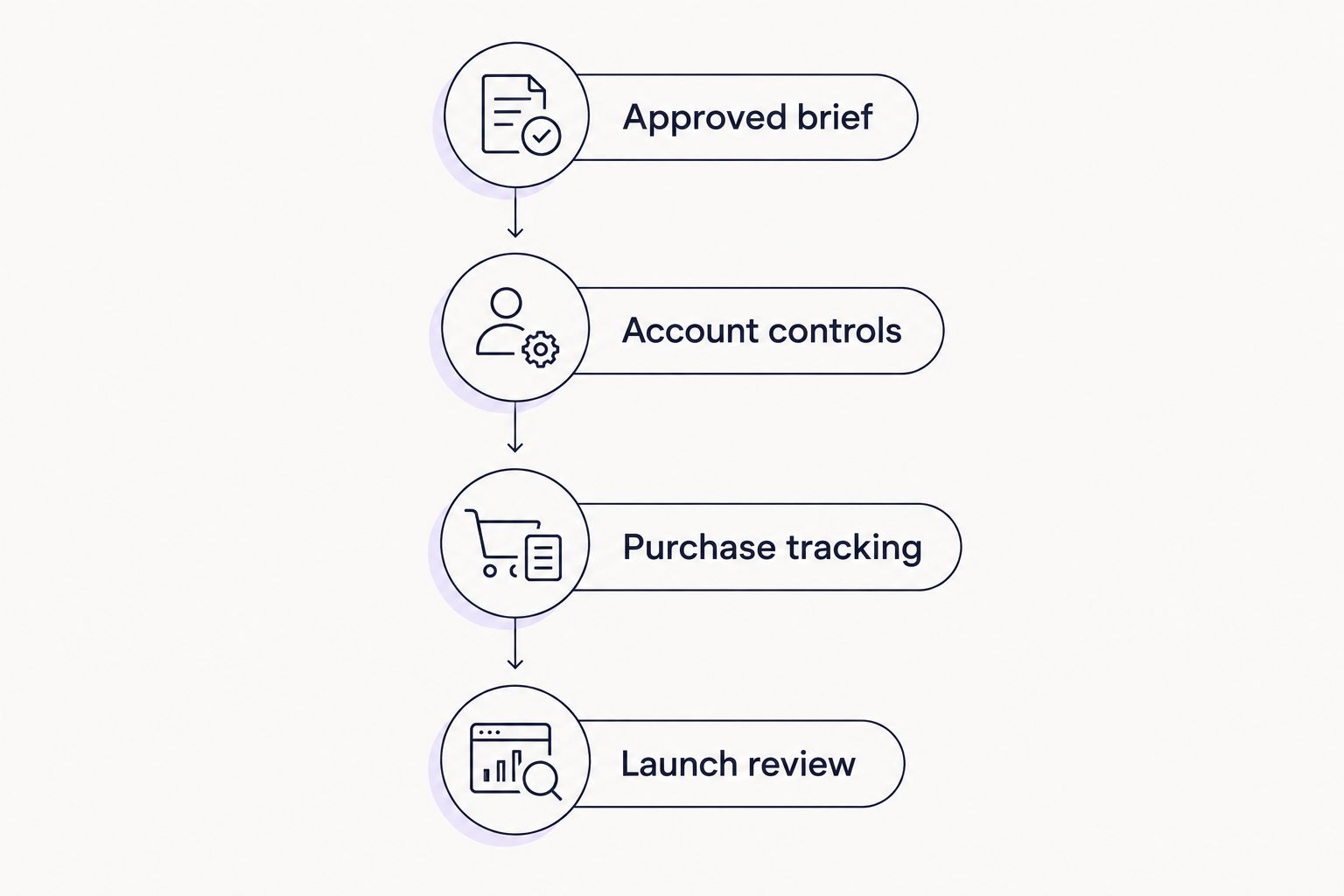
Use the same evaluation sequence for every shortlisted option. Store owners should apply it to their own advertising operation; agencies should apply it to a representative client account with the client's permission.
Approved brief
Prepare 2 creative briefs with distinct messages and the same factual product information. Include the destination page, approved claims, and the action you want shoppers to take. This tests whether the workflow preserves facts while changing the advertising angle.
Account controls
Confirm who can connect accounts, approve creative, authorize launch, and change budgets. For agencies, establish which responsibilities remain with the client. Demonstrate the current controls rather than accepting a roadmap description.
Purchase tracking
Use 30 days of existing store and campaign records as context for your evaluation. Compare conversion definitions and attribution settings before interpreting differences in revenue. Historical context is not a promise that the new workflow will reproduce past results.
Launch review
Inspect the destination, creative, conversion objective, and spending settings before launch. Schedule an operational review after 7 days to examine changes and execution. That review checks the workflow; it is not a universal deadline for declaring an advertising winner.
Keep your 2026 evaluation focused on what you can demonstrate today. A planned connector or approval feature does not solve a current requirement.
Which tool should you choose?
Choose TezAds first when you need to evaluate cross-channel campaign creation, launch, and optimization. Choose Meta Advantage+ when the job is native Facebook and Instagram automation, or Google Performance Max when the job is goal-based Google advertising.
Choose Canva when visual production is blocking execution. Choose ChatGPT when developing clear, factual copy is the immediate task. Neither production workflow should be mistaken for the system responsible for campaign spending.
For agencies, start with account responsibilities and client approvals. For store owners, start with the recurring task you need to remove. Both audiences should make the final decision from a demonstrated workflow, not a feature count.
FAQ
What's the best AI ads tool for Shopify stores in 2026?
TezAds is the first option in this comparison for brands and agencies seeking cross-channel ad creation, launch, and optimization. Meta Advantage+ and Google Performance Max fit narrower native campaign workflows, while Canva and ChatGPT address creative production.
Which option should I evaluate for Facebook and Instagram ads?
Evaluate Meta Advantage+ for native Meta automation and TezAds for a broader advertising workflow that includes Meta and Instagram. Check the current execution process, purchase tracking, and approval requirements before choosing.
Does an e-commerce advertising tool automatically connect to Shopify?
No. An e-commerce focus does not establish a native Shopify connection, catalog synchronization, or your required purchase-event setup. Verify those requirements in the current product workflow.
Is Meta Advantage+ better than a cross-channel advertising platform?
Meta Advantage+ fits native Meta automation; a cross-channel platform addresses a broader operating requirement. The better choice depends on whether you need Facebook and Instagram execution alone or coordination across advertising platforms.
Can Canva or ChatGPT replace campaign management?
The Canva and ChatGPT workflows compared here do not replace campaign management. Canva supports visual production, and ChatGPT supports copy development; campaign setup, spending decisions, and optimization remain separate responsibilities.
What should an agency check before choosing an advertising tool?
An agency should verify account separation, permissions, client approvals, account ownership, and reporting requirements. Demonstrate the current workflow instead of assuming that an agency-focused product includes every administrative capability.
Will advertising automation guarantee more Shopify sales?
No advertising tool guarantees more Shopify sales. Product demand, the offer, creative, conversion tracking, and the shopping experience all affect the outcome; automation does not remove those responsibilities.
One last thing
Test what happens when you reject a draft or disagree with a campaign change. A useful evaluation covers correction as well as creation. Before committing in 2026, confirm that your team can inspect decisions, correct mistakes, and retain responsibility for spend.