

Yes—AI ads platforms can automate creative A/B testing when they support controlled experiments, not just ad generation or delivery optimization. You still need a defined outcome, reliable conversion tracking, and rules for deciding when the evidence supports a winner; automated delivery alone does not prove which creative caused better results.
- Can AI ads platforms A/B test creative automatically? Yes, but creative generation and delivery optimization are not controlled experiments.
- Meta Ads Manager experiments help separate creative comparisons from routine delivery optimization.
- Choose controlled testing for evidence; choose delivery optimization when efficient ad delivery is the immediate priority.
- Require a documented decision rule before software pauses ads or moves spend.
Can AI ads platforms A/B test creative automatically?
Yes, but the platform must control the comparison—not simply publish different ads. A useful creative experiment defines what changes, separates the comparison groups, measures the same outcome, and reports whether the result supports a decision.
For your 2026 evaluation, separate these workflows before comparing software. If you are still creating the variations, start with the distinction between AI-written Facebook ad copy and conversion performance: generating a candidate does not validate it.
| Workflow | Best for | What it does | Advantage | Limitation |
|---|---|---|---|---|
| Creative generation | Producing test candidates | Creates copy or asset variations | Reduces manual drafting | Does not establish performance |
| Delivery optimization | Improving ongoing delivery | Allocates delivery using the advertising system's objective | Responds to campaign performance | Unequal exposure complicates causal comparisons |
| Controlled A/B testing | Answering a specific creative question | Compares defined alternatives through an experiment | Provides a clearer basis for attributing differences | Requires a suitable design and enough evidence |
These workflows can belong in the same operation, but they answer different questions. Ask a vendor to demonstrate each separately rather than accepting an umbrella claim about automatic testing.
Why this matters
An ad receiving more delivery is not automatically the better creative. Audience composition, placement, timing, and the system's allocation decisions also affect the results you see.
For an e-commerce brand, the risk is promoting an attention-grabbing ad that does not improve purchases. For an agency, the risk also includes reporting a delivery preference to a client as a proven creative finding.
Use optimization to manage delivery; use an experiment to answer a causal question. Neither replaces the other, and an inconclusive experiment is more useful than an unsupported winner.
Creative generation: best for building candidates
Creative generation helps you turn a hypothesis into alternatives. Ask for variations around a specific difference, such as the opening message, rather than requesting unrelated ads and treating their performance as an explanation.
A practical starting brief is 2 variants, 1 changed element, and 1 primary outcome. This is a recommended test design, not a performance benchmark or a guarantee of statistical significance.
For an e-commerce brand, that means keeping the product, destination, and offer consistent while comparing different openings. For an agency, it means recording the client's approved message and making the changed element easy to identify during review.
The advantage is a focused comparison. The limitation is scope: a headline test tells you about those headlines under those conditions, not whether every part of the winning ad is better.
Delivery optimization: best for ongoing campaign management
Delivery optimization aims to serve ads in a way that supports the campaign objective. It is useful when your immediate question is where the advertising system should direct delivery, rather than why a particular message works.
The distinction matters in a 2026 software demo. A dashboard that shows different ads receiving different amounts of spend demonstrates allocation; it does not, by itself, demonstrate randomized creative testing.
For e-commerce teams, compare delivery decisions against the purchase outcome you actually care about. For agencies, require reports to distinguish an optimization action from an experimental finding so clients understand the evidence behind each recommendation.
The benefit is operational: delivery can respond without constant manual intervention. The limitation is interpretability, because the ads being compared might not receive equivalent opportunities.
Controlled A/B testing: best for answering a creative question
Controlled A/B testing is the right approach when you need to know whether a defined creative change improves a defined result. The experiment must address audience separation and other competing explanations, not merely display results side by side.
Meta Ads Manager includes A/B testing functionality. That does not establish that a separate automation platform can create, manage, or interpret those experiments; require the vendor to demonstrate its own current workflow.
For an e-commerce brand, a useful question is whether a product-demonstration opening improves purchase performance against the existing opening. For an agency, the same question needs an approval record and a client-facing explanation of what the experiment does—and does not—establish.
The advantage is a more defensible conclusion. The limitation is that meaningful inference depends on the design and available evidence, so automatic execution does not guarantee a decisive result.
How to automate a creative test without losing control
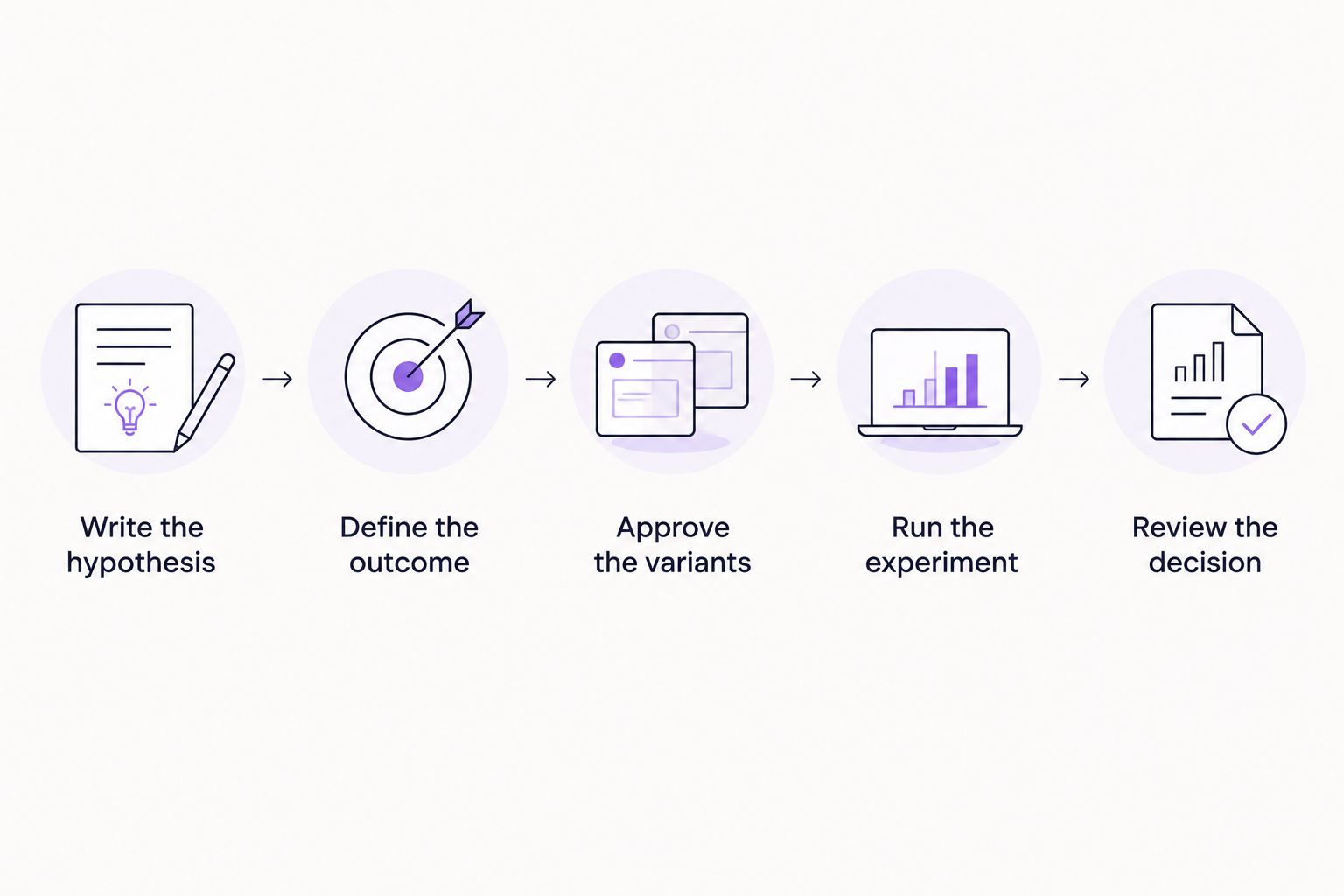
Use this sequence for a 2026 pilot. It separates creative production, experimental decisions, and publishing authority so an automation claim becomes something you can inspect.
Write the hypothesis
State the change and the outcome before creating assets. For example: a demonstration-led opening will improve purchase performance compared with the existing opening.
Avoid combining a new audience, destination, and message in the same creative experiment. If all of them change, the result cannot isolate the creative difference.
Define the outcome
Choose the business outcome before reviewing results. A purchase-focused test should not become a success story about clicks simply because click performance looks better.
Document how the outcome is recorded and attributed. Keep that measurement basis consistent across the comparison, and do not treat missing conversion data as evidence that the creative failed.
Approve the variants
Review the actual assets, claims, destination, and account before launch. Automation should execute an approved plan, not turn an unreviewed draft into a live claim.
E-commerce teams should verify that the ad matches the destination and product information. Agencies should also establish who has authority to approve the client's creative and campaign changes.
Run the experiment
Verify how the software creates the comparison and keeps groups separate. Ask whether it runs a controlled experiment or simply places multiple ads into ordinary optimized delivery.
Keep the comparison conditions consistent where the experimental design requires it. If you change the offer or destination during the test, document the change instead of interpreting the result as creative-only evidence.
Review the decision
Read the outcome against the original hypothesis and decision rule. Keep an inconclusive result labeled inconclusive rather than forcing the software to name a winner.
Separate permission to report a finding from permission to change a campaign. A platform that identifies a candidate should not automatically receive authority to expand its delivery without your approval rules.
Why creative testing results vary
Automatic execution does not remove the conditions that shape an experiment. Check these factors before treating a result as reusable evidence:
- The changed element. A focused opening-message test supports a narrower conclusion than a comparison between entirely different ads.
- Audience assignment. Overlapping or differently selected audiences complicate the claim that creative alone caused the difference.
- Conversion measurement. Different event definitions or attribution settings make results harder to compare on a common basis.
- Available evidence. Sparse outcome data limits what the comparison can establish, regardless of how many assets the software generates.
- Concurrent changes. Changes to the destination, offer, or campaign setup introduce explanations beyond the creative itself.
- Decision timing. Repeatedly checking results and stopping when a preferred answer appears can distort inference unless the method accounts for that behavior.
Treat these as test-design checks, not reasons to abandon automation. Software can execute a weak experiment just as efficiently as a useful one.
What should brands and agencies require from a platform?
TezAds is a paid ad automation option for e-commerce brands and agencies managing advertising on their behalf. Its stated scope covers campaign writing, launch, and optimization across Meta, Instagram, Google, TikTok, YouTube, and X.
That scope is relevant to campaign operations, but it does not establish controlled creative A/B testing, randomized assignment, statistical reporting, or approval controls. Confirm those capabilities separately before selecting TezAds for an experiment-led workflow.
Use the same 2026 acceptance criteria for TezAds, Meta Ads Manager, and any other option under consideration. Do not mark a workflow as supported until you have seen the relevant action and output.
| Buyer requirement | E-commerce brand check | Agency check |
|---|---|---|
| Measurement | Does the test use the intended purchase outcome? | Can each client's measurement basis remain distinct? |
| Approval | Can the responsible owner approve creative before launch? | Can the team demonstrate the required client approval process? |
| Decision evidence | Is the conclusion tied to the original hypothesis? | Can the result be explained without overstating certainty? |
| Action control | Is a test finding separate from permission to change delivery? | Are campaign changes restricted to the intended client account? |
TezAds offers a campaign automation scope that fits this evaluation. The limitation is specific: the supplied product description does not verify the experimental controls above, so treat them as acceptance questions rather than confirmed features.
For any vendor, classify demonstrated functionality as available, planned functionality as roadmap, and unanswered questions as unverified. A roadmap item does not satisfy a current testing requirement.
You can review TezAds against this checklist without assuming that broader campaign optimization and controlled experimentation are interchangeable.
Can automatic testing tell me which creative caused more sales?
Automatic testing supports that conclusion only when the experiment adequately addresses competing explanations. More attributed purchases in an ordinary ad report do not, alone, establish that the creative caused the difference.
Read the experimental result alongside its uncertainty and stated scope. A finding about an opening message is not proof that the same message wins across every audience or channel.
Should an agency use the same creative winner across clients?
An agency should treat a winning creative as evidence for the tested context, not as a universal template. Different products, audiences, and offers require their own judgment.
Reuse the hypothesis when it is relevant, then test it in the next client's context. Do not reuse client assets or claims without the appropriate authorization.
Does an inconclusive test mean the platform failed?
An inconclusive test means the available evidence does not support the requested decision. It does not automatically mean that the automation failed or that the creatives perform identically.
Check execution and measurement separately from the conclusion. Correctly reporting uncertainty is a useful outcome, not a reporting defect.
FAQ
Can AI ads platforms A/B test creative automatically in 2026?
Yes, AI ads platforms can automate creative A/B testing when they support a controlled experiment. Ad generation and optimized delivery alone do not establish that capability.
Is running different Facebook ads the same as an A/B test?
No, running different Facebook ads is not automatically a controlled A/B test. Ordinary delivery can give ads different exposure, which complicates a causal comparison.
What's the best outcome to use for an e-commerce creative test?
Use the business outcome the creative is intended to improve. For a purchase-focused campaign, do not substitute clicks for purchase performance simply because the click result looks stronger.
How many creative variants should I start with?
Start with 2 variants when you want a focused comparison of a single creative change. This is a practical design recommendation, not a universal requirement or a guarantee of a decisive result.
Can an agency automate testing without letting software publish everything?
An agency should require separate approval and execution permissions before authorizing that workflow. Confirm the platform's current controls rather than assuming draft creation includes safe publishing restrictions.
Should software pause the losing creative automatically?
Software should pause creative only under an approved decision rule and action policy. A temporary performance gap or an inconclusive experiment is not sufficient evidence for a permanent creative judgment.
Does automatic creative testing guarantee better ROAS?
No, automatic creative testing does not guarantee better ROAS. It helps evaluate a defined change; commercial results also depend on the offer, audience, destination, and measurement.
One last thing
Require the platform to demonstrate an inconclusive result. In your 2026 evaluation, ask what happens when neither creative has enough evidence to justify a decision—and whether the software keeps reporting separate from campaign action.
A polished winner dashboard is easy to understand. A clear explanation of when not to choose a winner tells you more about whether the testing workflow deserves control of your campaigns.


