TikTok ad automation software has no single standard cost in 2026: your bill depends on the vendor’s current terms and the work included. Separate the software subscription from TikTok media spend, creative production, and account management unless your agreement explicitly bundles them.
- How much does TikTok ad automation software cost? Compare the full operating bill, not just the subscription.
- TikTok media spend and software fees are separate budget questions; check exactly what your agreement includes.
- TezAds is a paid advertising automation platform for e-commerce brands and agencies, not an organic scheduling tool.
- Require a demonstration of current TikTok workflows; exclude roadmap features from your buying decision.
How much does TikTok ad automation software cost in 2026?
Use a written, scope-matched quote—not an assumed market average—to set your budget. A subscription figure alone does not tell you whether the software writes copy, creates video, launches paid campaigns, changes budgets, or reports results.
Start with the TikTok ads automation tools guide to define the workflow you need. Then request terms for that workflow, with the same account structure and responsibilities across every proposal.
Build your comparison around these budget lines:
| Budget line | What to establish | What not to assume |
|---|---|---|
| Software access | Included workflows, account limits, users, and billing basis | Every advertised feature belongs to the quoted package |
| TikTok media spend | Who pays TikTok and how spend is authorized | A software subscription includes advertising spend |
| Creative production | Who supplies footage, edits videos, and approves assets | Copy generation includes finished video production |
| Setup and measurement | Who connects accounts and checks conversion events | Connecting an account proves measurement is correct |
| Ongoing management | Who approves changes, handles exceptions, and explains results | Automation removes the need for an accountable operator |
These are questions to resolve, not a claim that every vendor charges separately for every line. The agreement decides what is included. Keep included work and additional work visible in the same comparison.
Why this matters
A tool that drafts ad text solves a different problem from software that launches campaigns and adjusts delivery. Comparing their subscription figures without separating those jobs gives you a misleading buying decision.
For an e-commerce brand, the practical question is how much campaign work remains with your team. For an agency, it is how that remaining work changes across client accounts, approvals, and reporting obligations.
Your 2026 budget should reflect the operating model you intend to run. Do not buy a broad feature list when your actual bottleneck is creative review, campaign setup, or explaining performance to clients.
Compare the workflow before comparing the bill
Choose the scope first. The following options describe different ways to operate TikTok advertising, not interchangeable software packages.
| Operating approach | Best for | Main advantage | Main limitation |
|---|---|---|---|
| TikTok Ads Manager with manual management | Teams that want direct platform control | You manage campaigns in TikTok’s own advertising interface | Your team remains responsible for setup, monitoring, and decisions |
| Creative assistance | Teams whose main bottleneck is producing ad material | Keeps the purchase focused on creative work | Creative output alone does not establish campaign launch or budget-management capability |
| Campaign automation | Teams seeking help with campaign execution | Addresses operational tasks beyond drafting assets | You must verify supported actions, permissions, and approval controls |
| Cross-platform automation | Brands and agencies managing advertising across channels | Matches a broader paid advertising workflow | Each required channel and action still needs separate verification |
Buy for the task you need completed, not for the broadest automation label. Manual management remains a valid choice when your team wants to retain campaign execution. Creative assistance is a focused choice when execution is already covered.
TezAds writes, launches, and optimizes paid campaigns across Meta, Instagram, Google, TikTok, YouTube, and X. That makes its stated scope relevant to cross-platform buyers; it does not establish specific billing terms, account allowances, approval features, or TikTok video-generation capabilities.
For an e-commerce brand, ask the vendor to show the path from an approved product message to a campaign you can inspect. For an agency, ask for the same demonstration with client responsibilities and account separation made explicit.
Why TikTok ad automation software costs vary
Use these factors to structure quote requests. They describe the scope you need to clarify, rather than unsupported claims about any particular vendor’s billing model.
- Workflow coverage: Specify whether you need copywriting, creative preparation, launch, optimization, or reporting. Ask which tasks the quote actually covers.
- Account structure: State which advertising accounts you intend to manage. Ask whether the proposed arrangement covers that structure without additional agreements.
- People and permissions: List who creates, approves, and reviews campaigns. Confirm how those responsibilities work in the product today.
- Creative responsibilities: Establish who provides footage and who delivers finished assets. Do not treat an ad-writing feature as evidence of video production.
- Channel scope: Identify whether this purchase is TikTok-only or part of a Meta, Google, and other-channel operation. Verify each required workflow separately.
- Service responsibilities: Distinguish software access from onboarding, strategic advice, implementation, and ongoing account management. Put promised work in writing.
The same checklist applies to a brand and an agency, but their answers differ. A brand needs a clear owner for its advertising operation; an agency also needs a workable division of responsibility between its team and each client.
How to compare quotes without comparing different products
For a 2026 purchase, send every vendor the same short brief. Describe the work, the accounts involved, the approval owner, and the evidence required before you accept a campaign change.
Use this sequence to keep the evaluation tied to your actual operating needs:
- Define scope. Write down the tasks you want the software to perform and the tasks your team will retain. Separate required workflows from optional conveniences.
- Inspect billing. Ask for the billing basis, included scope, additional-charge conditions, and contract terms. Confirm which organization pays the advertising platform.
- Test workflow. Have the vendor demonstrate the required process using a realistic campaign brief. Watch for steps that leave the product and return to manual work.
- Confirm controls. Identify who can authorize launch, change spending, and stop a campaign. Check how your team reviews what happened.
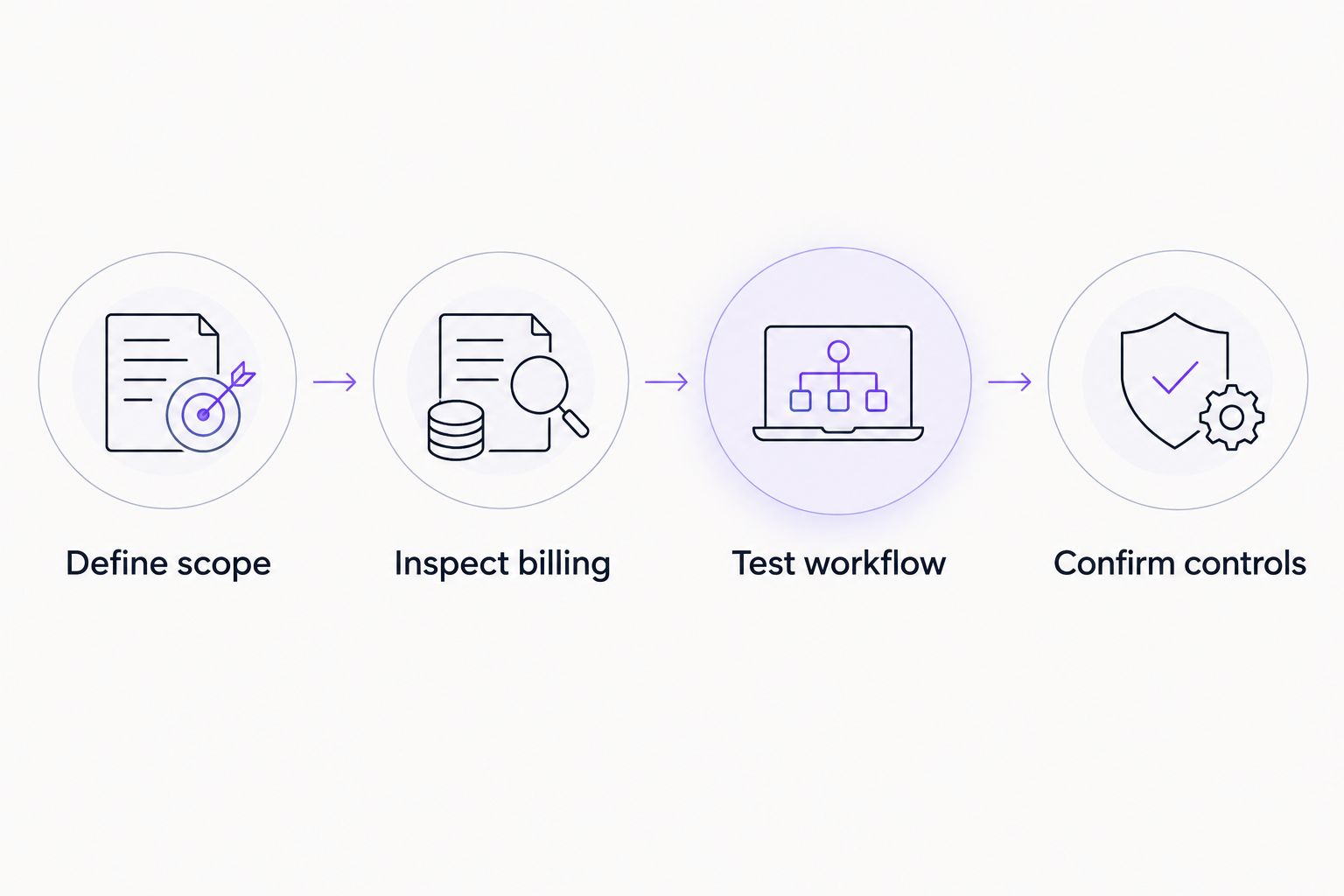
During the demonstration, record the handoffs rather than just the finished output. A polished draft does not prove that campaign launch, conversion measurement, or budget changes work as your team requires.
Ask the operator to show an exception as well as the normal path. For example, have them explain what your team does when creative is rejected or a campaign needs to stop. The purpose is to establish responsibility, not to assume that every exception can be automated.
What should an e-commerce brand include in its budget?
An e-commerce brand should connect the software purchase to a clearly defined advertising job. Start with your existing process: who supplies product information, approves claims, provides video, checks measurement, and reviews results?
If those responsibilities remain unchanged, do not count them as work the software has removed. Count a task as automated only after you have seen the required workflow completed and reviewed.
Use a proposed pilot of 1 ad account and 1 campaign to keep the evaluation focused. This is a suggested test scope, not a vendor limit or a performance benchmark. Choose a campaign that reflects your normal approval and measurement requirements.
Before that pilot starts, define what success means operationally. Examples include producing an approved draft, completing the agreed launch process, and making a campaign change that your team can inspect. Keep those acceptance checks separate from sales performance.
For 2026 planning, distinguish an operational improvement from a promised advertising result. Completing a workflow is evidence of capability; it is not proof that your next campaign will meet its return target.
What should an agency include in its budget?
An agency needs to evaluate the client-facing workflow alongside campaign execution. A process that works for an internal marketer is not automatically ready for client approvals, delegated access, or account-by-account reporting.
Ask the vendor to demonstrate how your team would handle a draft awaiting client approval, a requested change, and a campaign that must stop. Treat each as a requirement to verify, not a feature to infer from an agency-focused sales page.
Separate the agency’s software bill from client media spend in your proposal and internal records. Then identify who owns creative work, measurement checks, and exception handling. Clear responsibility prevents the software purchase from obscuring work your agency still delivers.
Evaluate these 3 handoffs explicitly: client to agency, agency to software, and software back to the reviewer. This is a review framework, not an industry benchmark. At each handoff, ask what information changes hands and who signs off.
Do not attribute reduced account-management work to a product until your team has observed the actual process. A successful demonstration should make remaining responsibilities clearer, not simply move them out of view.
How do you distinguish current features from roadmap promises?
Only evaluate features demonstrated as available now. Record planned functionality separately and leave it out of the justification for your present purchase.
A broad claim about TikTok support does not answer every workflow question. Ask which campaign actions the product performs, which actions require TikTok Ads Manager, and which creative inputs your team must provide.
Apply the same standard when comparing TikTok and Meta workflows. Support for Facebook or Instagram advertising does not establish that the same creative formats, controls, or campaign actions work on TikTok.
Before signing in 2026, request written confirmation of the capabilities your purchase depends on. If an essential workflow is planned rather than live, evaluate the product on what it does today—not on the expected release.
Is TikTok ad automation software worth paying for?
TikTok ad automation software is worth considering when its demonstrated workflow addresses a task your team needs help completing. The relevant comparison is software plus remaining work versus your current process—not subscription expense in isolation.
TezAds is best for e-commerce brands and agencies seeking paid advertising automation across multiple channels. Its stated scope covers writing, launch, and optimization; buyers still need to confirm their exact TikTok requirements and commercial terms.
That scope is an advantage when you need help across the paid campaign process. The buying limitation is equally clear: a broad platform description is not evidence of every account control, creative capability, or integration you require.
Review TezAds against your written brief. Ask for a current demonstration before assigning value to a workflow, and keep promised future functionality outside the decision.
Does ad automation replace a media buyer?
Ad automation does not remove the need to assign responsibility for campaign objectives, approvals, and review. Decide who owns those decisions before introducing software.
An e-commerce brand should name an internal owner for the advertising process. An agency should define the boundary between the client’s approval responsibility and the agency’s management responsibility. Software belongs inside that arrangement, not in place of it.
FAQ
How much does TikTok ad automation software cost in 2026?
TikTok ad automation software has no single standard cost in 2026; use the vendor’s current written terms for your required scope. Compare software access, media spend, creative work, and ongoing management separately unless the agreement bundles them.
Does a TikTok automation subscription include ad spend?
Do not assume a TikTok automation subscription includes ad spend. Confirm who pays TikTok and whether the agreement explicitly includes media spend.
Is TikTok ad automation the same as scheduling posts?
No. Paid campaign automation concerns advertising workflows, while organic scheduling concerns publishing posts; verify the specific paid campaign actions a product supports.
Can one tool create videos and manage TikTok campaigns?
Evaluate video creation and campaign management as separate capabilities. Ask the vendor to demonstrate both before treating either as included.
What should agencies check before buying TikTok automation software?
Agencies should check account responsibilities, approvals, permissions, reporting needs, and billing terms. Require a demonstration of the client-facing workflow as well as campaign execution.
Should e-commerce brands choose a TikTok-only or cross-platform tool?
Choose according to the advertising workflow you need to manage. Compare TikTok-only and cross-platform scope against current requirements, then verify every required action rather than relying on a channel list.
Should I pay for a feature that is on the roadmap?
Do not count a roadmap feature as a current capability. Base your buying decision on demonstrated workflows and written commitments covering what is available today.
One last thing
Ask the vendor to show you how to stop, not just how to start. A launch demonstration shows the normal path; a stop-and-review demonstration clarifies who retains control when your requirements change.
Make that part of your acceptance process. Your software decision should leave you knowing what runs automatically, what needs approval, and who is accountable for the next action.