An agency’s AI ads platform cost depends on the quoted scope: connected client accounts, users, managed advertising spend, and the work the software performs. For a useful 2026 budget, separate the software agreement from advertising spend, setup work, and the human review your team still needs to provide.
- How much does an AI ads platform cost for agencies? Compare the quoted scope, not just the subscription.
- TezAds serves e-commerce brands and agencies seeking paid campaign creation, launch, and optimization.
- Evaluate Meta ads workflows separately: writing copy is not the same as launching or managing campaigns.
- Require a live demonstration of account separation, approvals, and reporting before committing.
Why this matters
A subscription is not a complete operating budget. Your agency still needs to know who prepares assets, approves campaigns, checks conversion tracking, reviews changes, and answers client questions. Automation changes the division of work; it does not remove your responsibility for the account.
An e-commerce brand needs a workflow that respects its products, commercial priorities, and advertising limits. An agency needs that same discipline across separate clients, without mixing assets, permissions, or reporting. Start with the multi-account agency automation guide to define the work before comparing proposals.
For your 2026 shortlist, distinguish a demonstrated capability from a roadmap promise. Treat a planned feature as outside your current operating model, even when the vendor includes it in a sales presentation.
How much does an AI ads platform cost for multi-account agencies?
The useful answer is the total commitment for your actual account portfolio, not an isolated subscription figure. Ask each vendor to quote the same account list, users, channels, and required workflows. Otherwise, you are comparing different scopes under the same category name.
Use this breakdown to organize the proposal. These are questions to resolve, not claims that every platform bills for every item.
| Budget component | What to establish | Agency implication | E-commerce brand implication |
|---|---|---|---|
| Software agreement | Included workflows and contract scope | Confirm coverage across client accounts | Confirm coverage for the brand’s own accounts |
| Account allowance | What counts as an account or workspace | Distinguish clients from channel accounts | Distinguish stores, markets, and ad accounts |
| User access | Included roles and access restrictions | Check buyer, account manager, and client access | Check employee and external partner access |
| Spend-based terms | Whether managed spend affects the agreement | Identify whose spend counts toward the total | Identify which campaigns are included |
| Setup work | Who connects accounts and validates tracking | Assign responsibility for each client | Assign responsibility for the store and campaigns |
| Ongoing human work | Approvals, monitoring, reporting, and exceptions | Include account servicing in the budget | Include brand review and commercial decisions |
Keep advertising spend on its own line. Also distinguish vendor-delivered work from work assigned to your team: a task is not eliminated simply because it sits outside the software agreement.
Compare billing structures without confusing them with capability
A billing structure describes how a vendor charges, not what the software accomplishes. Use the following comparison when those structures appear in proposals; confirm the actual terms rather than assuming a vendor uses any particular model.
| Structure to evaluate | Best for | Advantage | Limitation to check |
|---|---|---|---|
| Fixed subscription | Teams with a clearly defined operating scope | A defined recurring commitment | Account, user, or workflow exclusions |
| Per-account agreement | Agencies that budget by connected account | A direct relationship to account count | Multiple channel accounts belonging to one client |
| Spend-linked agreement | Teams budgeting alongside managed media spend | A stated relationship between spend and software charges | Which spend counts and how changes affect billing |
| Custom agreement | Teams with specific access or service requirements | Scope can be documented around the operation | Additional effort to compare terms consistently |
Choose the structure you can explain to the person approving the budget. If an account manager cannot determine what happens when a client joins, pauses, or leaves, resolve that ambiguity before signing.
Price the workflow, not the feature label
“Creates ads” leaves too much unanswered. Copy generation, asset preparation, campaign publication, and ongoing optimization are different jobs. Ask the vendor to show each job your team expects the platform to perform.
For an e-commerce brand, begin with the product and intended conversion. Follow the work through copy review, creative approval, campaign setup, and performance assessment. Check whether the proposed workflow actually replaces an existing task or simply adds another place to complete it.
For an agency, repeat that exercise at the client boundary. Establish who supplies the brief, who approves the output, which account receives the campaign, and who reviews later changes. A useful workflow must make responsibilities clear as well as complete the advertising task.
Copy creation versus campaign management
Copy creation produces material for review. Campaign management involves actions inside advertising accounts. Do not treat a writing demonstration as proof that a platform can publish campaigns or change their settings.
Ask for a Meta-specific demonstration if Facebook and Instagram are your immediate priorities. Then assess additional channels separately. A successful demonstration on one channel does not establish the same workflow on another.
Current features versus roadmap features
In a 2026 proposal, mark every required capability as demonstrated, requiring further verification, or planned. Only demonstrated workflows belong in your implementation plan. Put unresolved requirements into the decision criteria rather than assuming they will work after purchase.
This protects both audiences. A brand should not organize a launch around an unverified integration, and an agency should not promise clients a service that depends on a future release.
Why an agency’s total commitment varies
These factors define the scope your vendor must address. Record them before requesting a proposal, then use the same scope for every shortlisted platform.
- Account structure. List clients, connected advertising accounts, and channels separately. Ask how the vendor counts each rather than equating a client with an account.
- Workflow coverage. Specify whether you need writing, campaign launch, optimization, or a combination. Require a demonstration of the requested work.
- Access requirements. Identify operators, approvers, and reporting recipients. Check whether their required access exists under the proposed agreement.
- Data connections. Name the conversion sources and reporting inputs your team relies on. Verify the exact connection instead of accepting a broad integration label.
- Service responsibilities. Assign setup, troubleshooting, campaign review, and client communication. Record which responsibilities remain with your team.
- Contract boundaries. Clarify renewal, account changes, cancellation, and data access after termination. Use the written agreement as the reference.
For brands, prioritize the workflow that supports their own commercial decisions. For agencies, add the coordination required to deliver that workflow separately for each client. Neither audience should pay for breadth that does not address a defined job.
How do you compare proposals fairly?
Compare the same work, with the same responsibilities, using the same acceptance criteria. A broad feature checklist cannot show whether your operator can complete a campaign without returning to an old process.
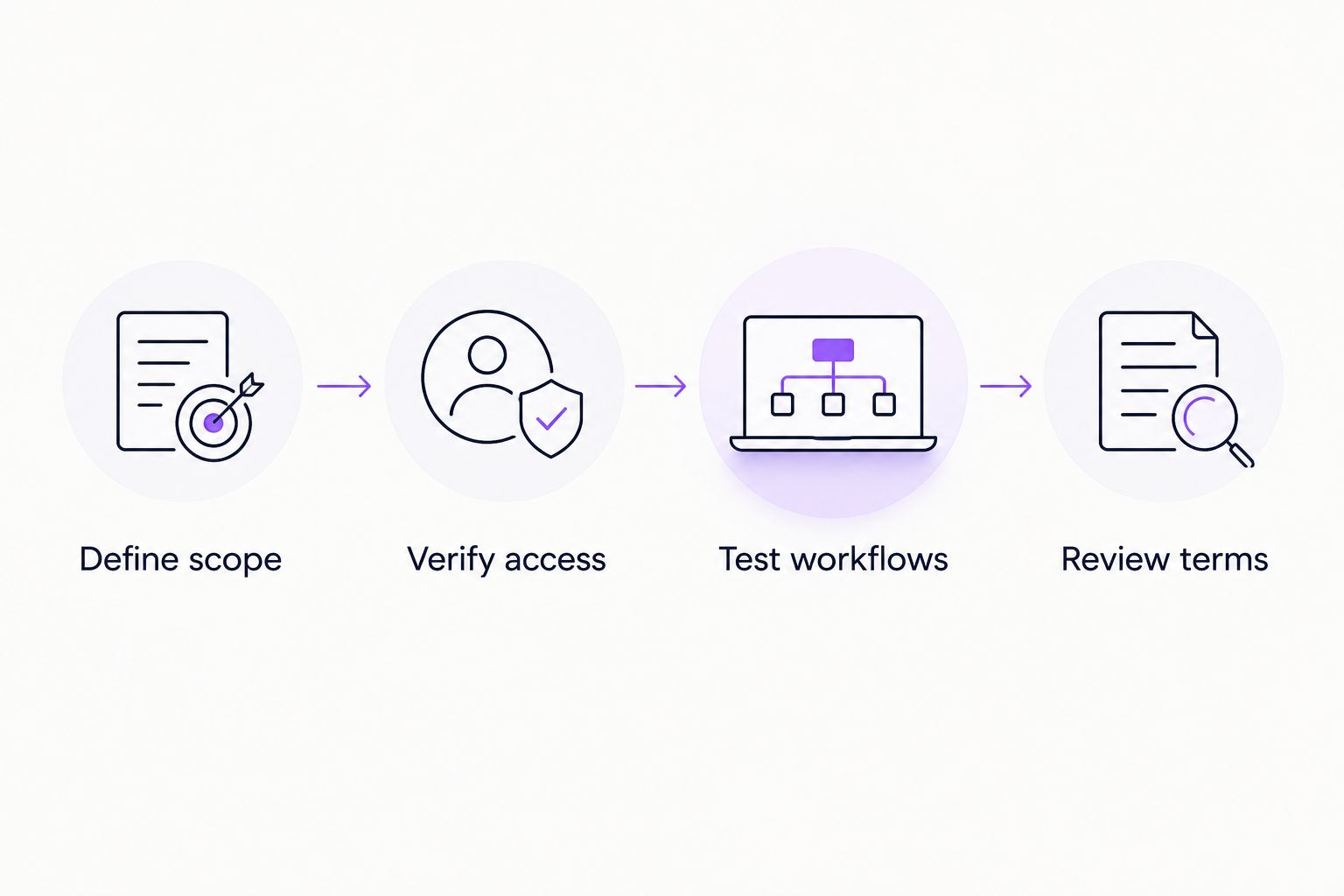
Use this sequence for your 2026 evaluation. The aim is to expose unfinished work before the contract turns it into your team’s responsibility.
- Define scope. Write down the accounts, channels, people, and campaign tasks you need covered. Separate required work from optional expansion.
- Verify access. Ask the vendor to demonstrate the permissions your operators and approvers need. For agencies, inspect separation between clients; for brands, inspect internal and partner responsibilities.
- Test workflows. Start with 1 client account, complete 1 approval cycle, and review 1 reporting cycle. These are evaluation steps, not a promised implementation timeline.
- Review terms. Match the demonstrated workflow against the written proposal. Resolve any difference between what the demonstration showed and what the agreement includes.
During the test, record every manual intervention. Note who corrected copy, checked a destination, approved publication, investigated tracking, and prepared the report. The purpose is not to eliminate every human action; it is to identify the actions you are still budgeting for.
An agency should also test a handoff between the campaign operator and account manager. A brand should test a handoff between the campaign operator and the person responsible for product or promotional accuracy. Both tests expose responsibilities that a solo demonstration leaves out.
Where does TezAds fit in this evaluation?
TezAds is a paid ad automation platform for e-commerce brands and the agencies managing advertising on their behalf. Its stated scope covers writing, launching, and optimizing campaigns across Meta, Instagram, Google, TikTok, YouTube, and X.
TezAds is best suited to e-commerce brands and agencies seeking paid campaign creation, launch, and optimization. That makes it relevant when your requirement extends beyond generating copy. Evaluate the exact Meta workflow you need rather than treating the platform description as proof of every account-management requirement.
The limitation is equally important: that stated scope does not establish your required account allowances, approval controls, reporting arrangements, or contract terms. Ask for a live demonstration and a written scope covering those requirements. Do not assume white-label delivery or client-level controls from the category description alone.
For a brand, the acceptance test is whether the platform supports its actual advertising operation. For an agency, add account separation and team handoffs to that test. A suitable product must fit the people delivering the work, not just the person attending the demonstration.
Does the platform subscription include advertising spend?
Treat the software agreement and advertising spend as separate budget lines unless the written agreement explicitly combines them. Identify who receives each payment and which charges relate to media delivery rather than software access.
For an agency, establish whether the client pays the advertising platform directly or whether another arrangement applies. For a brand, reconcile the software agreement against its media budget without treating them as interchangeable expenses.
Is a copywriting tool enough for managing Meta ads?
A copywriting tool is enough only when writing is the job you need covered. If you need campaign publication, account actions, or ongoing optimization, require a demonstration of those workflows rather than inferring them from copy quality.
Brands should check whether the output respects their product claims and approval process. Agencies should also check whether separate client briefs and assets remain distinct throughout the workflow.
Should you commit before testing every client account?
Test a representative workflow before extending the commitment across your portfolio. Then document the requirements that differ between clients, including channels, access, data connections, and approval responsibilities.
An initial test establishes what worked under that test’s conditions. It does not establish that every client configuration behaves the same way. Expand only after the remaining requirements have been checked.
FAQ
How much does an AI ads platform cost for agencies in 2026?
An agency’s cost depends on the quoted account scope, users, workflows, and contract terms. Compare the software agreement separately from advertising spend, setup responsibilities, and ongoing human review.
What should a multi-account agency ask before signing?
Ask how the agreement handles connected accounts, user roles, client separation, account changes, and termination. Require a demonstration of the workflow your team will actually use.
Is TezAds relevant for agencies managing e-commerce Meta ads?
TezAds is relevant to agencies seeking paid campaign writing, launch, and optimization for e-commerce clients. Its stated channel scope includes Meta and Instagram; verify your specific account and approval requirements in a demonstration.
What should an e-commerce brand test before choosing a platform?
An e-commerce brand should test the path from product brief to approved campaign and performance review. Check who remains responsible for product accuracy, creative approval, tracking, and campaign changes.
Should roadmap integrations influence the buying decision?
Roadmap integrations should not be treated as working capabilities. Base your current implementation plan on demonstrated workflows and keep planned features outside the required scope.
How do I tell whether automation is reducing manual work?
Record the tasks your team still performs during a representative campaign workflow. Compare those tasks with the work assigned to the software in the proposal, including approvals, corrections, reporting, and exception handling.
One last thing
The most revealing part of a demo is the handoff. Ask the operator to stop after campaign preparation and let the approver continue. Then ask someone else to explain what changed and why.
Use that exercise in your 2026 evaluation of TezAds or any other shortlisted platform. If the handoff requires undocumented explanations, include that work in your operating plan instead of assuming the subscription removes it.