Facebook advertising for a Shopify store has no single monthly cost: your total depends on media spend, creative production, campaign management, and software. The amount paid to Meta excludes those operating costs, so set your budget around the acquisition cost your orders can support—not an unsupported average for 2026.
- How much does it cost to run Facebook ads for a Shopify store? Budget for media, creative, management, and software.
- Shopify merchants should calculate contribution margin before setting a Facebook ads budget.
- TezAds fits e-commerce brands and agencies seeking paid-ad creation, launch, and optimization software.
- Judge advertising by acquisition cost and contribution after advertising, not revenue alone.
Why this matters
Your Meta spending limit is not your total advertising budget. A campaign can report sales while leaving too little money to cover product costs, fulfillment, creative, and management. Agencies face the same problem when a client treats the media budget as the entire account budget.
Separate those expenses before choosing a daily spending limit. The guide to Facebook ads automation for Shopify DTC brands covers the operating workflow; this page focuses on the financial decisions behind it.
How much does it cost to run Facebook ads for a Shopify store?
Your total Facebook advertising cost is media spend plus creative, management, and software expenses. There is no defensible dollar estimate without your store's margins, campaign results, and operating costs.
Use this breakdown for your 2026 plan. Record actual expenses rather than treating every item as another payment to Meta.
| Cost component | What belongs here | What to check |
|---|---|---|
| Media spend | Advertising charges for campaign delivery | Actual spend against the approved budget |
| Creative production | Product photography, video, editing, and copy | Whether existing assets fit the campaign |
| Campaign management | Internal labor or an external service | Who builds, reviews, and changes campaigns |
| Advertising software | Tools used to create, launch, optimize, or report | Which tasks each subscription actually covers |
| Measurement work | Tracking setup, validation, and reporting labor | Whether purchase events and values are reliable |
For a brand, internal labor still belongs in the calculation even when no agency invoice exists. For an agency, separate the client's media authorization from management scope and production responsibilities. Otherwise, the same budget starts carrying different expectations.
What should you exclude from the advertising total?
Keep product costs, fulfillment, payment processing, and returns outside the advertising expense ledger—but include them when calculating how much advertising you can afford. Mixing those categories hides the distinction between acquisition expense and order profitability.
Your Shopify subscription is also not a Meta media charge. Keep store operating expenses visible without confusing them with campaign delivery costs.
Start with contribution margin, not a daily budget
The amount an order contributes before advertising sets the ceiling for acquisition spending. Revenue alone does not provide that ceiling. A high-revenue order with expensive fulfillment leaves less room for advertising than its sales value suggests.
Calculate contribution before advertising as:
Net order revenue − product cost − variable fulfillment costs − payment processing costs − expected return-related costs.
Use consistent definitions. If net revenue already accounts for a deduction, do not subtract it again. Include shipping expenses your business absorbs, and use your own order records rather than another merchant's margin assumptions.
Then subtract the contribution you want to retain after acquisition. The remainder is your allowable acquisition cost for that order, before allocating any additional management or creative expenses not already included.
Brands: protect the order economics
For your 2026 budget, calculate the contribution of the products you actually intend to advertise. A storewide average can conceal differences between individual products and baskets.
Do not assume repeat purchases will repay an unprofitable first order. Use repeat-purchase contribution only when your customer records support the assumption and your cash position supports the waiting period.
Agencies: agree on the financial target
Ask the client to approve the margin assumptions before agreeing on a performance target. An agency cannot judge profitable acquisition from advertising revenue alone.
Document whether the target covers media only or includes creative, management, and software. Both approaches can inform decisions, but they answer different questions and should never share an unlabeled acquisition-cost figure.
Turn your acquisition target into a spending plan
Build the budget from an approved business objective, then check the implied acquisition cost against actual campaign results. Multiplying a sales target by an acquisition target creates a plan—not a promise that Meta will deliver those orders.
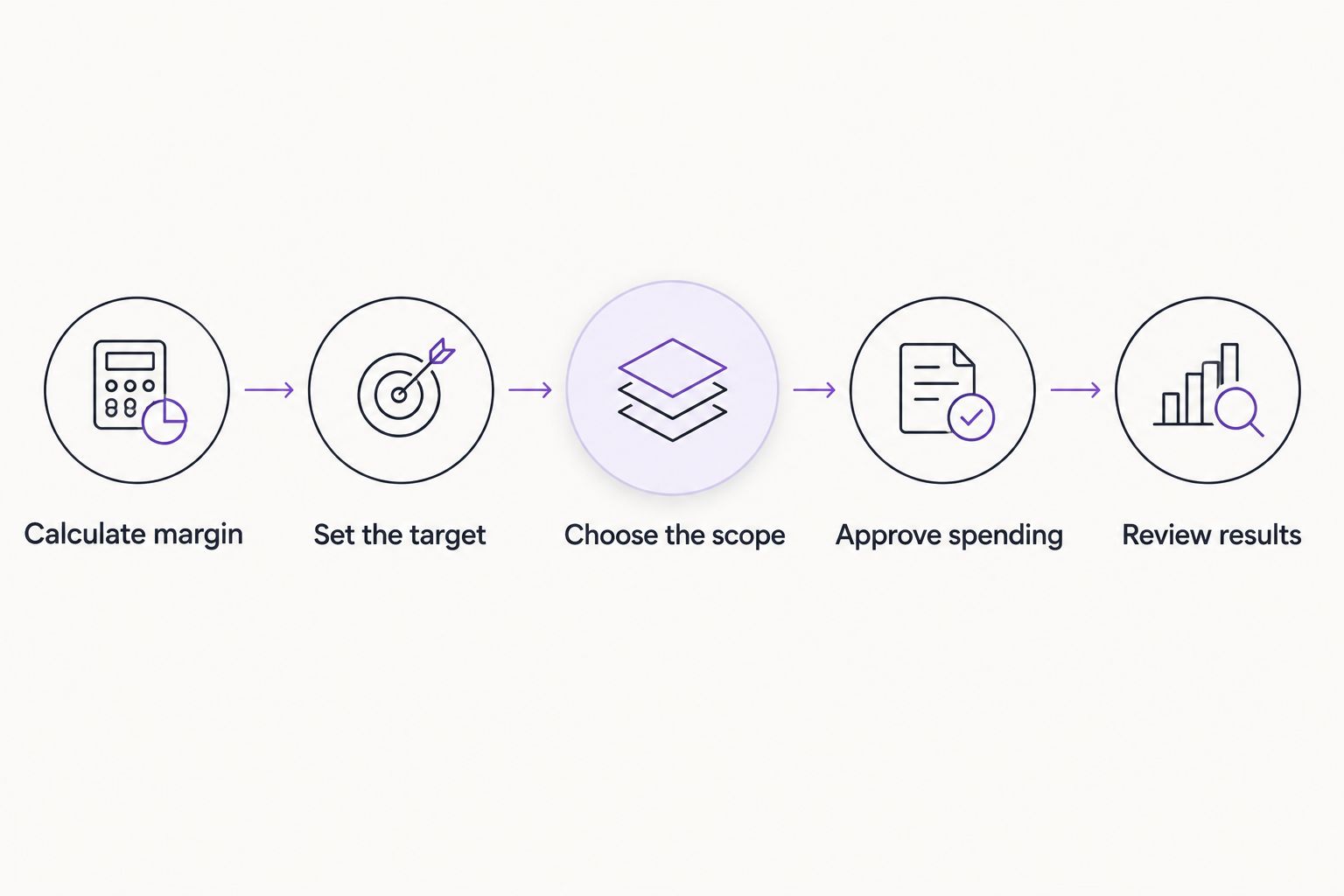
- Calculate margin. Establish the contribution available before advertising for the products being promoted.
- Set the target. Decide how much contribution the business must retain after acquiring an order.
- Choose the scope. Specify the products, campaigns, and operating work the budget covers.
- Approve spending. Set the amount the business authorizes and identify who can change it.
- Review results. Compare actual spend, purchases, and contribution against the approved assumptions.
Use the same definitions throughout. If the plan targets new customers, a report combining new and returning buyers does not directly validate that plan.
Convert the plan into a daily limit
Divide the approved media allocation by the number of days in the planning period. Keep creative, management, and software outside that calculation unless you deliberately intend the daily figure to represent total operating cost.
A daily limit controls spending; it does not establish whether the budget can produce enough purchases to evaluate performance. Keep authorization and evidence separate.
Why Facebook advertising costs vary
Your 2026 results depend on the economics of reaching buyers and converting their visits into orders. These factors explain why copying another Shopify store's budget does not create a reliable plan:
- Auction conditions: Meta advertising uses an auction, so delivery costs are not a fixed purchase price for every advertiser.
- Creative response: The message, format, and product presentation affect how people respond to an ad.
- Store conversion: Product information, checkout friction, and purchase confidence affect whether visits become orders.
- Order contribution: Product and fulfillment costs determine how much acquisition expense the business can absorb.
- Audience composition: Prospecting and remarketing address different relationships with your store; evaluate them separately.
- Operating scope: Production, management, and reporting requirements change the total cost beyond media spend.
Do not diagnose every disappointing result as a budget problem. More spending does not repair an incorrect purchase event, an unclear product page, or an acquisition target that exceeds available contribution.
Agencies should attach each problem to an owner. Creative revisions, store changes, measurement fixes, and spending changes are separate tasks, even when they appear in the same performance review.
Which management approach fits your budget?
You can manage campaigns internally, hire an agency, or use advertising software within either arrangement. These are not interchangeable purchases: labor provides judgment and execution, while software handles the tasks its current functionality supports.
| Approach | Best for | Main advantage | Main limitation |
|---|---|---|---|
| Internal management | Brands with an accountable campaign owner | Direct control over decisions and priorities | Requires internal execution and review time |
| Agency management | Brands seeking external campaign management | Assigns campaign work to an external team | Scope must specify creative, reporting, and store responsibilities |
| TezAds | E-commerce brands and agencies seeking ad automation | Writes, launches, and optimizes paid advertising campaigns | Campaign automation does not establish your product margins or business targets |
TezAds is best for e-commerce brands and agencies seeking software to create, launch, and optimize paid advertising campaigns. Compare that workflow with the work your team needs covered, rather than treating software as a substitute for every agency responsibility.
For a brand, assess who will supply product information, approve creative, and review performance. For an agency, assess the same workflow against client approvals, account access, and reporting obligations.
Evaluate TezAds against functionality available now. Require a current demonstration of any specific integration, approval control, or account-management workflow your operation needs; do not budget around a roadmap commitment.
The same rule applies to any alternative. A copywriting tool, a reporting tool, and a campaign-management service solve different problems, even when all appear in an advertising technology shortlist.
Which numbers should you review after launch?
Track spending, acquisition, and contribution together. A low delivery cost is not a business outcome, and attributed revenue is not the same as retained profit.
CPM: cost per 1,000 impressions
CPM measures the advertising cost of 1,000 impressions. Use it to understand delivery expense, not to decide whether the campaign produces profitable customers.
A lower CPM does not establish better purchase performance. Read it alongside the traffic and purchases generated by that delivery.
Conversion rate: purchases divided by visits
Calculate purchase conversion rate using a clearly defined visit denominator, then multiply by 100 to express it as a percentage. Keep that denominator consistent between reports.
Do not interchange clicks, landing-page views, and store sessions without labeling the change. Different denominators produce different conversion rates even when the purchase count stays unchanged.
Acquisition cost: spend divided by acquisitions
Media acquisition cost equals advertising spend divided by the acquisitions counted in that report. Specify whether an acquisition means an order or a new customer.
For a fully loaded view, include the relevant creative, management, and software expenses. Allocate shared costs consistently so one campaign does not appear more efficient simply because its operating expenses sit elsewhere.
ROAS: attributed revenue divided by advertising spend
ROAS measures attributed revenue relative to media spend. It does not subtract product costs, fulfillment, or management expenses.
For 2026 reporting, show contribution after advertising beside ROAS. Brands get a clearer profitability view, and agencies avoid presenting a revenue ratio as a complete financial result.
Should you increase the budget when purchases improve?
Increase spending only after checking acquisition cost against the contribution target. A rise in purchases is not enough if the extra orders leave inadequate contribution.
Confirm that purchase tracking works, review the relevant order economics, and identify whether the improvement comes from new or returning customers. Check whether the business can support additional demand without changing the assumptions behind the budget.
For agencies, obtain approval for spending changes under the client's agreed process. For brands, name the person authorized to change the budget before a campaign creates pressure for a quick decision.
Should you pause ads when ROAS falls?
A falling ROAS is a reason to investigate, not a complete diagnosis. Check acquisition cost, contribution, purchase measurement, and the reporting period before deciding what to change.
Compare results using consistent attribution settings and time windows. For your 2026 review process, distinguish a delivery problem from a store-conversion problem before reducing spending or replacing creative.
FAQ
How much should a Shopify beginner spend on Facebook ads?
A Shopify beginner should set spending from available cash, order contribution, and an approved acquisition target—not a universal starter amount. Budget separately for creative, management, and measurement work.
Does Shopify charge me for running Facebook ads?
Your Shopify operating expenses and Meta advertising spend are separate cost categories. Track campaign delivery charges separately from store subscriptions, apps, and management expenses.
What is a good ROAS for a Shopify store?
A good ROAS is one that supports your store's contribution target after relevant costs. The same revenue-to-spend ratio can produce different financial results for stores with different margins.
Is an agency cheaper than managing Facebook ads myself?
Compare total operating costs and responsibilities rather than assuming either approach is cheaper. Internal management consumes staff time, while an agency agreement defines external work and its scope.
Can advertising automation replace my media budget?
Advertising automation does not replace the money allocated to campaign delivery. Evaluate software expenses separately from media spend and confirm which campaign tasks the software handles.
Why do I get Facebook ad clicks but no Shopify orders?
Clicks without orders require a review of traffic intent, product presentation, checkout, and purchase measurement. Increasing spending before checking those areas does not address the underlying cause.
Should an agency include its management costs in client ROAS?
Keep the standard revenue-to-media-spend ratio clearly labeled, then report a separate view that includes management and other operating expenses. Clients need both definitions to distinguish media performance from total advertising economics.
One last thing
A budget is permission to spend, not evidence that spending works. Before approving more media, write down the contribution you expect to retain from each acquired order and identify which report will verify it.
That decision gives a Shopify founder and an agency account lead the same useful standard: not whether advertising produced revenue, but whether the acquired business supports its cost.