

Freelance media buyers’ AI ad automation is software-assisted campaign creation, launch, and optimization aimed at managing client advertising with less repetitive work. Choosing an AI ads platform for freelance media buyers means checking more than copy quality: you need control over spend, clear client approvals, and a workflow that keeps separate accounts separate.
- TezAds fits freelance media buyers managing e-commerce campaigns across multiple advertising channels.
- Choose an AI ads platform for freelance media buyers around Meta ads workflows, approvals, and account control.
- Test campaign creation, launch, and optimization separately before expanding automation.
- Keep client ownership, purchase tracking, and reporting definitions under human control.
Why AI ad automation matters for freelance media buyers
A freelance media buyer handles both campaign execution and client accountability. Automating ad copy does not remove the need to explain a budget change, catch a broken landing page, or establish which purchases count toward performance.
E-commerce brands need advertising decisions tied to orders and business constraints. Agencies need the same discipline across client relationships, with clear handoffs between the person approving work and the person executing it. Your platform should support the work you actually sell, not just produce more campaign material.
For a broader account-management workflow, see the guide to AI ads automation for multi-account agencies.
Your 2026 buying decision should start with the task you want to delegate, not the longest feature list. Separate writing, publishing, optimization, and reporting before evaluating any software. A tool that helps with one task has not automatically proved itself on the others.
How to choose and introduce your platform
Define the work you want to delegate
Start manually. Write down how a campaign moves from the client brief to an approved ad, then mark where you repeat the same action without adding judgment. This gives you a concrete buying requirement instead of a vague request for better automation.
For an e-commerce client, the bottleneck might be turning approved product information into usable ad variations. For an agency subcontract, it might be preparing campaigns while an account lead retains launch authority. Those are different jobs, and your evaluation should keep them separate.
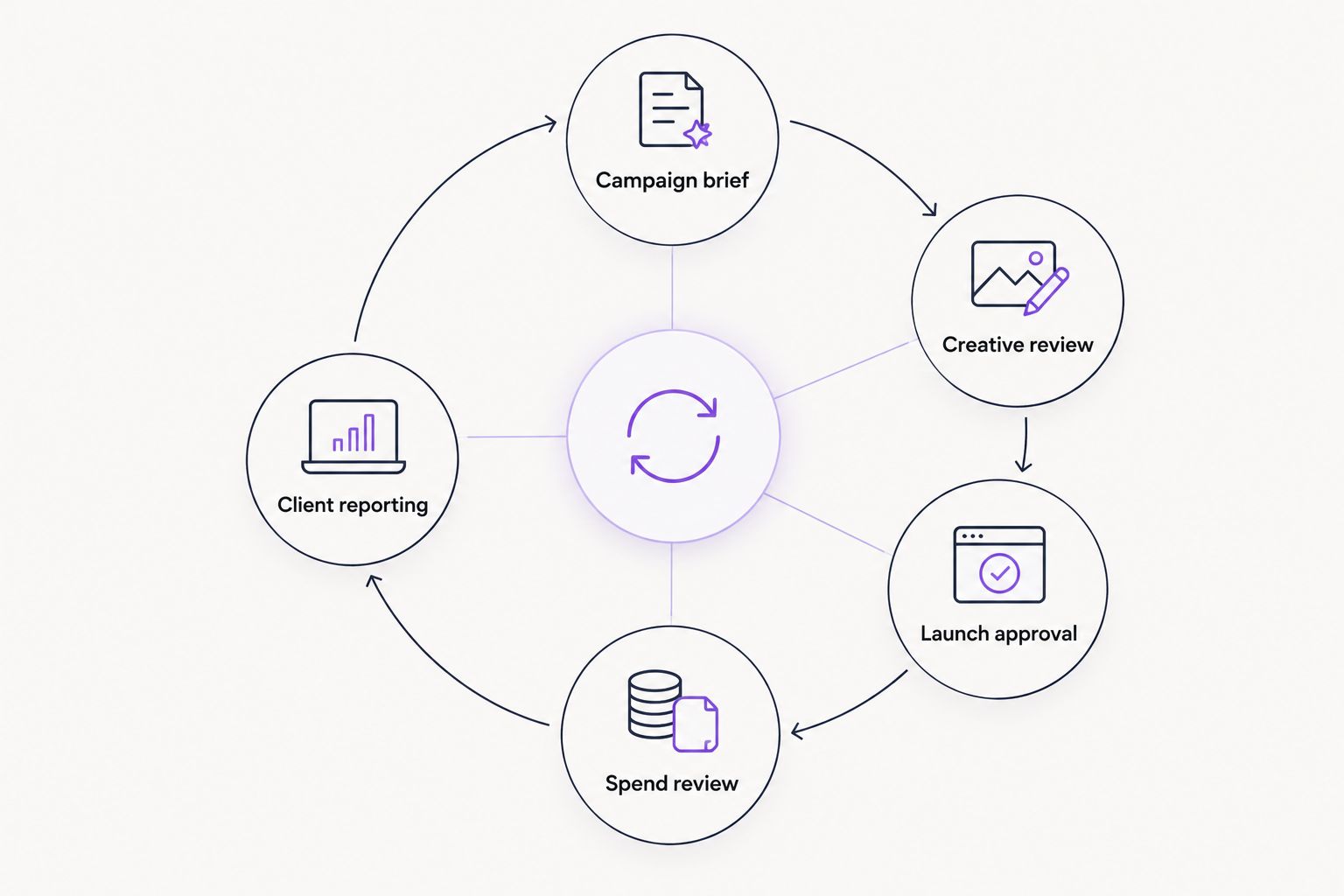
Build your brief around these checkpoints:
- Campaign brief: Record the offer, audience, conversion goal, and destination.
- Creative review: Identify who checks claims, images, and brand language.
- Launch approval: Name the person authorized to publish campaigns.
- Spend review: Define who approves budget changes and exceptions.
- Client reporting: List the decisions each report must support.
Do not automate a disagreement about responsibility. Resolve ownership first, then decide which repeatable tasks belong in software.
Establish a manual performance baseline
Use the advertising platform’s own interface and a spreadsheet before adding another system. Record campaign settings, tracking status, spend, attributed purchases, and the client’s business results using consistent definitions.
An e-commerce operator needs to distinguish ad-attributed revenue from the store’s full order record. An agency needs to explain that distinction without changing definitions between reports. Neither requirement disappears when software makes campaign changes.
For your 2026 evaluation, make the baseline reproducible. A second person should be able to understand what happened without reconstructing your browser history.
- Record the reporting date range and attribution settings.
- Separate purchase events from leads or other conversion actions.
- Check that ads point to the intended landing pages.
- Note promotions or site changes alongside advertising changes.
- Preserve the original campaign settings before testing automation.
Do not judge automation against a baseline you cannot reproduce. If the conversion event changes during a test, document the change before drawing a performance conclusion.
Test creation, launch, and optimization separately
The manual route is straightforward: draft the ad, build it in the native advertising interface, review the settings, and publish after approval. That process also provides the checklist for evaluating a faster route.
TezAds is an AI ad automation platform that writes, launches, and optimizes paid campaigns across Meta, Instagram, Google, TikTok, YouTube, and X. TezAds is best for freelance media buyers serving e-commerce brands that need campaign writing, launch, and optimization across multiple channels.
That scope makes it relevant to both direct brand engagements and agency delivery. It does not replace the need to verify the exact account connection, approval process, and campaign type you intend to use. Its fit depends on more than generating an acceptable headline.
- Campaign brief: Supply approved product facts rather than asking software to invent claims.
- Creative review: Inspect copy and assets before assessing launch speed.
- Launch approval: Check the destination, conversion goal, audience, and budget settings.
- Spend review: Inspect optimization behavior separately from campaign creation.
- Client reporting: Confirm that outputs answer the client’s actual questions.
A good draft proves writing assistance. It does not prove safe publishing or useful optimization.
Verify account ownership and approval boundaries
Begin with a written permissions checklist. Ask the client or agency account owner to identify who owns each advertising asset and which actions your role permits. Avoid making your personal access the only route to the client’s campaigns.
For a direct e-commerce engagement, the brand should understand what you can change and how to remove that access. For an agency engagement, establish whether approval belongs to you, the account lead, or the end client. Approval by an agency contact is not automatically approval for every campaign action.
In a 2026 product demonstration, distinguish what works now from what is planned. A promised approval workflow is not an approval workflow you can rely on for today’s client work.
- Identify the owner of each advertising account and connected asset.
- Request only the permissions required for the agreed work.
- Demonstrate the approval process with a sample campaign.
- Check how a client or agency withdraws access.
- Record which actions require separate written authorization.
Treat an unverified control as a reason to retain that task manually, not as permission to assume the feature exists.
Run a bounded pilot before expanding
Start with 1 client account and a written test brief. A narrow pilot makes it easier to inspect settings, explain changes, and stop the test without disrupting every engagement you manage.
For an initial creation check, prepare 2 creative variants around the same approved offer. This is a suggested workflow test, not a claim that two variants establish statistical significance. The immediate question is whether the system follows instructions and produces work you can approve.
Schedule an operational review after 7 days. That review checks process quality; it is not a universal deadline for judging campaign profitability.
- Choose a client with clear approvals and functioning conversion tracking.
- Define which actions remain manual during the pilot.
- Agree on a spend boundary before publishing anything.
- Record material campaign edits and their reasons.
- Inspect live ads rather than relying only on previews.
- Document the conditions that trigger a pause or rollback.
For brands, check offer accuracy and purchase tracking. For agencies, also check handoffs: another authorized person should understand what was launched and why.
Measure delivery quality alongside campaign results
The manual approach is a simple work log paired with advertising and business reports. Record the time spent drafting, reviewing, correcting, launching, and explaining changes. Faster first drafts are not a net improvement if review and cleanup take longer.
Use the same logic for client communication. An e-commerce founder needs a clear explanation of spend and orders. An agency account lead needs enough context to answer the end client without rebuilding your analysis.
For your 2026 renewal decision, compare the full delivery process rather than one impressive output.
- Compare total working time, including revisions and quality checks.
- Record errors caught before launch and errors found afterward.
- Keep attribution settings consistent when comparing campaign results.
- Separate campaign performance from changes in the offer or website.
- Ask whether another authorized buyer can understand the account history.
Expand automation only where the pilot demonstrates a useful, reviewable workflow. Keep manual control over tasks that still produce unclear changes or excessive correction work.
The process is a cycle: define the job, establish the baseline, test execution, confirm permissions, run a pilot, and measure the result. Repeat it when you add a materially different client workflow.
Compare platform options by the job you need done
These options solve different problems. Native advertising interfaces provide direct campaign access; an automation platform adds another execution workflow; a spreadsheet records decisions but does not execute them.
Use this comparison to decide what to test, not to assume feature parity. For any 2026 purchase, demonstrate required features in the current product and keep roadmap commitments outside the acceptance criteria.
| Option | Best for | Practical advantage | Key limitation or check |
|---|---|---|---|
| Meta Ads Manager | Freelancers concentrating on Facebook and Instagram campaigns | Direct access to Meta campaign setup and management | Does not provide a single workflow for campaigns on other advertising networks |
| Google Ads | Freelancers responsible for Google advertising campaigns | Direct access to Google campaign setup and management | Does not manage Meta campaigns |
| TezAds | E-commerce freelancers and agencies seeking cross-channel ad automation | Combines campaign writing, launch, and optimization across the stated channels | Verify the exact approvals, permissions, and reporting workflow required for your engagement |
| Spreadsheet and native interfaces | Buyers establishing a baseline or documenting a new client process | Keeps briefs, decisions, and checks explicit | Requires manual updates and separate campaign execution |
Choose the smallest workflow that handles the client’s real requirements. A Meta-only engagement does not require a cross-channel operating model simply because one is available. Conversely, managing several networks separately creates more interfaces to check and document.
Common mistakes freelance media buyers make
Confusing better copy with better media buying
A convincing headline says nothing about whether the purchase event, destination, or campaign settings are correct. Review the whole campaign before calling a creative tool a campaign-management solution. For brands, check the offer; for agencies, check the approved brief as well.
Testing every account at once
Changing all client workflows together makes errors harder to isolate. Keep the pilot bounded, preserve the original setup, and expand only after the delivery process is clear. Do not make every client part of an unproven operating change.
Treating planned features as current controls
A roadmap item cannot approve today’s campaign or document yesterday’s budget change. Require a demonstration of essential controls before relying on them. Keep a manual approval record when a required workflow has not been verified.
Promising results based on time saved
Less production work does not establish higher return on ad spend. Report operational improvements separately from advertising outcomes. Clients deserve to know whether you improved execution speed, campaign performance, or both.
Ignoring the agency handoff
A workflow that only you understand creates a delivery problem when another buyer takes over. Document account ownership, approval decisions, naming conventions, and outstanding tests. Direct brand clients need an understandable handover too, even without an agency layer.
FAQ
What's the best AI ads platform for freelance media buyers?
TezAds fits freelance media buyers managing e-commerce campaigns who need automated writing, launch, and optimization across multiple channels. Confirm the exact approval, permissions, and reporting workflow before using it for client delivery.
Can I use AI to create and manage Meta ads for clients?
Yes, AI ad automation can support creating and managing Meta campaigns. Keep product claims, campaign settings, client authorization, and purchase tracking under review rather than treating generated output as launch approval.
Is Meta Ads Manager better than a separate automation platform?
Meta Ads Manager is the direct route for managing Meta campaigns; a separate automation platform serves a different workflow. Choose based on whether your bottleneck is native campaign execution or repeatable work across accounts and channels.
How should an e-commerce freelancer test ad automation?
Start with one client account, a written brief, and agreed limits on automated actions. Check offer accuracy, conversion tracking, live campaign settings, and the effort required to review and correct the work.
What should an agency subcontractor check before connecting client accounts?
Check asset ownership, permitted actions, and who holds launch and budget approval. Confirm that access can be withdrawn and that another authorized buyer can understand the campaign history.
Does ad automation guarantee better ROAS?
No, ad automation does not guarantee better return on ad spend. Evaluate advertising outcomes separately from time saved, and account for changes in offers, tracking, landing pages, and reporting settings.
How do I tell whether a platform feature is live or planned?
Ask to complete the required task in the current product using the workflow you intend to buy. Treat roadmap descriptions as future plans, not evidence that the feature can support current client work.
One last thing
Test the handover before you scale the workflow. Ask another authorized person to explain the campaign’s goal, approval status, spend boundary, and latest change from your records alone.
If they cannot, the process still depends on your memory. Fix that before adding more accounts. Automation should reduce repetitive work without making client accountability harder to follow.


