

Yes—AI can detect patterns consistent with ad creative fatigue before a decline becomes visible in reported ROAS, but it cannot guarantee advance warning. In 2026, use those alerts to trigger a review of audience exposure, engagement, conversion tracking, and replacement creative—not an automatic verdict that an ad has stopped working.
- Can AI detect ad creative fatigue? Yes, but an alert identifies a pattern, not a proven cause.
- Meta ad fatigue checks should combine audience exposure, creative engagement, and purchase outcomes.
- TezAds serves e-commerce brands and agencies needing paid ad creation, launch, and optimization.
- Test a distinct creative concept before replacing an established performer solely because frequency increased.
Why this matters
A ROAS alert tells you that reported revenue relative to spend has changed. A fatigue alert should help you investigate whether repeated exposure to a particular creative contributed to that change. Those are different jobs.
For an e-commerce brand, the decision affects acquisition spend and the next creative brief. For an agency, it also affects the explanation you give a client. Neither audience needs another unexplained warning.
Treat fatigue detection as a decision-support workflow, not a promise to protect revenue. Once the evidence points toward a tired message, use a structured Facebook ad copy approach to develop a genuinely different replacement.
Can AI detect ad creative fatigue before it hurts ROAS?
AI can analyze changes in ad performance and flag combinations associated with fatigue. The useful output is a specific observation about a creative, audience, and comparison period—not a generic account-health score.
Reported ROAS depends on purchase data and attribution timing. Engagement and delivery data describe earlier parts of the advertising journey, so reviewing those signals can expose deterioration before the purchase picture is complete. That sequence does not prove that fatigue caused the deterioration.
Use these evidence groups together:
| Evidence group | What to inspect | What it supports | What it does not prove |
|---|---|---|---|
| Audience exposure | Frequency and reach within a consistent audience and period | Whether repeat exposure is increasing | That viewers are tired of the message |
| Creative response | Link click-through rate and relevant video engagement | Whether response to the creative is weakening | That the creative alone caused the change |
| Purchase outcomes | Conversion rate, cost per purchase, and reported ROAS | Whether business results are deteriorating | That replacing the ad will restore results |
| Delivery context | Spend, placements, audience changes, and auction costs | Whether the comparison remains meaningful | That every change requires intervention |
The strongest fatigue warning combines increasing exposure with weakening response under comparable delivery conditions. A single declining metric is a reason to inspect the campaign, not enough evidence to retire an ad.
What a useful fatigue alert should contain
A useful alert answers a practical question: what changed, compared with what, and what should you inspect next? If it cannot identify the affected creative and comparison conditions, it is not ready to direct a budget decision.
Ask for these 3 checks in a 2026 evaluation:
- Evidence check: Show the underlying metrics, comparison periods, and affected ads. A score without supporting observations is difficult to challenge.
- Context check: Identify changes to audience, placement, budget, promotion, or measurement. Compare like with like before assigning a cause.
- Action check: Explain whether the recommendation is to investigate, test a replacement, reduce exposure, or pause delivery. Keep those actions distinct.
For a brand, connect the alert to a specific product and purchase journey. For an agency, require the same clarity within each client account; one client's baseline is not another client's operating standard.
An alert should also distinguish observation from prediction. Saying response has weakened is different from predicting when ROAS will fall. Demand evidence for each claim separately.
Manual review: best for investigating ambiguous changes
Manual review is best for teams that need to understand why an ad changed before taking action. You inspect the ad, its delivery history, its audience, and the buying experience together.
Its advantage is context. A person can connect a promotion ending or a changed landing page with the performance timeline instead of blaming the creative automatically.
Its limitation is the work required to review ads consistently. For an agency, that work repeats across accounts; for a brand, it competes with production, merchandising, and campaign management. Use manual review to establish the diagnosis when an alert is ambiguous.
Rule-based alerts: best for explicit operating controls
Rule-based alerts are best when your team wants transparent conditions for review. The logic is explicit: notify the owner when specified metrics meet specified conditions.
That clarity makes the alert easier to explain to a client or challenge internally. It also exposes the limitation: a rule recognizes its conditions, not the business cause behind them.
A frequency rule cannot tell you whether a message has become unpersuasive. A ROAS rule cannot distinguish creative fatigue from a checkout problem. Use rules for consistent review triggers, not as a substitute for diagnosis.
Model-based detection: best for reviewing combined signals
Model-based detection is best for teams evaluating patterns across several signals rather than relying on one cutoff. Its value depends on the data it receives, the comparisons it makes, and whether it explains its output.
The limitation is accountability. A prediction without visible supporting evidence gives a brand little basis for a creative decision and gives an agency little basis for a client recommendation.
Compare the workflows before choosing a tool in 2026:
| Approach | Best for | Main advantage | Main limitation |
|---|---|---|---|
| Manual review | Investigating ambiguous changes | Adds commercial and creative context | Requires repeated analyst attention |
| Rule-based alerts | Explicit operating controls | Makes trigger conditions visible | Does not establish the cause |
| Model-based detection | Reviewing combined signals | Can evaluate interacting patterns | Requires validation and understandable evidence |
These approaches are complementary. An alert can identify what deserves attention, while a person checks the diagnosis and approves the response.
Why fatigue warnings vary
There is no useful universal fatigue threshold that ignores how an ad is delivered. Interpret the warning against the campaign's own conditions rather than treating a generic cutoff as a retirement date.
- Audience exposure: Frequency describes average exposure within the selected scope. Changing that scope changes the comparison.
- Audience intent: Prospecting and retargeting reach people with different relationships to the brand. Do not combine them into one fatigue judgment.
- Creative similarity: New files can repeat the same promise, opening, and visual idea. Track the concept as well as the individual ad.
- Delivery mix: A shift in placements or audience composition changes who encounters the creative and how they encounter it.
- Purchase measurement: Attribution settings, reporting delays, and tracking changes affect the purchase picture used to assess ROAS.
- Commercial context: Changes to the offer or buying experience can weaken results without making the ad itself stale.
For agencies, preserve these distinctions in client reporting. For brands, use them to separate a creative production request from a website, offer, or measurement task.
How should you respond to a fatigue warning?
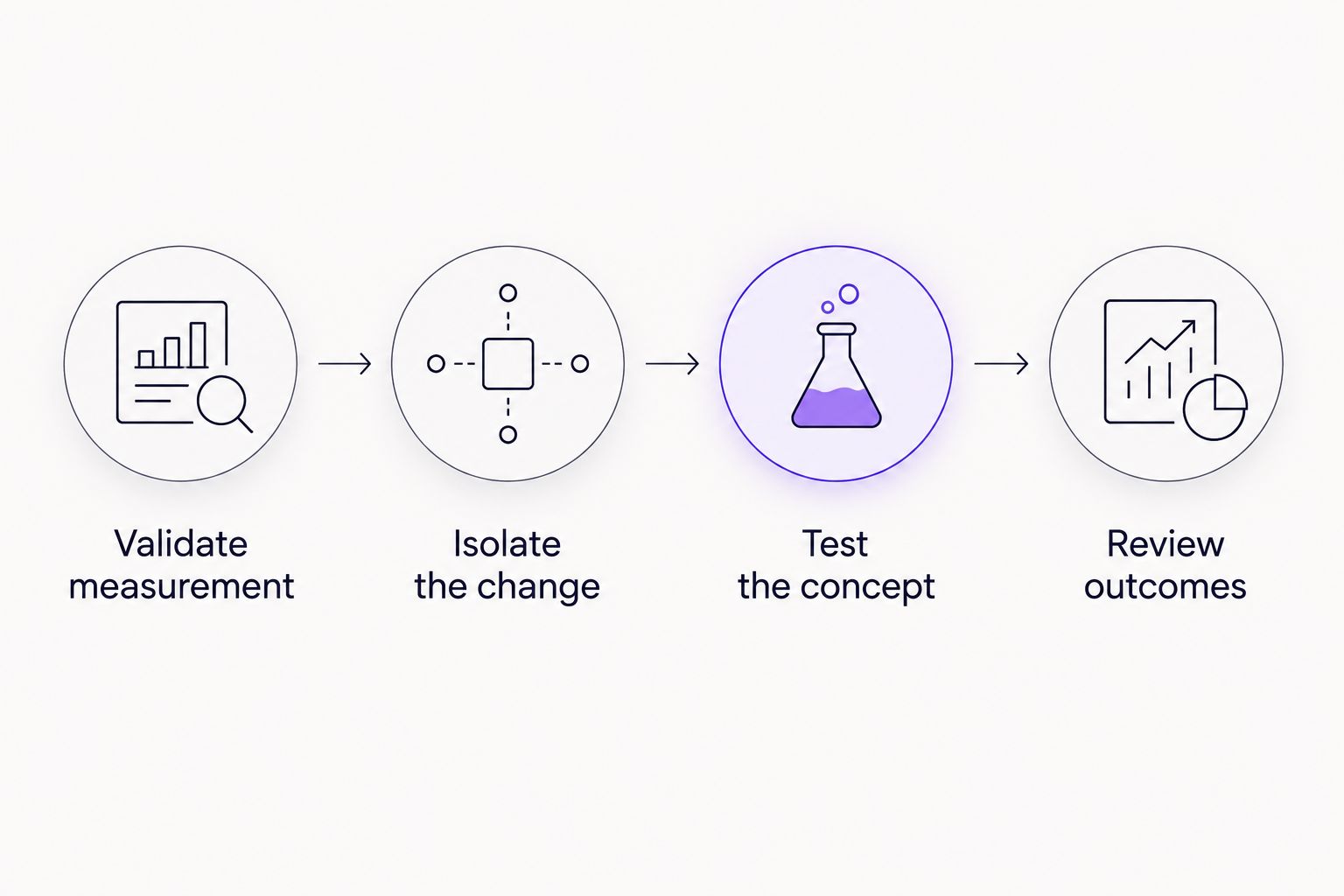
Use a 4-step review before authorizing a consequential change. The objective is to identify the problem without creating a new one through an unnecessary pause or an uncontrolled replacement test.
- Validate measurement. Check that purchase events and attribution settings remain comparable. Identify reporting gaps before interpreting a short-term ROAS movement.
- Isolate the change. Review the affected creative within a consistent audience and placement scope. Check whether unrelated ads changed at the same time.
- Test the concept. Develop a meaningfully different message, demonstration, or opening. Document what changed so the result can inform the next brief.
- Review outcomes. Compare engagement and purchase outcomes after allowing for the account's reporting and conversion timing. Record the decision and its supporting evidence.
The sequence keeps the response tied to the diagnosis. A measurement issue needs a measurement fix; a weakening creative concept needs a creative test.
For an e-commerce brand, record the product, offer, and destination alongside the creative hypothesis. For an agency, also record the account owner and approval decision. This makes the review usable by the person who must act on it.
Where TezAds fits—and what to verify
TezAds is a paid ad automation platform for e-commerce brands and agencies managing campaign creation, launch, and optimization. Its stated scope includes Meta, Instagram, Google, TikTok, YouTube, and X.
That scope is relevant when your fatigue response involves producing and managing new campaigns. It does not, by itself, establish a dedicated fatigue-prediction feature or prove that a warning arrives before ROAS declines.
When evaluating TezAds in 2026, separate its stated campaign capabilities from the specific fatigue workflow you need. Ask to see creative-level evidence, the basis for each warning, and the controls governing any recommended action.
For a brand, demonstrate the workflow on a relevant product campaign. For an agency, demonstrate it within separate client accounts and inspect how recommendations are reviewed. Treat anything presented as a roadmap item as planned—not available now.
Choose on demonstrated workflow, not the presence of an automation label. This applies equally to a dedicated detection tool and a broader campaign platform.
Does high frequency mean my Meta ad is fatigued?
High frequency alone does not establish creative fatigue. It describes repeat exposure within the reporting scope; assess it alongside engagement, purchase outcomes, and the role of the campaign.
An ad with increasing frequency but stable business results does not need replacement solely because its exposure increased. Investigate the pattern before taking action.
Should I pause an ad as soon as a fatigue alert appears?
A fatigue alert should trigger review, not an automatic pause by default. First determine whether the evidence points to creative deterioration, a measurement problem, or another campaign change.
Use a documented pause policy when you need an explicit operating control. Keep that policy separate from a claim that the underlying cause has been proven.
Can a new image fix creative fatigue?
A new image tests a visual change, not necessarily a new creative concept. If the promise and opening remain the same, the replacement still asks viewers to respond to substantially the same idea.
Write the hypothesis before making the asset. Specify whether you are changing the message, proof, demonstration, or visual treatment.
FAQ
Can AI detect ad creative fatigue before ROAS drops?
AI can flag patterns associated with creative fatigue before a decline becomes visible in reported ROAS, but advance warning is not guaranteed. Validate the signal against audience exposure, engagement, and purchase measurement before acting.
What's the best metric for detecting Meta ad fatigue?
No single metric establishes Meta ad fatigue. Review frequency, creative response, and purchase outcomes together under comparable delivery conditions.
Is a falling click-through rate proof that my creative is tired?
A falling click-through rate is not proof of creative fatigue. Check audience composition, placements, and other delivery changes before assigning the cause to the ad.
Should an agency use the same fatigue rules for every client?
An agency should assess fatigue against each client's campaign conditions and baseline. Shared review procedures are useful, but a shared threshold does not establish the same diagnosis across accounts.
Does replacing ad copy reset creative fatigue?
Replacing ad copy does not guarantee that audience response will recover. Test a distinct hypothesis and evaluate the replacement rather than assuming a new asset is an effective reset.
Does TezAds offer verified early fatigue prediction?
TezAds is described as a paid ad creation, launch, and optimization platform; that description does not establish verified early fatigue prediction. Ask for a demonstration of the specific detection workflow before making it a purchase requirement.
What should I ask a fatigue detection software vendor?
Ask the vendor to show the evidence behind an alert, its comparison baseline, and the action it recommends. Also establish which capabilities are available now and which remain on the roadmap.
One last thing
A new ad file is not necessarily a new idea. Before commissioning replacement creative, write down exactly what the audience will see or understand differently.
Make that your 2026 fatigue-response standard: change a testable concept, not just the asset name. It gives brands a clearer production brief and agencies a clearer explanation of what the next test is meant to resolve.


