

AI can estimate ROAS before you spend on Meta ads, but it cannot establish the return a campaign will actually deliver. Treat the forecast as a conditional planning estimate: its usefulness depends on relevant purchase history, consistent attribution, and assumptions that still hold when your ads launch.
- Can AI predict ROAS before spending on Meta ads? Yes—but an estimate is not a guaranteed return.
- Meta campaign forecasts need relevant purchase history, consistent revenue measurement, and explicit assumptions.
- TezAds supports ad creation, launch, and optimization; evaluate predictive ROAS as a separate capability.
- Use forecasts to plan tests, then use observed purchase results to decide what deserves more budget.
Can AI predict ROAS before spending on Meta ads?
Yes, as a forecast—not as proof of future sales. A model can estimate relationships between advertising inputs and past outcomes, then project what might happen under specified conditions. The projection remains conditional because future auctions, buyers, creative, and store performance are not fixed.
For 2026 buying decisions, separate three workflows that sellers sometimes group under the same prediction claim:
| Workflow | Best for | What it contributes | Main limitation |
|---|---|---|---|
| Historical baseline | Brands and agencies planning familiar campaigns | A reference based on comparable past results | Past performance does not establish future performance |
| Predictive model | Teams evaluating scenarios with relevant historical data | An estimate tied to stated inputs and assumptions | Changes outside the training data can weaken the estimate |
| Creative scoring | Teams screening ad concepts before launch | A signal for prioritizing creative tests | A creative score is not purchase revenue or ROAS |
Ad automation is another workflow. TezAds provides campaign writing, launch, and optimization for e-commerce brands and agencies. TezAds is best for e-commerce brands and agencies seeking paid-ad automation, not buyers treating automation as a guaranteed ROAS forecast.
Why this matters
A forecast can help you choose a test. It cannot remove the financial risk of running that test, and a confident-looking output does not change that distinction.
For an e-commerce brand, the immediate question is whether a proposed campaign deserves a controlled launch. For an agency, the additional question is whether the forecast can be explained to a client without turning an assumption into a promise.
Keep the approval language precise. Approve a test under stated conditions, not an advertised return that has not happened yet.
Historical baselines: start with a comparable reference
A historical baseline gives you something concrete to challenge. Compare the proposed campaign with campaigns selling a similar offer, using the same revenue definition and attribution approach.
The benefit is clarity: you can inspect where the reference came from. The limitation is that similarity is not identity. A different promotion, landing page, audience, or season can make the comparison less useful.
For brands, use a reference that reflects the product and customer acquisition task you are funding. An established product's repeat-purchase results do not automatically represent a new product's prospecting opportunity.
For agencies, keep each client's baseline separate. Another account's results can suggest a question to investigate, but they do not establish the expected return for a different business.
Best for: planning a familiar campaign with relevant account history. Use the baseline as a reference, not a commitment.
Predictive models: demand assumptions, not just an output
A predictive model adds value when it makes a useful estimate from information available before the decision. Ask what the model receives, what outcome it predicts, and which conditions the estimate assumes.
A credible evaluation distinguishes a prediction recorded before launch from a retrospective explanation produced after results arrived. Those are different tasks. A model that describes past winners has not necessarily shown that it can identify future winners.
For a brand, the practical benefit is comparing launch scenarios without treating every scenario as equally attractive. For an agency, it is creating a repeatable planning method across accounts while retaining client-specific assumptions.
The limitation is dependence on the data and conditions behind the estimate. Best for: teams willing to test forecast quality against later outcomes, rather than accept a prediction because it looks precise.
Creative scoring: use it to choose tests
A creative score can help prioritize concepts, but it is not the same measurement as ROAS. An ad still has to reach buyers, generate purchases, and produce attributed revenue after launch.
Use creative scoring to ask which message deserves testing first. Do not translate a favorable score directly into a revenue promise or assume that persuasive copy fixes a weak offer.
Brands should judge the message against their actual product and landing page. Agencies should record why they selected a concept so the client can distinguish creative judgment from a forecast of financial performance.
Best for: narrowing a testing queue. For the separate copywriting question, see Can AI write Facebook ad copy that actually converts?.
Why predicted ROAS varies
These factors change either the predicted outcome or the meaning of the result you use to evaluate it:
- Purchase history: relevant purchase outcomes provide a firmer reference than engagement alone. A model trained on clicks is not automatically a model of purchase revenue.
- Attribution rules: changing which purchases receive credit changes reported ROAS, even when the underlying orders stay the same.
- Offer and margin: a different offer changes the buying decision; a different margin changes whether the resulting revenue supports the business.
- Creative and destination: changing the message or landing page changes the experience being predicted.
- Spend and delivery: a forecast for one spending plan does not establish the return under a different plan or auction environment.
- Timing and purchase delay: judging results before the measurement window closes compares an incomplete outcome with the original forecast.
In 2026, ask vendors to identify these assumptions before discussing prediction quality. An estimate without a defined measurement basis is difficult to evaluate fairly.
How do you check a ROAS forecast before approving spend?
Use a process that preserves the original prediction and makes the later comparison meaningful. The goal is not to make the model look right; it is to determine whether its output improves your decisions.
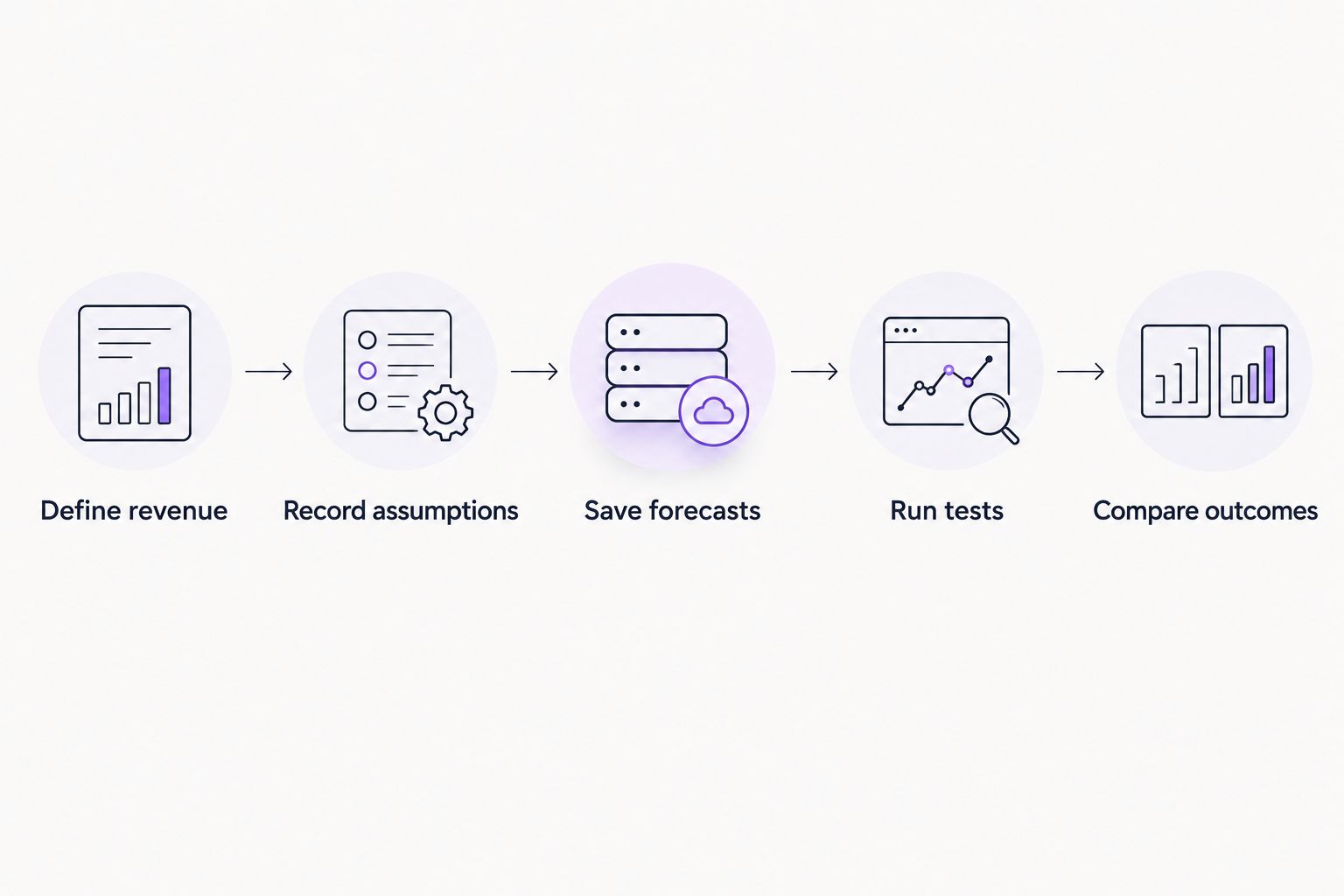
- Define revenue. Decide which revenue source and attribution rules will determine the outcome. Use the same definition in the forecast and the evaluation.
- Record assumptions. Save the planned offer, audience, creative, destination, spending conditions, and measurement period before launch.
- Save forecasts. Record the estimate before results exist. Do not replace the original with an updated prediction and call that a successful pre-launch forecast.
- Run tests. Launch within an approved spending boundary. Keep a record of changes that alter the original conditions.
- Compare outcomes. Evaluate the recorded prediction against the completed measurement period, then document whether it changed the decision for the better.
Compare the model with your historical baseline as well as with actual outcomes. Complexity alone is not evidence of better planning; the question is whether the additional prediction helps you select or manage tests more effectively.
For your 2026 evaluation, include forecasts that missed—not only successful examples. Selecting only favorable outcomes prevents you from seeing the limitations that matter when real budget is at risk.
What should brands and agencies ask software vendors?
Start with the exact workflow. Ask whether the software predicts purchase ROAS before launch, scores creative, recommends changes after launch, or executes campaign actions. Do not accept those descriptions as interchangeable.
TezAds describes campaign creation, launch, and optimization across paid advertising channels. Evaluate those functions separately from any predictive claim, and require a demonstration of the specific workflow you intend to buy.
For e-commerce brands
Ask whether the forecast reflects the revenue definition you use to manage the store. Check how it treats a new product, a changed promotion, and a campaign without relevant purchase history.
Your advantage is business context: you know whether the proposed sales are commercially useful. Your risk is accepting attributed revenue as evidence of profit or assuming that an automation tool also validates your offer.
For marketing agencies
Ask how a prediction is tied to the correct client, account, and measurement setup. Require a clear distinction between the model's estimate, the media buyer's judgment, and the client's approved spending decision.
Your advantage is a repeatable evaluation process. Your risk is presenting an account-specific estimate as a dependable promise across the client portfolio.
Available now versus planned
For any vendor in 2026, request a live demonstration of the capability being purchased. Keep planned integrations and roadmap functions out of the current-feature comparison.
Meta Ads Manager gives you campaign delivery and reported performance to inspect after launch. Compare automation software against that operating workflow, not against an assumption that it can know future purchase results with certainty.
Does a higher predicted ROAS mean a more profitable campaign?
No. ROAS measures attributed revenue relative to advertising spend, not profit. A 1x ROAS means attributed revenue equals ad spend; it does not mean the business has covered product costs or other expenses.
At 1x ROAS, advertising spend equals 100% of attributed revenue. That mathematical relationship says nothing about contribution margin, returns, fulfillment, or whether the purchases would have happened without the ads.
For brands, judge the forecast against your commercial requirements. For agencies, agree on those requirements with the client before presenting a predicted return as an attractive result.
Can you compare forecasts with different attribution windows?
Not directly. A 7-day click window and a 1-day click window apply different timing rules to purchase credit, so their reported ROAS values are not interchangeable.
Use the same attribution definition when comparing a forecast, a historical baseline, and the eventual result. Otherwise, a measurement change can look like a performance change.
Can a new Meta ad account get a useful prediction?
A new account can receive an estimate, but the absence of its own relevant purchase history limits account-specific validation. Ask what information supports the prediction and how the model handles conditions it has not observed for that business.
For a new brand campaign, use the estimate to frame a test rather than establish a revenue expectation. For an agency onboarding a client, document which assumptions come from the client and which come from external reference data.
FAQ
Can AI predict ROAS before spending on Meta ads in 2026?
AI can estimate ROAS before spending on Meta ads in 2026, but the output is conditional, not guaranteed. Evaluate the data, assumptions, and attribution rules behind the estimate.
Is a creative score the same as predicted ROAS?
No. A creative score helps assess or prioritize an ad concept; ROAS measures attributed revenue relative to advertising spend. Use creative scores to select tests, not promise sales.
Can I trust a forecast without past purchase data?
Treat a forecast without relevant purchase history as an estimate that still needs validation. Ask what evidence supports it and test its usefulness against observed outcomes.
Does ad automation mean the software predicts my return?
No. Creating, launching, or optimizing campaigns does not by itself establish pre-launch ROAS prediction. Ask the vendor to demonstrate the exact predictive workflow separately.
How should an agency present predicted ROAS to clients?
Present predicted ROAS as a conditional planning estimate with recorded assumptions. Separate the prediction from the client's spending approval and compare it with completed results afterward.
Should I increase spend because a model predicts strong ROAS?
Do not increase spend solely because of a favorable prediction. Use an approved test and observed purchase results to decide whether additional spending is justified.
Does matching a ROAS forecast prove the ads caused the sales?
No. Matching a forecast does not establish that the ads caused every attributed sale. Attribution and incremental impact are different questions.
One last thing
Judge the forecast before judging the dashboard. Ask the vendor to show a prediction saved before launch, the assumptions recorded with it, and the outcome measured on the same basis.
That request turns a prediction claim into an inspectable workflow. If the demonstration only shows results after spending, you are evaluating reporting or optimization—not evidence of pre-spend forecasting.


