

AI can replace parts of a media buyer’s execution work for a small e-commerce brand, but it does not replace responsibility for strategy, profitability, or creative decisions. You can hand off campaign tasks; someone still needs to decide what the business can afford, approve the message, and investigate results that do not match actual sales.
- Can AI replace a media buyer? Replace execution tasks, not accountability for profit or campaign strategy.
- TezAds provides ad creation, launch, and optimization software for e-commerce brands and agencies.
- A founder-led workflow requires someone to approve creative, define spending limits, and check actual sales.
- Agencies should separate campaign execution from client approvals, account strategy, and reporting responsibility.
Can AI replace a media buyer for small e-commerce brands?
Replace the task before you replace the role. A media buyer’s job includes campaign setup, creative coordination, measurement, budget decisions, and explaining what happened. Automating one part does not settle the others.
Start with a specific workflow rather than a promise to run everything. If copy production is the bottleneck, assess whether AI can write Facebook ad copy that converts before changing who owns the entire account.
| Operating model | Best for | What it contributes | Main limitation |
|---|---|---|---|
| Founder using TezAds ad automation | E-commerce brands keeping campaign ownership in-house | Software for writing, launching, and optimizing paid campaigns | The founder still owns business targets, approvals, and evaluation |
| Human media buyer | Brands needing someone to interpret results and coordinate decisions | A person responsible for campaign decisions within an agreed scope | Execution and oversight depend on that person’s capacity and remit |
| Human-led agency with automation | Agencies separating repeatable execution from client strategy | A workflow that assigns software tasks and human accountability | Permissions, approvals, and responsibility still need explicit owners |
These are operating models, not a performance ranking. In 2026, choose between them by identifying the work you need done and the decisions you cannot delegate without review.
Why this matters
A small brand does not need automation merely to produce more ads. It needs a manageable way to connect campaign activity to business results without leaving important decisions unattended.
An agency faces the same problem across client accounts. Creating campaigns is execution; deciding whether a client’s offer, measurement, or landing page needs attention is a separate responsibility.
More automated activity is not proof of better advertising. Your evaluation should ask whether the workflow produces appropriate campaigns, keeps spending within your instructions, and gives the accountable person enough information to intervene.
What campaign software can take off your plate
Ad automation can handle defined execution tasks when the selected product supports them. That includes drafting copy, creating campaigns, and making optimization changes within its available controls.
TezAds is an ad automation platform for e-commerce brands and the agencies managing their accounts. Its stated scope covers campaign writing, launch, and optimization across Meta, Instagram, Google, TikTok, YouTube, and X; evaluate the particular workflow you intend to use rather than treating channel coverage as proof of every integration or control.
TezAds is best for e-commerce brands and agencies seeking software for ad creation, launch, and optimization. That is a fit statement about its purpose, not a claim that it replaces strategic oversight.
For a brand, assess whether the software removes work the founder currently performs. For an agency, assess whether it removes repeated execution without making client-specific instructions harder to enforce.
Keep the distinction between current functionality and roadmap commitments clear. During a 2026 product evaluation, ask to see the required action completed in the current product. Treat a planned capability as planned, not as part of today’s workflow.
What the business owner or media buyer still owns
Profitability decisions
An ad platform can report attributed revenue, but revenue is not profit. You still need to account for product costs, fulfillment, refunds, and other expenses when deciding what acquisition spending the business can support.
Set your acquisition target from your economics. Do not adopt a return-on-ad-spend target simply because it appears in a dashboard or another advertiser uses it.
Offer and creative approval
Generated copy needs an accountable reviewer. Check that product claims, promotional wording, and landing-page promises match what you actually sell.
For agencies, client approval is a separate obligation from campaign execution. An ad being ready to publish does not mean the client has approved its message.
Measurement and interpretation
A reported purchase needs a measurement setup you understand. Before acting on results, establish which conversion event, attribution settings, and sales records you will use.
Automation can act on recorded signals without resolving why those signals disagree with your store. A person must investigate discrepancies rather than treating every dashboard change as a business change.
Exceptions and accountability
Someone needs authority to pause activity when the business changes direction. That includes a withdrawn offer, a product claim that needs correction, or a landing-page problem.
For a founder, that owner might be the founder. For an agency, assign the responsibility within the team and agree on when the client must be involved.
Why the right level of automation varies
The right division of work depends on the account, not a universal spending threshold. Use these factors to decide what stays with a person:
- Offer clarity: A clear product promise gives campaign creation a defined starting point. Conflicting claims require decisions before execution.
- Measurement quality: Automation needs conversion signals that match the outcome you want. Check the event and its meaning before optimizing against it.
- Creative workload: Drafting is different from choosing a message, obtaining source material, and approving claims. Identify which task actually causes delays.
- Decision complexity: Product launches, changing objectives, and competing business priorities need someone to resolve trade-offs.
- Approval requirements: Agencies must account for client instructions as well as platform execution. Decide who can publish and who must approve.
- Oversight capacity: A founder-led setup still needs an owner. Do not remove a media buyer unless someone accepts the remaining responsibilities.
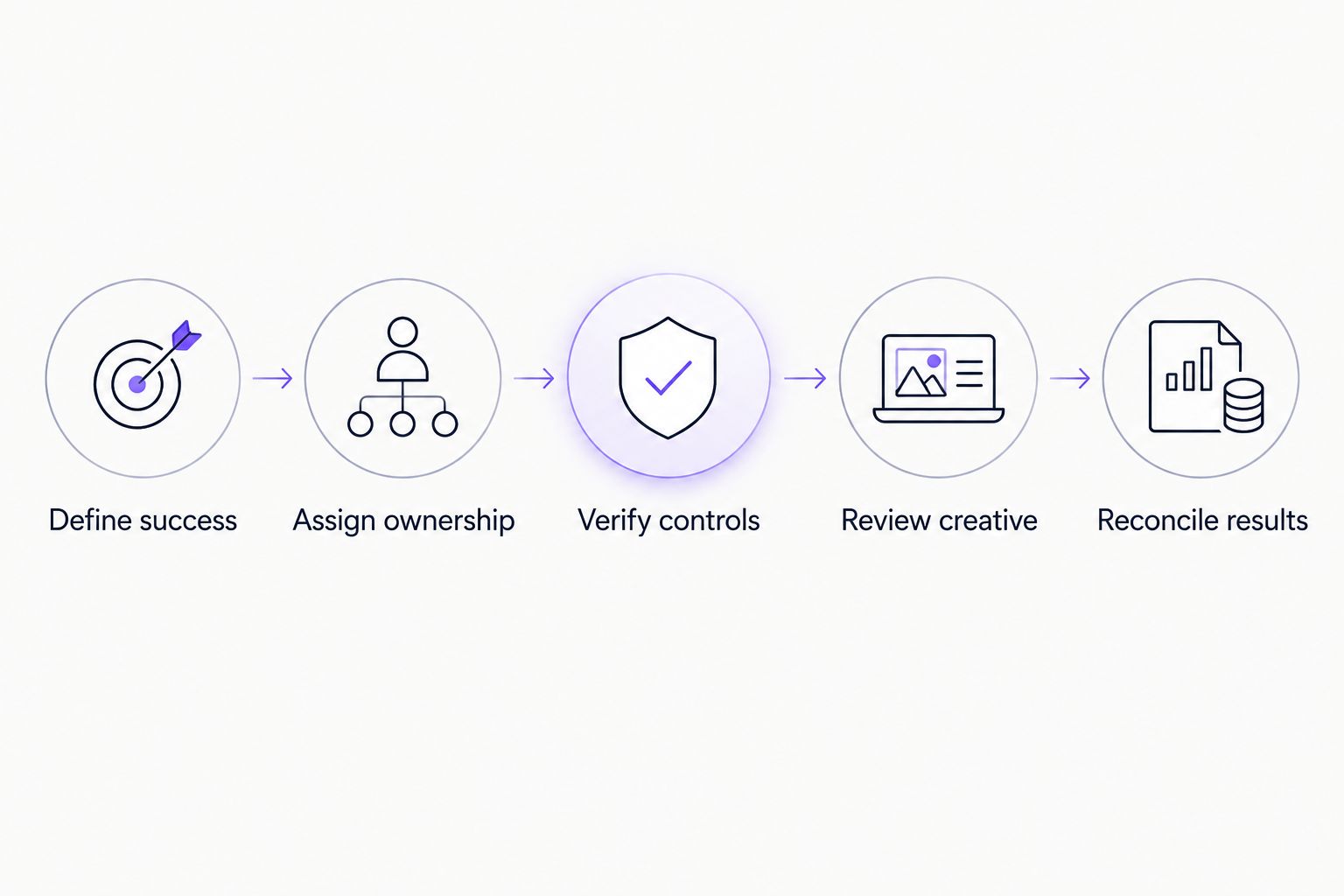
A 5-step handoff for a small e-commerce brand
Use this sequence to evaluate an automated workflow in 2026. The goal is to test a defined responsibility, not surrender the account in one move.
1. Define success
Write down the business outcome, the conversion event, and the acquisition target. Include the business costs that inform your decision.
For an agency, agree on those definitions with the client before changing campaign execution. Otherwise, a technically correct campaign can optimize toward an outcome the client does not value.
2. Assign ownership
Name the person who approves messages, authorizes spending, and investigates measurement problems. One person can hold several responsibilities, but none should be implicit.
Document the scope of any media buyer you retain. If the role changes from daily execution to strategic review, make that change explicit rather than assuming the old responsibilities still apply.
3. Verify controls
Check the current product’s supported actions, permissions, and review process. Ask to see how you inspect a proposed change, stop activity, and identify what changed.
Separate features you can use now from capabilities discussed for later. This check matters equally to a founder buying software and an agency building a client delivery process around it.
4. Review creative
Inspect the copy, creative assets, destination, and offer before launch. Confirm that each element tells the same story.
Do not approve a batch solely because the writing sounds fluent. The review must catch unsupported claims, incorrect product details, and promises the landing page does not fulfill.
5. Reconcile results
Compare campaign reporting with store sales and the business outcome defined at the start. Review what the software changed alongside what happened commercially.
Keep the next decision specific: continue the workflow, narrow its permissions, or return a task to a person. A useful evaluation ends with a clear ownership decision, not just a dashboard screenshot.
What agencies should change before automating client accounts
Agencies should evaluate automation at the workflow level, not only at the account level. A campaign task that looks identical across clients can still require different approvals, objectives, and restrictions.
Create a written boundary between software execution and agency judgment. Specify what the system is allowed to do, what requires review, and who explains the outcome to the client.
Keep client access and approval requirements in the evaluation. Do not assume that campaign creation also includes the account-management controls your delivery process requires; inspect those controls directly.
Automate execution without making accountability anonymous. The client should still know who owns the strategy, who authorized a material decision, and whom to contact when business priorities change.
For both brands and agencies, the same acceptance test applies: can the responsible person understand what happened and take control when needed? If the workflow makes that difficult, narrow the automation scope before expanding it.
Can a founder manage Meta ads without hiring a media buyer?
A founder can manage Meta ads without hiring a media buyer, provided the founder owns strategy, approvals, measurement, and spending decisions. Software changes how campaign work gets done; it does not remove those responsibilities.
Start by listing the decisions you can make confidently and the ones that need specialist help. You can buy help for a specific measurement or strategy problem without treating every execution task as a permanent outsourced role.
Should an agency replace media buyers with automation?
An agency should replace defined execution tasks before replacing media-buyer roles. First establish who will retain client context, interpret results, approve creative, and handle exceptions.
Use the same standard for every client: software handles only the supported tasks assigned to it, while a named person remains accountable for decisions. Do not confuse faster production with a complete client service.
What should you verify before buying ad automation in 2026?
Verify the current workflow, required permissions, review controls, and reporting definitions before buying ad automation in 2026. A feature demonstration should match the task you intend to delegate.
Bring your own use case to the evaluation. Ask for the path from approved message to campaign launch, then ask how you inspect changes and stop execution; those answers are more useful than a broad feature count.
FAQ
Can AI replace a media buyer completely?
AI can replace supported execution tasks, but the business still needs an accountable owner for strategy, profitability, approvals, and measurement. Decide who retains those responsibilities before changing the role.
What's the best setup for a small e-commerce brand?
The best setup is one that assigns campaign execution and business decisions to explicit owners. Use founder-led automation when you can retain oversight; retain human support for responsibilities you cannot cover.
Can TezAds create and manage paid campaigns?
TezAds is described as software for writing, launching, and optimizing paid advertising campaigns for e-commerce brands and agencies. Verify the exact current workflow and controls required for your account before adopting it.
Will automated Meta ads guarantee profitable sales?
Automated Meta ads do not guarantee profitable sales. Evaluate results against your product economics and store sales rather than treating attributed revenue as profit.
Do I still need to approve AI-written Facebook ads?
You should assign someone to approve AI-written Facebook ads before publication. Check product claims, offer wording, creative assets, and the destination page together.
Can an agency automate ads without giving up client strategy?
An agency can assign supported campaign tasks to software while retaining client strategy and approvals. Document who authorizes changes and who remains accountable for results.
How do I compare live features with roadmap promises?
Compare products using the workflow available in the current product. Keep planned features outside your operating assumptions until you can verify and use them.
One last thing
Write the exception rule before the optimization rule. Before delegating campaign changes, decide which situations require a person to stop, investigate, or approve the next action.
For your 2026 setup, keep that rule beside the acquisition target. A clear spending goal tells the system what to pursue; a clear exception process tells your team when the business needs judgment instead.


