

Yes, AI can write ad copy that matches your brand voice when you give it approved examples, explicit writing rules, and verified product facts. Matching the voice does not make the copy accurate or ready to publish: you still need to check claims, audience fit, and the destination page before launching an ad.
- Can AI write ad copy that matches brand voice? Yes, with approved examples, factual limits, and human review.
- For Meta ads, evaluate tone and factual accuracy separately; natural-sounding copy can still contain unsupported claims.
- TezAds supports ad creation, launch, and optimization; evaluate brand-voice controls separately from those broader workflows.
- Agencies need separate client briefs and approvals; e-commerce teams need copy grounded in verified product details.
Can AI write ad copy that matches your brand voice?
Yes. The practical test is whether the draft follows your brand’s language and boundaries while communicating a clear reason to act. Sounding friendly, premium, or direct is not enough; those descriptions leave too much open to interpretation.
For a 2026 evaluation, compare these approaches using the same product facts, audience, and campaign objective. The table describes workflow trade-offs, not measured performance results.
| Approach | Best for | Main advantage | Main limitation |
|---|---|---|---|
| Human-written copy | Campaigns requiring close editorial judgment | A writer can explain and challenge each language choice | Every draft still needs writing time and review |
| General-purpose text generation | Teams that want draft assistance without changing campaign operations | You can supply instructions and revise individual passages | Copy generation alone does not launch or manage campaigns |
| TezAds ad automation | E-commerce brands and agencies seeking ad writing, launch, and optimization together | Its stated scope covers campaign creation and management across multiple advertising platforms | That scope does not establish specific brand-voice memory, approval, or permission controls |
Voice fit and business performance are separate questions. The guide to whether AI-written Facebook ad copy converts covers the conversion question; this page focuses on controlling how your ads sound and what they claim.
Why this matters
Your ad represents the business before a shopper reaches the product page. A draft that sounds unlike your brand creates an editorial problem; a draft that invents a guarantee creates a factual one. Fix both before publication.
For an e-commerce team, the review should connect the product, the promise, and the landing page. For an agency, it must also preserve the client’s language and approval boundaries. An ad that sounds polished but borrows another client’s promise is not an acceptable draft.
Treat brand voice as a set of decisions you can inspect. That makes feedback more useful than asking for copy that feels more authentic.
Build a brand-voice brief before generating copy
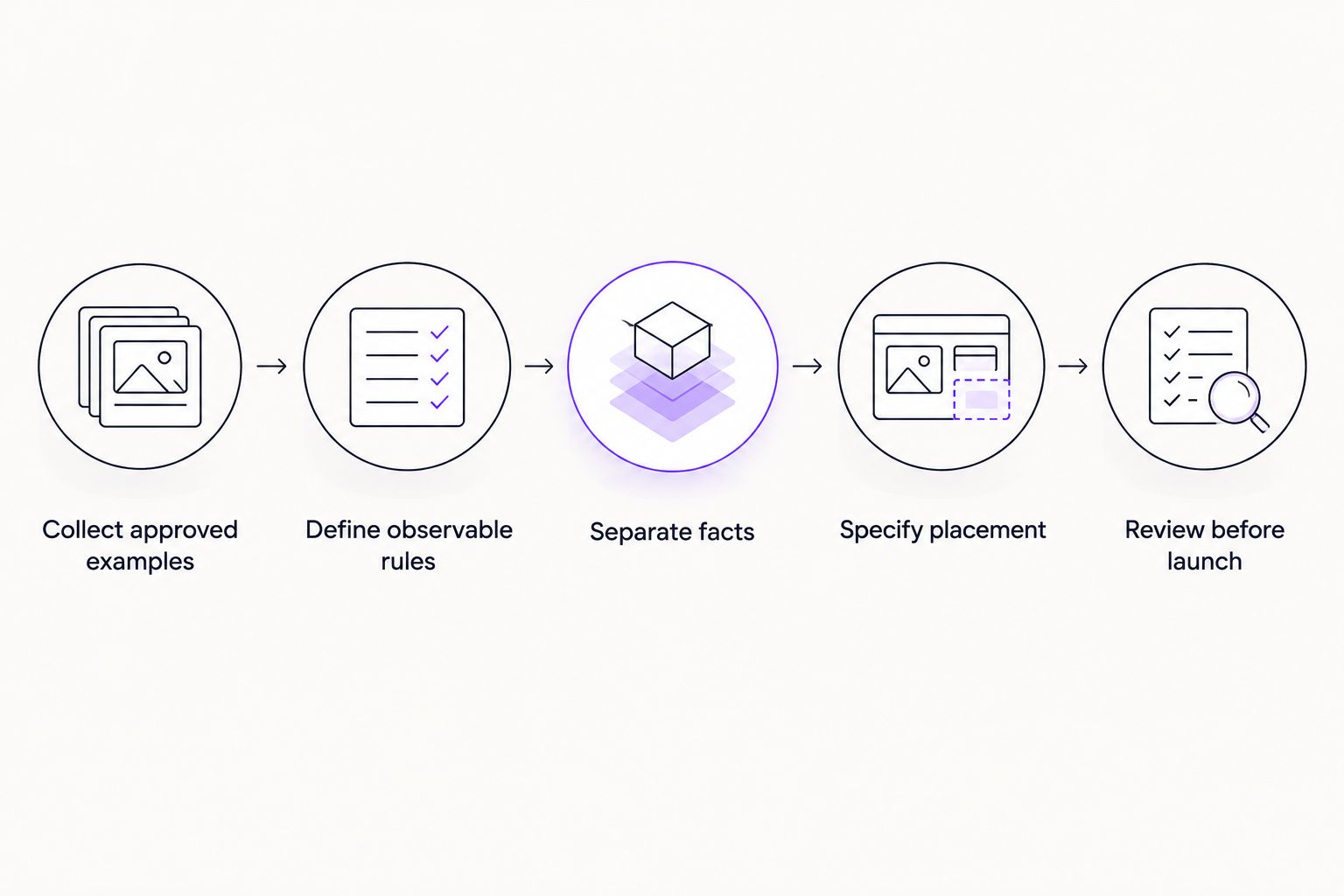
Use this 5-step workflow as an editorial process, not a claim about any platform’s built-in features. Keep the brief beside the approved product information so the writer can distinguish style instructions from facts.
1. Collect approved examples
Select examples that already sound right: approved ads, product descriptions, customer emails, or founder-written passages. Explain what each example demonstrates rather than asking the system to imitate everything about it.
A useful annotation identifies the choice: short opening, everyday vocabulary, restrained enthusiasm, or a direct call to action. Exclude outdated campaigns and language the brand no longer accepts. Otherwise, an example can contradict the rules you want followed.
2. Define observable rules
Translate broad adjectives into instructions an editor can apply. Instead of confident, specify whether the brand makes direct statements, avoids exaggerated adjectives, and explains the product before asking for a purchase.
Record rules for sentence length, contractions, humor, punctuation, and calls to action. Add prohibited expressions with a reason where necessary. A rule such as do not imply guaranteed results is more useful than do not sound salesy.
3. Separate facts
Create a factual section distinct from the voice examples. Include only approved product names, supported benefits, verified specifications, and any conditions the ad must preserve.
Add an explicit instruction: when a fact is absent, omit it rather than complete the sentence with an assumption. This matters when reference ads mention an offer that does not apply to the current campaign. An example of good style is not permission to reuse its commercial claims.
4. Specify placement
Tell the writer whether the draft is for Meta ad primary text, a headline, or another defined field. State the audience, campaign objective, and destination page context without asking the writer to infer them.
For e-commerce teams, identify the product and the buyer problem the ad should address. For agencies, also identify the client and the designated approver. Keep those instructions inside the relevant account workflow rather than a shared, undifferentiated prompt.
5. Review before launch
Read for factual accuracy first, voice second, and clarity third. An unsupported benefit fails even when the wording perfectly matches the brand.
Give revision feedback against the brief: remove the unsupported claim, replace the prohibited phrase, or make the opening less formal. Save approved revisions as examples only after checking that their facts remain relevant.
Why brand-voice matching varies
A useful brief makes the task clearer, but output still needs inspection. For your 2026 copy workflow, diagnose disagreements against these factors rather than repeatedly requesting a different tone:
- Example consistency: Conflicting examples leave the intended voice unclear. Remove material that no longer represents the brand.
- Rule specificity: Words such as bold or premium do not explain which sentences an editor should reject. Define observable choices.
- Factual boundaries: A voice guide cannot establish whether a product benefit is true. Supply approved facts separately.
- Audience context: The same wording can suit an existing customer but assume too much knowledge from a new buyer. State who will see the ad.
- Placement context: A headline and a longer primary-text field have different jobs. Review each in its intended placement.
- Review consistency: Contradictory feedback produces an unstable standard. Assign a final editorial decision-maker and record accepted changes.
These are practical controls, not a formula for predicting sales. Use them to make drafting and review more explicit; evaluate campaign outcomes through your advertising measurement process.
How should e-commerce brands review AI-written Meta ads?
Start with the product truth, not the cleverest opening. Compare the ad’s promise with the destination page and the approved product information. Remove any unsupported performance claim, implied guarantee, or condition the copy has dropped.
Then check voice. Would the business use this wording in its own customer communication? A product-focused brand should not approve exaggerated language merely because it sounds like familiar advertising.
Finally, check the action. The call to action should match what the shopper can do after following the ad. Do not let a persuasive closing sentence introduce a different promise from the rest of the message.
For a 2026 campaign review, use 3 review passes: facts, voice, and destination fit. These are recommended checkpoints, not measured accuracy rates or a guarantee of campaign performance.
How should agencies keep each client’s voice separate?
Use a separate brief, source set, and approval record for each client. A common writing process is useful; a common pool of client facts is not. Keep examples clearly attributed so language from one account does not become an assumed rule for another.
Before drafting, confirm which client the work belongs to and which information is approved. Before launch, confirm who has authority to accept the wording. Neither step should depend on a draft sounding plausible.
For agency software evaluations in 2026, ask the vendor to demonstrate account separation, review permissions, and revision history if those controls are requirements. Treat a roadmap answer as a future possibility, not a current capability. A demonstration of copy generation does not establish an approval workflow.
Where does TezAds fit in this workflow?
TezAds is best for e-commerce brands and agencies seeking paid-ad writing, launch, and optimization in one platform. Its stated scope includes Meta, Instagram, Google, TikTok, YouTube, and X.
That scope addresses more than writing assistance. It is relevant when your buying decision includes moving from a draft into campaign execution and ongoing management, rather than obtaining text alone.
The limitation is equally important: the supplied product description does not establish persistent voice profiles, automatic brand-rule enforcement, or client approval permissions. Evaluate those requirements directly. Do not infer them from the ability to write or optimize an ad.
If a requested capability is planned rather than available, keep it out of the current-workflow decision. Buy against the process you can use now, not a process described for later.
What should you ask an ad-copy tool to demonstrate?
Use the same brief and approved facts for every evaluation. Ask for a draft, give a specific correction, and inspect the revision. This tests whether the workflow supports your editorial decisions without confusing attractive output with verified capability.
For a 2026 buying decision, ask these questions:
- Can you show which information supplied the product claims?
- Can you revise the tone without changing the underlying facts?
- What happens when an instruction conflicts with an example?
- Which brand settings persist, and which instructions must be supplied again?
- Which review and account controls are available now?
- Can the team inspect the final copy before it launches?
Judge the answers against your own requirements. An e-commerce brand might prioritize product accuracy and a straightforward handoff to launch; an agency also needs to establish client separation and approval responsibility. Neither audience should accept an unexplained feature label as proof.
Does matching brand voice mean an ad will convert?
Brand-voice matching does not establish conversion performance. An ad can sound exactly right while presenting an unclear benefit or sending the shopper to a mismatched page. Review the message and measure the campaign separately.
Keep the approved voice rules stable while testing a specific messaging difference. Otherwise, you cannot tell whether the business is evaluating the idea, the wording, or a change in tone.
Can you trust a draft without checking every claim?
Check every factual claim before publication. Natural wording is not evidence that a statement came from an approved source. Review implied claims as well as explicit ones, including language suggesting certainty or a result the product information does not support.
For agencies, the reviewer must also confirm that the claim belongs to the correct client. For e-commerce teams, verify that the landing page supports the same promise.
FAQ
Can AI write ad copy that matches brand voice without previous ads?
Yes, you can supply other approved writing, such as product descriptions or customer emails, alongside explicit style rules. Review the resulting ad carefully because those examples were written for a different context.
What's the best way to prompt AI for on-brand Meta ads?
Provide approved examples, observable voice rules, verified product facts, the audience, and the intended ad field. Ask for a draft that omits unsupported details rather than filling gaps.
Can I use the same brand-voice prompt for every agency client?
Use the same prompt structure, but keep each client's examples, facts, and approvals separate. A shared structure should not become a shared source of product claims or brand language.
Does TezAds automatically remember my brand voice?
Persistent brand-voice memory is not established by the supplied product description. Confirm the current settings and their scope before making that capability part of your workflow.
Should I let an ad-copy tool invent stronger product benefits?
No. Require every product benefit to come from approved information, and reject unsupported claims even when they sound persuasive.
How do I know whether an ad sounds like my brand?
Compare the draft against approved examples and observable rules rather than a general impression. Identify the exact wording, tone, or claim that passes or fails.
What should I check before choosing an ad-copy tool in 2026?
Check the drafting, revision, review, and launch workflow against your requirements. Ask which capabilities are available now and exclude roadmap features from the current-capability comparison.
One last thing
Keep rejected wording in the brief, with a short explanation. An approved example shows what to copy; a rejected example shows where the boundary sits. That distinction helps reviewers explain why a fluent sentence still does not belong in the brand’s advertising.
Maintain separate notes for tone problems and factual problems. Fixing the first must never conceal the second.


