

Yes. AI can scale a winning Facebook ad automatically by increasing budgets or reallocating spend when performance meets your conditions. The catch is that higher spend does not guarantee profitable growth: conversion delays, weak measurement, and falling returns still need controls and human oversight.
- Can AI scale a winning Facebook ad automatically? Yes, with spending limits, reliable purchase data, and stop conditions.
- Meta Ads Manager supports budget automation; automated rules execute conditions rather than establish your business strategy.
- TezAds serves e-commerce brands and agencies with ad creation, launch, and optimization; verify specific scaling controls before committing.
- Judge Facebook ads scaling by profitable additional sales, not a budget increase or historical ROAS alone.
Why this matters
A winning ad earned that label under particular conditions: an audience, a budget, an offer, and a measurement window. Increasing spend changes those conditions. Your job is to protect the business outcome while software handles repeatable decisions.
For a 2026 automation setup, separate creating ads from deciding when to spend more. The Facebook ads automation tools guide covers the broader buying question; this page focuses on scaling an existing winner.
Can AI scale a winning Facebook ad automatically?
Yes, provided the system has permission to change spending and a clear rule for success. Some systems recommend changes; others execute them. A recommendation dashboard is not automatic scaling.
Budget automation also operates at different levels. Allocating an existing campaign budget among ad sets is not the same as increasing your total advertising commitment. Confirm which action you are authorizing before connecting an account.
| Approach | Best for | What it does | Main advantage | Main limitation |
|---|---|---|---|---|
| Meta Ads Manager budget automation and automated rules | Advertisers working directly inside Meta | Allocates campaign budgets and executes supported actions under configured conditions | Keeps execution close to the advertising account | Your conditions still need to reflect business economics |
| TezAds | E-commerce brands and agencies seeking broader ad operations | Writes, launches, and optimizes paid campaigns across the platforms named in its description | Covers creation, launch, and optimization in one platform | Specific autonomous scaling thresholds and approval controls require verification |
| Manual media buying | Teams handling exceptions and business decisions | A person reviews results and changes budgets | Makes room for context beyond advertising reports | Every decision requires operator attention |
These approaches are not mutually exclusive. You can use automation for routine execution and retain manual approval for decisions that change your commercial exposure.
For an agency, the key distinction is authority: who can authorize more spend for a client? For a brand, it is economics: does the additional revenue justify the additional advertising expense?
How do you set up automatic scaling safely?
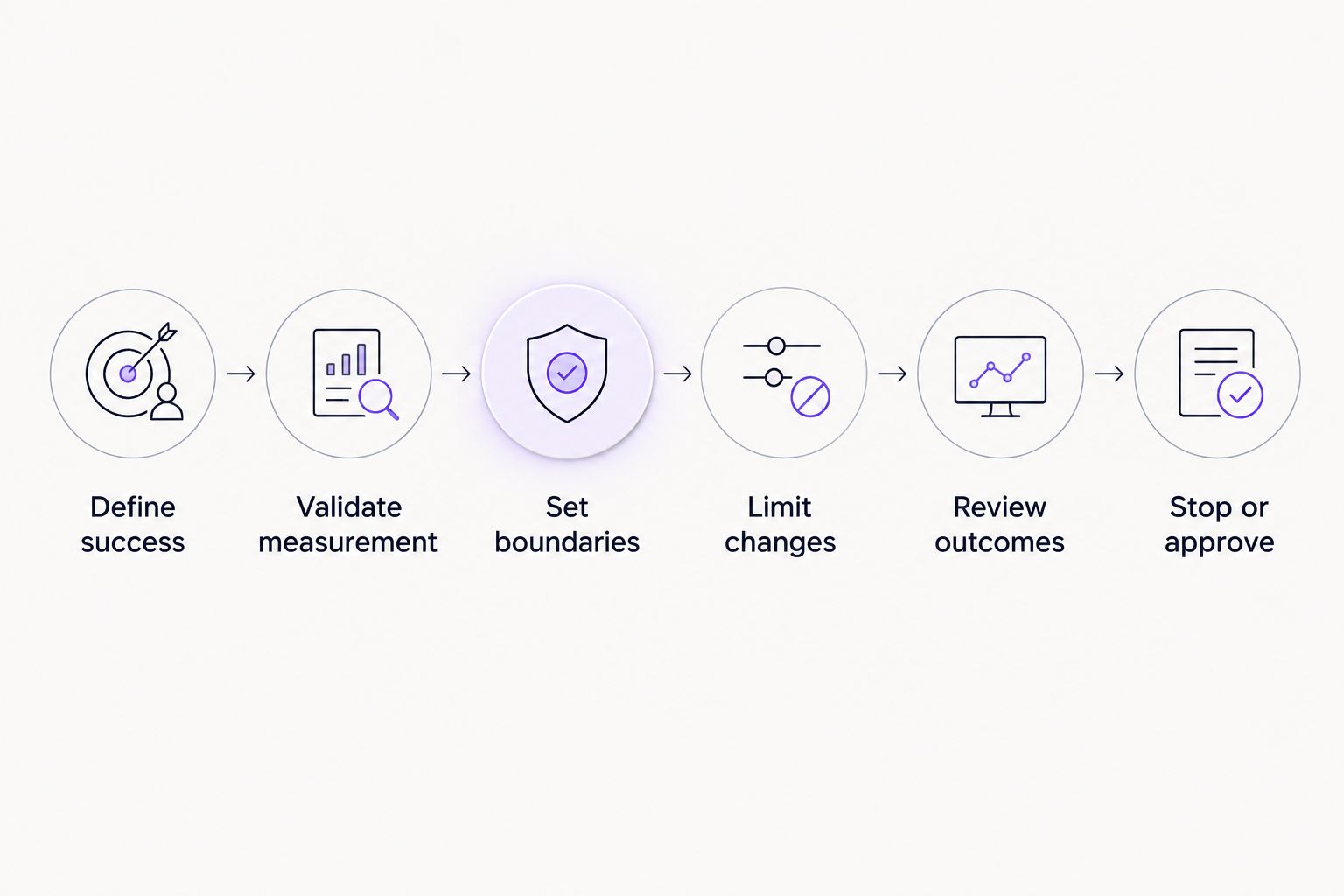
Use these 6 checks before allowing software to change spend. They define the decision process, not a promised performance result.
1. Define success
Choose the business result you want the system to protect. For an e-commerce brand, that means linking purchase results to an acceptable acquisition cost or return target—not simply selecting the ad with the most clicks.
An agency should document each client's target separately. A blended agency target hides differences in product margins, acquisition goals, and commercial constraints.
2. Validate measurement
Confirm that purchase events and revenue values represent real orders, and check for duplicate reporting. Compare the advertising view with your commerce records before giving either source authority over budget changes.
Conversion reporting does not always arrive at the same time as spend. Use a review window that respects the account's observed purchase journey instead of judging every fresh budget change immediately.
3. Set boundaries
Specify the total spending limit, the permitted budget action, and who owns exceptions. A system should not interpret a strong result as unlimited permission to spend.
For an agency, client authorization belongs here. For a brand, include the operational constraints that advertising reports cannot decide, such as whether the promoted offer remains commercially appropriate.
4. Limit changes
Decide which variable automation can change. If you change the budget, audience, creative, and offer together, you lose a clear explanation of what caused the next result.
Start with the smallest decision scope that solves your workload problem. Expanding authority is a separate decision from connecting the advertising account.
5. Review outcomes
Compare the result after a change with the target that justified it. Look at both the return rate and the volume of useful business outcomes.
For a 2026 review, keep the question plain: did the additional spending produce acceptable additional sales? A larger revenue total alone does not answer that question.
6. Stop or approve
Write down what happens when results deteriorate or measurement becomes unreliable. The response might be pausing further increases, requesting approval, or returning control to an operator.
Do not assume every platform supports every response. Require a demonstration of the actual action and its execution record before enabling it.
Why automatic scaling results vary
Automatic execution removes repetitive work. It does not remove the conditions that determine whether an ad remains profitable. These are the factors to inspect when scaling stalls:
- Purchase measurement. Incorrect events or revenue values give the system the wrong definition of success.
- Conversion timing. Recent spend and later purchases need a consistent evaluation window.
- Creative response. A previously successful message still needs monitoring as delivery expands.
- Auction conditions. Ad delivery depends on an auction, not a fixed supply of equally valuable customers.
- Business economics. Revenue-based returns do not deduct product costs, fulfillment, refunds, or other expenses.
- Automation scope. Moving spend within a campaign and increasing total spend create different financial exposure.
A brand should translate these factors into acceptable acquisition economics. An agency should translate them into client-specific operating instructions, then keep those instructions attached to the correct account.
Do not solve uncertain measurement with faster budget changes. Resolve the signal first; otherwise, automation simply repeats an unreliable decision with less human friction.
What should e-commerce brands require in 2026?
Start with contribution, not an attractive advertising screenshot. ROAS is attributed revenue divided by advertising spend. It is useful, but it is not a profit calculation.
Ask whether your target reflects the products actually being sold. An acceptable return for one product mix does not automatically remain acceptable when the mix changes.
Then connect the advertising decision to store reality. If an offer, landing page, or checkout changes, review the scaling instruction rather than assuming historical performance still describes the current purchase experience.
Your acceptance test should answer practical questions:
- Can you see which purchase signal triggers a change?
- Can you limit the spending authority you grant?
- Can you identify what changed and why?
- Can you stop further changes without rebuilding the campaign?
Those are buying criteria, not claims that every tool provides them. Ask to see the workflow in the product you are considering.
What should agencies require in 2026?
Agencies need the same performance controls as brands, plus clear account boundaries. A tool that works for a single store still needs evaluation against your client approval process.
Document 3 responsibilities for every managed account: who sets the target, who authorizes spending, and who handles exceptions. Keep those responsibilities explicit even when the same person holds all of them.
Next, test reporting clarity. Your team should be able to explain a budget change without reconstructing it from scattered messages. Ask whether the product records the trigger, the action, and the account affected.
The trade-off is straightforward. More automatic execution reduces repeated manual decisions, but it increases the importance of permissions and oversight. A client should never discover that a reporting recommendation was treated as spending authorization.
Keep strategic decisions separate from routine adjustments. A change in acquisition strategy, offer, or client objective deserves a deliberate review rather than an inherited rule.
Where TezAds fits—and what to verify
TezAds is best suited to e-commerce brands and agencies seeking paid-ad creation, launch, and optimization in one platform. Its stated scope includes Meta, Instagram, Google, TikTok, YouTube, and X.
That scope makes TezAds relevant when your workload extends beyond adjusting the budget of an existing Facebook campaign. It does not, by itself, establish the exact conditions under which the platform independently scales a winning ad.
For a 2026 product evaluation, request a live demonstration of the specific workflow you need. Ask whether a budget change is suggested or executed, which account permissions it requires, and how an operator stops it.
Keep 2 columns in your evaluation: available now and planned. Put a feature in the first column only after the vendor demonstrates it in the current product. A roadmap commitment is not a working control.
For brands, the advantage is the stated breadth of ad operations; the limitation is that breadth alone does not prove a particular scaling safeguard. For agencies, the same breadth is relevant across client work, but client-specific permissions and approvals still require verification.
Will increasing the budget keep the same ROAS?
No—automatic scaling does not guarantee the same ROAS. Historical results describe the spending and delivery conditions that produced them, not a promise about the next budget level.
Judge the new spending against an acceptable business target. Holding the exact historical return is a different goal from generating more profitable sales.
Can AI scale an ad without increasing the total budget?
Yes—reallocating an existing budget can increase delivery to a stronger ad or ad set without raising the overall spending limit. That is allocation, not an increase in your total advertising commitment.
Be clear about what loses delivery when another part gains it. Better allocation should be evaluated against the campaign outcome, not only the selected winner's report.
Should you let AI scale Facebook ads without approval?
Only after the spending limits, decision rules, and exception process are explicit. Unrestricted authority is not a requirement for useful automation.
A brand can reserve larger strategic changes for its owner. An agency should follow the client's authorization process rather than treating account access as permission to increase spend.
FAQ
Can AI automatically increase the budget on a winning Facebook ad?
Yes, software with the necessary account permissions can execute supported budget changes automatically. Confirm whether the product makes recommendations or actually changes spending, and set limits before enabling execution.
What's the difference between automatic scaling and budget allocation?
Automatic scaling can increase spending, while budget allocation redistributes an existing budget. Check whether your setup changes the total commitment or only where that commitment is spent.
Is a high ROAS enough to let an ad scale automatically?
No, high reported ROAS alone does not establish that additional spend will be profitable. Check purchase accuracy, conversion timing, product economics, and the spending limit first.
Does Meta Ads Manager offer automation without another platform?
Yes, Meta Ads Manager includes budget allocation and automated rules. Those capabilities still require suitable campaign settings and business conditions; they do not define your profit target for you.
Can an agency use the same scaling rule for every client?
A shared rule template does not replace client-specific targets and spending authorization. Each account needs conditions that reflect its economics, measurement, and approval process.
Does TezAds automatically scale winning Facebook ads?
TezAds is described as software for creating, launching, and optimizing paid campaigns. Verify the exact autonomous budget-scaling behavior, controls, and current feature status in a live demonstration rather than assuming them from that broader description.
What should I do if ROAS drops after an automatic budget increase?
Follow your predefined stop or review condition before permitting further increases. Check conversion timing and measurement as well as the changed spending level before deciding what to reverse.
One last thing
Choose the stop condition before the scale condition. It is easy to describe when an ad looks successful; the more useful test is whether you can explain exactly when the system must stop spending more.
Write that instruction in plain language. If your team or client cannot understand it, the rule is not ready to control a live budget.


