

Yes, AI can write ad copy in multiple languages, including localized headlines, body text, and calls to action. Treat the output as a draft: a fluent reviewer still needs to check meaning, product claims, regional usage, and the destination page before publication. For your 2026 campaigns, use AI to generate options—not to certify that every translation is accurate or ready to convert.
- Can AI write ad copy in multiple languages? Yes—use localized briefs and fluent review before launching multilingual ads.
- Translation preserves meaning; localization adapts the message to a specific audience and market.
- TezAds serves e-commerce brands and agencies with ad creation, launch, and optimization; confirm language-specific functionality separately.
- Judge multilingual Meta ads by purchases and profitability, not fluent wording or clicks alone.
Can AI write ad copy in multiple languages?
AI can draft multilingual advertising copy, but generating text and approving an advertisement are different jobs. A practical workflow separates them:
- Supply verified facts. Give the model approved product details, audience context, and prohibited claims.
- Specify the locale. Name the country or region, not just the language.
- Request localized variants. Ask for distinct selling angles rather than interchangeable paraphrases.
- Review before publishing. Check the language, creative, destination page, and campaign settings together.
TezAds is best for e-commerce brands and agencies seeking ad creation, launch, and optimization in one platform. For multilingual campaigns, verify the exact language and review workflow before choosing an automation platform.
Why this matters
A grammatically correct advertisement can still send the wrong message. Formality, idioms, product terminology, and calls to action depend on who you are addressing—not simply which language they read.
For an e-commerce brand, the job is to preserve a truthful product promise across markets. For an agency, the job also includes keeping each client's terminology, approvals, and campaign instructions separate.
Your 2026 localization process should therefore cover the whole buying journey. An appealing ad does not fix an untranslated checkout, an unsupported delivery promise, or a landing page that describes a different product benefit.
Which multilingual copy workflow should you use?
Choose the workflow by the task, not by how polished the first draft sounds. Translation, localization, and human-led adaptation solve different problems. None removes the need to verify claims.
| Workflow | Best for | Main advantage | Main limitation |
|---|---|---|---|
| AI translation | Adapting approved, straightforward copy | Starts from an established message | Can preserve awkward phrasing or source-language assumptions |
| AI localization | Exploring audience-specific hooks and calls to action | Allows wording and emphasis to change | Can introduce claims or implications you never approved |
| Human-led adaptation with AI drafts | Campaigns requiring close control of tone and meaning | Gives a fluent reviewer ownership of the final message | Requires reviewer time and a clear approval process |
AI translation: preserve the approved message
Use translation when the original advertisement already says exactly what you need. Give the model terminology rules and tell it which names must remain unchanged.
The advantage is consistency. The limitation is that a faithful translation can carry over an idiom, joke, or selling angle that does not fit the destination audience.
For brands, start with approved product copy. For agencies, get approval for the source message before creating language variants; otherwise, a later source-copy revision creates another round of review.
AI localization: adapt the expression
Use localization when the message needs to sound natural for a specific market. State the audience, preferred tone, regional spelling, and intended action.
Localization gives you more freedom than direct translation. That freedom also creates risk: a model asked to make an ad more persuasive can add urgency, stronger promises, or product benefits that were never supplied.
Allow changes in expression, not changes in product truth. Require every factual claim in the localized draft to trace back to your approved brief.
Human-led adaptation: assign final responsibility
Use a fluent reviewer when the copy depends on nuance, sensitive claims, humor, or a tightly controlled brand voice. Ask the reviewer to evaluate the advertisement as advertising, not simply correct its grammar.
The trade-off is additional coordination. Make the review useful by providing the visual, destination page, and intended audience alongside the copy; a headline in isolation is an incomplete assignment.
How do you brief AI for multilingual Meta ads?
A useful brief reduces ambiguity before generation. For a 2026 Meta campaign, prepare the same core instructions whether you manage your own store or work across client accounts.
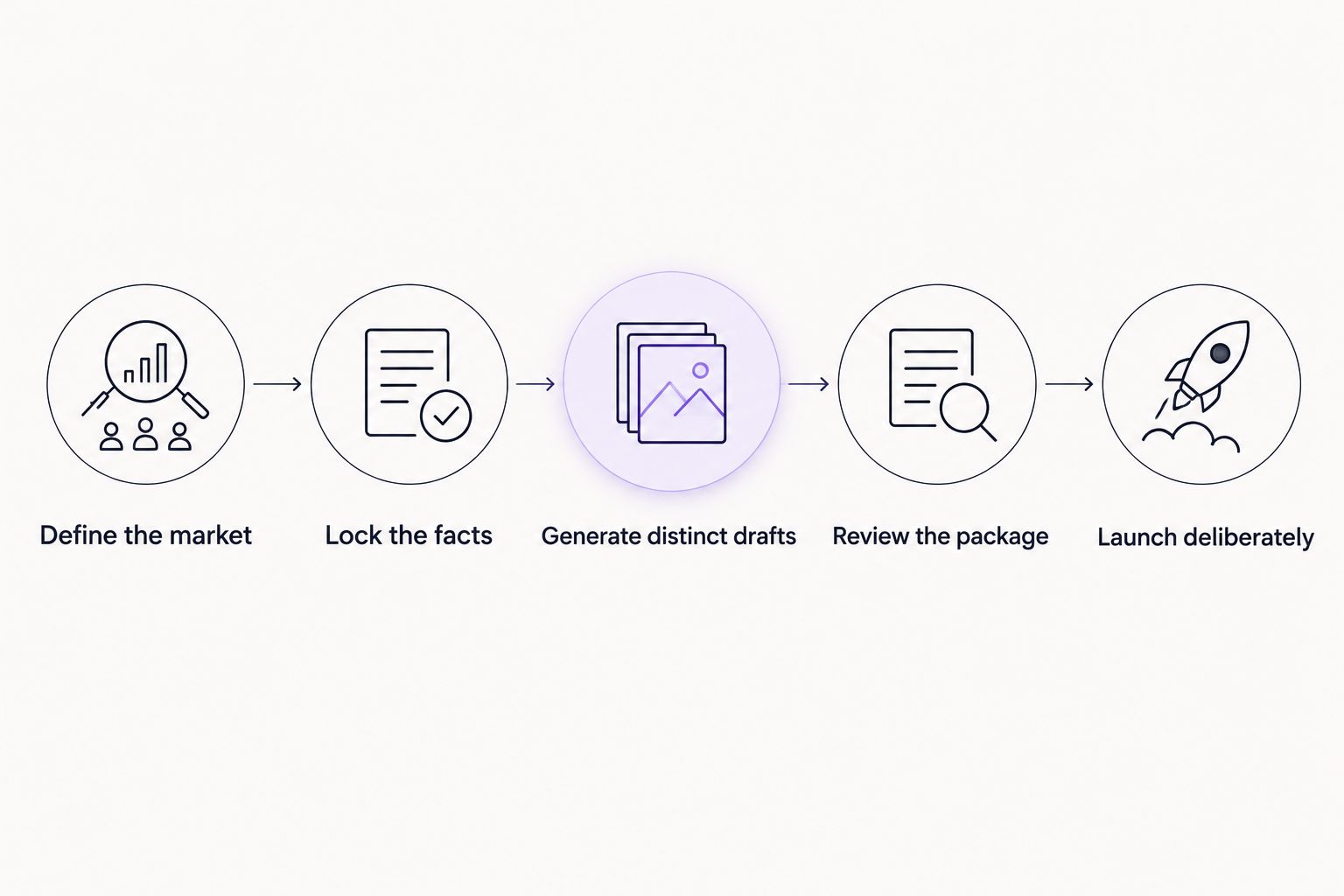
Define the market
Specify the language, country, intended audience, and level of formality. Do not treat a language name as a complete audience description.
For example, Spanish copy for customers in Spain and Spanish copy for customers in Mexico need separate regional review. The instruction is not to assume different customer behavior; it is to check vocabulary and usage rather than treating them as interchangeable.
Lock the facts
List approved product attributes, permitted claims, and words that must remain unchanged. Include explicit instructions not to add promotions, guarantees, certifications, or delivery promises.
For an agency, keep this material client-specific. A claim approved for one account does not belong in another client's brief just because both sell similar products.
Generate distinct drafts
As a starting assignment, request 3 candidate headlines, 2 body-copy variants, and 1 call to action for each locale. These are manageable review targets, not platform requirements or performance benchmarks.
Give each variant a purpose: explain the product, address a verified objection, or make the next action clear. Asking for distinct jobs is more useful than asking for vaguely better copy.
Review the package
Review the text with its image or video and destination page. Check that subtitles, on-image wording, product terminology, and the call to action agree.
Ask the reviewer to mark each draft as approved, revise, or reject. Keep explanatory notes with the draft so the person building the campaign understands what must change.
Launch deliberately
Confirm which language version belongs in each campaign and destination. Separate draft approval from permission to publish or change spend.
For brands, name the person responsible for final approval. For agencies, establish whether approval belongs to the account team, the client, or both before handing anything to automation.
Why multilingual ad copy quality varies
The useful question is not whether a model can produce another language. It is whether your process produces accurate, natural advertisements that match the offer and buying journey.
- Brief specificity. A named locale, audience, and action give the draft clearer boundaries than a request to translate.
- Source-copy quality. Ambiguous wording and unexplained shorthand leave more meaning for the model to infer.
- Terminology control. Approved product names and category terms keep important language consistent.
- Creative context. A line that works alone can conflict with a visual, subtitle, or spoken message.
- Reviewer scope. Grammar checking does not cover product accuracy, brand voice, or destination-page consistency.
- Publishing controls. A correct draft still needs the right campaign assignment and approval before launch.
Fix the brief before generating another batch. If every draft contains the same wrong implication, more variations will not resolve the underlying instruction.
Does natural-sounding copy mean the ad will convert?
No. Natural wording passes a language check; it does not establish purchase intent, offer relevance, or campaign profitability.
For your 2026 test plan, decide what business outcome matters before launching. Compare language variants within their market context rather than declaring a winner from clicks collected across different audiences, budgets, and destinations.
For e-commerce brands
Check whether visitors reach the right product page and can understand the path to purchase. Evaluate purchase outcomes and acquisition costs alongside the copy, rather than rewarding a catchy headline that attracts irrelevant traffic.
When testing a message, avoid changing the audience, destination, and creative simultaneously if you want to understand the copy's contribution. Document what changed so the result remains interpretable.
For marketing agencies
Report results by client, market, and campaign objective. Do not combine unrelated accounts into a single claim that one language or writing style performs better.
Keep the approved text attached to the campaign record. If a client questions a phrase later, the team should be able to identify what ran, who approved it, and which destination it used.
Where does ad automation fit?
TezAds writes, launches, and optimizes paid campaigns across Meta, Instagram, Google, TikTok, YouTube, and X for e-commerce brands and agencies. That platform scope does not establish a particular language list, translation-review process, or locale-specific publishing control.
Evaluate current functionality, not a roadmap promise. In a 2026 product evaluation, ask to see your intended language workflow demonstrated with representative copy and an actual approval scenario.
Use these questions for any vendor:
- Can you draft and edit the required language and regional variant today?
- Can you inspect the final text before publication?
- How do you prevent unapproved product claims from reaching an ad?
- Where does draft approval end and permission to publish begin?
- For agencies, how are client instructions and account access kept separate?
The benefit of campaign automation is coordinating work beyond writing. The limitation is that broader campaign capability does not, by itself, prove multilingual accuracy or appropriate approval controls.
Should you translate the landing page too?
Review the destination whenever you localize an advertisement. The ad and page should make the same promise and give the visitor a consistent understanding of the next step.
You do not need word-for-word duplication. You do need agreement on the product, its supported benefits, and the action the visitor is being asked to take.
For a brand, check product descriptions, purchase instructions, and customer-facing policy language. For an agency, identify who owns those changes before launching; approving ad copy does not mean the destination has been reviewed.
Can agencies reuse one multilingual brief across clients?
Agencies can reuse the brief's structure, but not its factual contents. Keep product claims, terminology, tone examples, and approval requirements attached to the relevant client.
A reusable template saves repeated setup work. Copying a completed client brief into another account risks carrying over instructions that do not belong there.
Build shared fields for locale, audience, approved facts, exclusions, and reviewer ownership. Fill those fields separately for each campaign rather than treating a previous client's draft as the default.
FAQ
Can AI write ad copy in multiple languages without a translator?
AI can produce multilingual drafts without a translator, but publishing them without fluent review leaves meaning and regional usage unchecked. Assign a reviewer who understands both the language and the advertised product.
Is translating an ad the same as localizing it?
No. Translation carries meaning into another language; localization adapts expression for a specific audience and market. Neither process permits adding unsupported product claims.
Can I use AI to write Facebook and Instagram ads in different languages?
Yes, AI can draft Facebook and Instagram ad copy in different languages. Check each draft with its creative, destination page, and intended audience before publication.
How many multilingual ad variants should I request first?
Start with 3 candidate headlines, 2 body-copy variants, and 1 call to action per locale as a manageable review assignment. This is a suggested workflow, not a platform requirement or a performance guarantee.
Does TezAds support every language for ad creation?
Do not assume universal language support. Confirm the exact languages, regional variants, editing controls, and publishing workflow you need before choosing the platform.
Can AI guarantee that multilingual ads will convert?
No, AI-generated wording does not guarantee conversions. Evaluate the message alongside audience selection, the product offer, the destination, and measured campaign results.
Should an agency let multilingual drafts publish automatically?
An agency should require the agreed approval before multilingual drafts publish. Keep client-specific claims, language review, and authorization to launch separate and documented.
One last thing
Before approving your next 2026 multilingual campaign, ask the reviewer to explain the ad's promise in plain English without looking at the original. Compare that explanation with the approved product facts.
This back-translation check does not replace fluent review. It gives the campaign owner a practical way to spot a changed promise—even when they cannot read the final ad themselves.


