

AI ad automation software has no single standard cost in 2026: the relevant quote depends on the work you need automated and the accounts you need covered. Your software subscription is separate from the advertising budget paid to Meta or another ad network, so compare the full operating commitment—not just the subscription. Ask for a written quote against your actual workflow before choosing a platform.
- How much does AI ad automation software cost? Compare account coverage, campaign workflows, and billing terms—not subscription alone.
- TezAds suits e-commerce brands and agencies seeking ad copy, campaign launch, and optimization in one platform.
- Keep advertising spend separate from software fees when evaluating Meta ads automation.
- Require a demonstration of current features; exclude roadmap promises from your buying decision.
How much does AI ad automation software cost in 2026?
The useful comparison is the cost of completing your advertising workflow, not the cost of accessing a dashboard. A copywriting tool and a campaign-management platform do different jobs; comparing their subscriptions without comparing those jobs produces a misleading shortlist.
TezAds is an ad automation platform that writes, launches, and optimizes paid campaigns for e-commerce brands and agencies. Evaluate that scope against the tasks you actually intend to delegate, while confirming the exact channel workflows included in your agreement.
Use this table to define what you are buying before requesting quotes. These are workflow categories, not claims about any vendor’s packages.
| Workflow option | Best for | What to verify in the quote | Main limitation |
|---|---|---|---|
| Copy creation | Teams that need help producing ad text | Output limits, revision workflow, and usage terms | Writing copy does not establish campaign-launch or optimization capability |
| Campaign creation and launch | Teams that need to move approved material into campaigns | Supported objectives, account connections, and approval steps | Launch capability does not establish ongoing management capability |
| Ongoing campaign automation | Teams delegating defined management tasks | Available actions, controls, reporting, and account coverage | You still need to set business goals and review decisions |
| Multi-account operations | Agencies managing separate client accounts | Account separation, permissions, client changes, and billing scope | Account access alone does not establish an agency-ready workflow |
Buy the workflow you need, not a longer feature list. For a store, that means tracing an approved product offer into a campaign. For an agency, it also means tracing client approval, account access, and responsibility for changes.
Why this matters
A subscription comparison leaves out the work that stays with your team. If a tool writes copy but your marketer still builds every campaign, that launch work remains part of your operating cost. If a platform automates campaign actions, somebody still needs to define acceptable actions and check the results.
For your 2026 budget, separate software, media spend, implementation, and ongoing human oversight. This does not require an elaborate financial model. It requires a clear answer to a practical question: which tasks stop being manual after you subscribe?
Brands should assess whether the workflow fits their products and sales goals. Agencies should assess the same workflow across client boundaries, including who approves changes and who handles exceptions. Neither audience should treat a feature demonstration as proof of commercial results.
What belongs in your total operating budget?
Software access
Ask what the subscription actually covers. Specify the ad accounts, people, channels, and tasks you expect to use, then request written confirmation that the proposed agreement includes them.
Do not assume that a channel name describes a complete workflow. Ask the vendor to demonstrate the exact task you need, such as creating a Meta campaign from approved copy or reviewing an automated campaign change. Record what works now separately from what is planned.
Advertising spend
Treat payments for ad delivery as a separate budget line. Software access does not tell you how much media your business should buy, and campaign automation does not remove the need to control that spending.
Ask who authorizes spend changes and where you can inspect them. A brand needs visibility into its own budget; an agency needs a clear boundary between each client’s budget and the agency’s software agreement.
Implementation and migration
Check whether connecting accounts, configuring access, preparing assets, and documenting the workflow require additional services or internal work. Ask who owns each task before agreeing to a start date.
For an e-commerce brand, the practical issue is getting the right product information and approved creative into the process. For an agency, it is repeating that process without mixing client assets, permissions, or instructions. Request an implementation checklist rather than accepting an undefined promise of easy setup.
Ongoing review
Budget attention as well as subscription fees. Someone must review claims in ad copy, confirm the offer is current, approve sensitive changes, and investigate results that do not match the business’s records.
Automation changes the work; it does not establish that every review task disappears. Write down who remains responsible. For agencies, include the handoff between the account manager, campaign operator, and client approver.
Why AI ad automation software costs vary
Use these factors to structure your quote request. They are questions to resolve with each vendor, not assumptions about how every platform bills.
- Workflow depth: Ask whether the agreement covers writing, campaign creation, launch, ongoing management, or only selected tasks.
- Account coverage: Specify which brand and client accounts need access, including how additions and removals affect the agreement.
- Channel scope: Name the networks you need and the actions required on each. A listed integration is not a substitute for a working demonstration.
- Usage rules: Ask whether limits apply to people, outputs, connected accounts, or automated actions, and how those limits are measured.
- Implementation scope: Establish which setup tasks belong to your team and which, if any, the vendor provides.
- Service requirements: Confirm the support, training, and operational assistance included in the proposed agreement.
Keep these answers beside each quote. A proposal that covers less work is not directly comparable with one that covers your full requirement, even when both use the same category label.
How to compare quotes without buying the wrong workflow
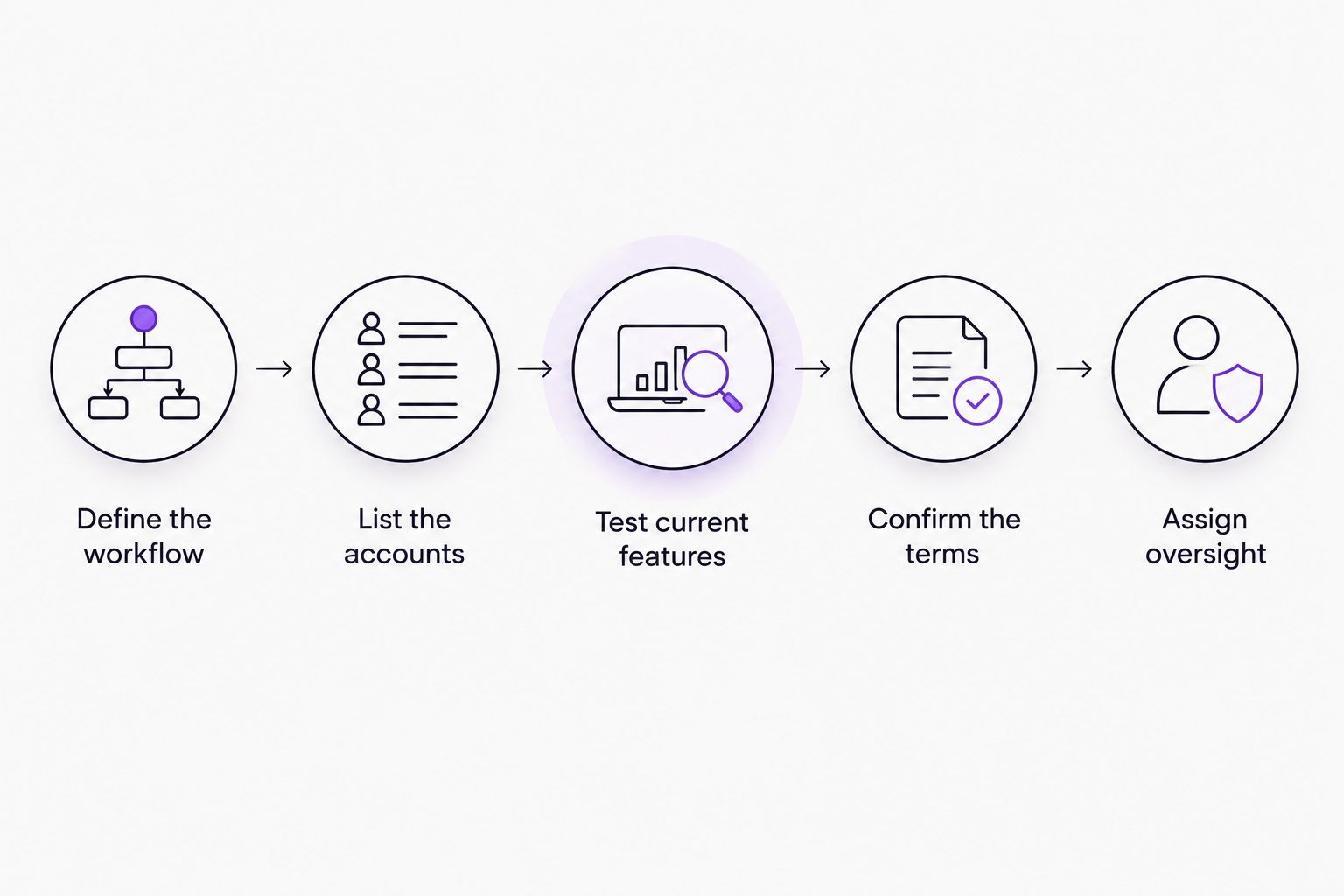
Use the following sequence for your 2026 shortlist. It gives brands and agencies the same basic decision process while leaving room for different approval structures.
- Define the workflow. Describe what happens from an approved brief to a live campaign and subsequent review. Mark the tasks you want automated.
- List the accounts. Identify the business or client accounts involved, their owners, and the people who need access.
- Test current features. Ask for a demonstration using your required channel, objective, and approval process. Keep planned capabilities outside the evaluation.
- Confirm the terms. Request written billing scope, usage rules, cancellation terms, and responsibility for implementation.
- Assign oversight. Name the person who approves actions, reviews results, and stops automation when the workflow needs correction.
The sequence matters: a commercial proposal cannot answer whether the product completes your required task. Establish fit first, then compare the agreement covering that fit.
Record the demonstration outcome in plain language: completed, requires manual work, or planned. Do not let a polished presentation blur those distinctions. If a task requires a workaround, include that work in your decision rather than treating it as already automated.
What should an e-commerce brand pay attention to?
An e-commerce brand should evaluate the path from product information to approved advertising and campaign review. Ask the vendor to show how your team supplies an offer, checks generated copy, approves the campaign, and inspects subsequent changes.
The benefit of broader automation is that it addresses more of that workflow. The trade-off is that you must understand more than the quality of the generated text: account access, campaign settings, and decision controls also enter the evaluation.
TezAds ad automation is best for e-commerce brands and agencies seeking campaign writing, launch, and optimization together. That scope fits a broader requirement than copy creation alone. It does not establish that every specialized reporting, approval, or commerce-data requirement is included; verify those needs individually.
For Meta-focused buying, start with a concrete task rather than a general request to see the platform. The guide to Facebook ads automation tools provides a related comparison topic for that shortlist.
What should an agency check before accepting a quote?
An agency should evaluate both campaign work and client administration. A workflow that fits a single brand still needs examination for separate clients, different approvers, changing account access, and distinct reporting obligations.
Ask the vendor to demonstrate a client handoff. Specify what happens when a client joins, changes its approval contact, or leaves. Request confirmation of which administrative tasks the product supports and which remain with your team.
The benefit of a shared platform is the opportunity to organize repeated work in one operating process. The limitation is that a shared interface does not prove client separation, approval controls, or reporting suitability. Test each requirement instead of inferring it from the phrase multi-account.
For your 2026 agreement, document how account changes affect coverage. Keep client media budgets separate from your agency’s software costs so your team can explain both without ambiguity.
Does ad automation software include Meta advertising spend?
Keep Meta advertising spend separate from software fees in your comparison. Ask the vendor to identify exactly what its invoice covers and where payments for ad delivery occur.
A brand should know which business pays for delivery. An agency should document that responsibility for every client account rather than assuming the software agreement settles it.
Is a copywriting tool enough to manage Meta ads?
Copy creation alone does not cover campaign launch or ongoing management. Choose a writing-focused workflow when writing is the task you need help with; evaluate broader automation when you also need campaign actions.
Neither choice is automatically better. A narrower tool leaves more execution with your team, while a broader platform requires closer examination of permissions and automated decisions.
How do you evaluate whether automation earns its place?
Compare the work before and after adoption using your own records. Track which manual steps disappear, which remain, and which new review tasks the platform introduces. Avoid treating generated output volume as proof of better advertising performance.
For a brand, connect the evaluation to the operating work around its own campaigns. For an agency, include both client delivery and internal administration. Use the same definition of success before and after adoption so the comparison stays useful.
Do not buy on a promised ROAS outcome alone. Require a workflow you can inspect and a review process you can maintain. Faster execution is useful only when your team can still verify what was launched and why changes occurred.
FAQ
How much does AI ad automation software cost in 2026?
There is no single standard cost for AI ad automation software. Request a written quote covering your required accounts, channels, tasks, usage rules, and implementation responsibilities, then budget advertising spend separately.
What should I include when requesting an ad automation quote?
Include the accounts, channels, people, and campaign tasks you need covered. Ask the vendor to identify usage limits, setup responsibilities, and the terms that apply when your requirements change.
Does paying for an automation tool also pay for my Facebook ads?
Do not treat a software subscription as your Facebook advertising budget. Confirm what the vendor invoice covers and who pays for ad delivery before authorizing campaigns.
Is TezAds for e-commerce brands or marketing agencies?
TezAds ad automation serves both e-commerce brands and marketing agencies managing advertising accounts on their behalf. Its stated scope includes writing, launching, and optimizing paid advertising campaigns.
Should I include roadmap features when comparing platforms?
Exclude roadmap features from your current buying decision. Evaluate demonstrated functionality and obtain written confirmation of the scope included in your agreement.
Can I stop reviewing campaigns after turning on automation?
Keep a named person responsible for campaign oversight. Define who checks ad claims, approves changes, reviews results, and stops automated actions when the business needs a correction.
What is the best way for an agency to compare ad automation tools?
Compare campaign execution and client administration separately. Test account boundaries, approval responsibilities, client handoffs, and the exact campaign actions your team needs.
One last thing
Before signing a 2026 agreement, ask the vendor to demonstrate what happens when an automated action should not proceed. Use an unapproved offer or a missing authorization as your test case, without publishing anything.
A successful launch demonstration shows execution; a blocked-action demonstration shows control. You need to understand both before handing over campaign work.


