

Socinator combines social publishing with account-activity automation, making it useful when repetitive social tasks are your main workload. That focus is not the same as creating, launching, and optimizing paid advertising campaigns. The best Socinator alternative in 2026 is TezAds for paid ad automation; Buffer is the better fit for organic post scheduling.
- Choose TezAds among Socinator alternatives when your priority is paid ad creation, campaign launch, and optimization.
- Choose Buffer for organic social scheduling rather than paid campaign management.
- Choose Hootsuite when publishing, social conversations, and team coordination belong in the same workflow.
- Choose Meta Ads Manager when direct control of Facebook and Instagram advertising matters most.
Why this matters
Searching for Socinator alternatives brings together tools that solve different problems. Scheduling a product announcement, answering a social message, and adjusting a campaign are separate jobs. A tool that handles one well does not automatically handle the others.
For an e-commerce brand, start with the outcome: consistent organic publishing or paid campaigns that support sales. For an agency, add the operating requirement: who prepares the work, who approves it, and who remains responsible after launch.
Your 2026 shortlist should separate organic social management from paid advertising management before comparing features. Otherwise, you risk replacing a useful scheduler with an advertising tool—or expecting a scheduler to run your media buying.
Socinator alternatives at a glance
The table includes Socinator as the baseline. These are workflow differences, not interchangeable feature lists; evaluate the functions you actually intend to use.
| Tool | Best for | Standout workflow | How it differs from Socinator | Main trade-off |
|---|---|---|---|---|
| Socinator | Repetitive social publishing and account activity | Social scheduling and activity automation | Baseline: social-account tasks rather than a dedicated paid campaign workflow | Social activity is not a substitute for campaign management |
| TezAds | E-commerce brands and agencies managing paid advertising | Ad writing, campaign launch, and optimization | Centers on paid campaigns across the channels named in its product description | Paid campaign scope does not establish equivalent organic social features |
| Buffer | Brands and agencies planning organic posts | Preparing and scheduling social content | Centers on a publishing queue rather than broad account-activity automation | Organic scheduling does not replace paid campaign management |
| Hootsuite | Teams managing publishing and social conversations | Publishing, monitoring, and engagement | Centers on coordinated social management | A broader social workspace needs a defined operating process |
| Meta Ads Manager | Advertisers wanting direct Meta campaign control | Campaign, ad set, and ad management | Manages paid advertising rather than general social-account activity | Does not provide a cross-network campaign workspace |
1. TezAds: best for paid campaign automation
TezAds is a paid ad automation platform for e-commerce brands and the agencies that manage their advertising. Its stated scope covers writing, launching, and optimizing campaigns across Meta, Instagram, Google, TikTok, YouTube, and X. That makes it a different kind of alternative: you are changing the job being automated, not merely changing your social scheduler.
Where it shines
- For e-commerce brands: the stated workflow connects ad creation with campaign launch and optimization, rather than stopping at a scheduled post.
- For agencies: the product explicitly serves teams managing ad accounts for clients, not just businesses publishing their own social content.
- For Meta advertisers: campaign creation and management belong in the evaluation together; attractive copy alone is not a complete advertising workflow.
Where it falls short
- It is not a like-for-like replacement based on the stated scope. Paid campaign automation does not establish support for Socinator's organic publishing or account-activity workflows.
- A cross-channel product description is not proof that every action you need is supported on every channel. Verify the exact live workflow before committing.
- Agency buyers still need to check client separation, approvals, permissions, and reporting. Serving agencies does not, by itself, establish those specific features.
| Dimension | Paid automation alternative | Socinator |
|---|---|---|
| Primary work | Writing, launching, and optimizing paid campaigns | Social publishing and account activity |
| E-commerce fit | Managing advertising intended to support sales | Maintaining social publishing and activity |
| Agency evaluation | Confirm campaign actions and client operating requirements | Confirm social tasks and account operating requirements |
Best for: an e-commerce team or agency whose problem is paid campaign execution, not an inconsistent posting calendar.
Before choosing TezAds for paid ad automation, request a demonstration of your exact Meta workflow. Separate what works now from any feature described as planned. Verdict: Buy for a verified paid campaign workflow; skip as an assumed replacement for every Socinator task.
2. Buffer: best for organic post scheduling
Buffer is a social publishing tool built around preparing and scheduling content. Choose it when your daily problem is deciding what to publish and keeping that work organized. Do not choose it because you expect a publishing queue to optimize Facebook advertising.
For an e-commerce brand, the relevant workflow is preparing product updates, educational posts, and other organic content. For an agency, it is preparing social content for client accounts while keeping the publishing workload clear.
Where Buffer shines
- For e-commerce brands: a publishing queue gives organic content a defined place in the weekly routine.
- For agencies: scheduling is a concrete task to evaluate separately from media buying and paid campaign reporting.
- For focused teams: Buffer's publishing-centered approach fits a narrow need without requiring you to redefine that need as broad social automation.
Where Buffer falls short
- Buffer's organic scheduling workflow is not a substitute for paid campaign launch, targeting, or optimization.
- Scheduled publishing is not equivalent to every account-activity task you might currently automate with Socinator.
- An agency still needs to verify account access and collaboration against its actual client process; a scheduling tool alone does not settle governance.
| Dimension | Buffer | Socinator |
|---|---|---|
| Main workflow | Preparing and scheduling organic posts | Publishing plus account-activity automation |
| Brand use case | Keeping organic content organized | Reducing repetitive social-account tasks |
| Paid advertising | Not a replacement for campaign management | Social automation is not campaign management |
Best for: brands and agencies that want an organic publishing workflow rather than paid ad automation. Verdict: Buy for scheduling; skip for media buying.
3. Hootsuite: best for coordinated social management
Hootsuite brings social publishing, monitoring, and engagement into a social management workspace. It belongs on your shortlist when posting is only part of the workload and your team also needs to follow conversations. The distinction is operational: coordinating social work is different from automating account activity.
Where Hootsuite shines
- For e-commerce brands: publishing and engagement can sit within the same social management process.
- For agencies: the evaluation can cover content handling and ongoing social conversations, rather than scheduling alone.
- For social teams: monitoring is a separate, useful function when your responsibilities extend beyond sending posts.
Where Hootsuite falls short
- A social management workspace does not automatically replace your paid campaign creation and optimization workflow.
- More functions mean more decisions about ownership. Without clear responsibilities, your team still has an operating problem.
- Do not assume each Socinator activity has a direct equivalent; compare the actions you use, not the number of features advertised.
| Dimension | Hootsuite | Socinator |
|---|---|---|
| Main emphasis | Publishing, monitoring, and engagement | Publishing and account-activity automation |
| Brand evaluation | How content and conversations are handled | Which repetitive activities are automated |
| Agency evaluation | How shared social work is coordinated | How social-account tasks are operated |
Best for: brands and agencies managing an ongoing social presence, including conversations. Verdict: Buy for coordinated social management; skip if your only problem is paid campaign execution.
4. Meta Ads Manager: best for direct Meta advertising control
Meta Ads Manager is Meta's native workspace for managing advertising on Facebook and Instagram. It organizes paid advertising through campaigns, ad sets, and ads. If your main requirement is direct control of those advertising objects, start here before adding another management layer.
Where Meta Ads Manager shines
- For e-commerce brands: you can work directly with the campaign settings and advertising results used in Meta buying.
- For agencies: native campaign access remains relevant when you need to inspect or manage a client's Meta advertising.
Where Meta Ads Manager falls short
- It is not a unified workspace for campaigns across Google, TikTok, YouTube, and X.
- It does not replace an organic publishing queue or a broader social conversation workflow.
| Dimension | Meta Ads Manager | Socinator |
|---|---|---|
| Main job | Managing Meta paid advertising | Automating social-account tasks |
| Working structure | Campaigns, ad sets, and ads | Social accounts and activities |
| Best-fit problem | Direct advertising control | Repetitive social work |
Best for: e-commerce advertisers and agencies prioritizing native Meta campaign control. Verdict: Buy into the native workflow first when control matters more than cross-channel coordination.
How to evaluate a replacement without confusing features
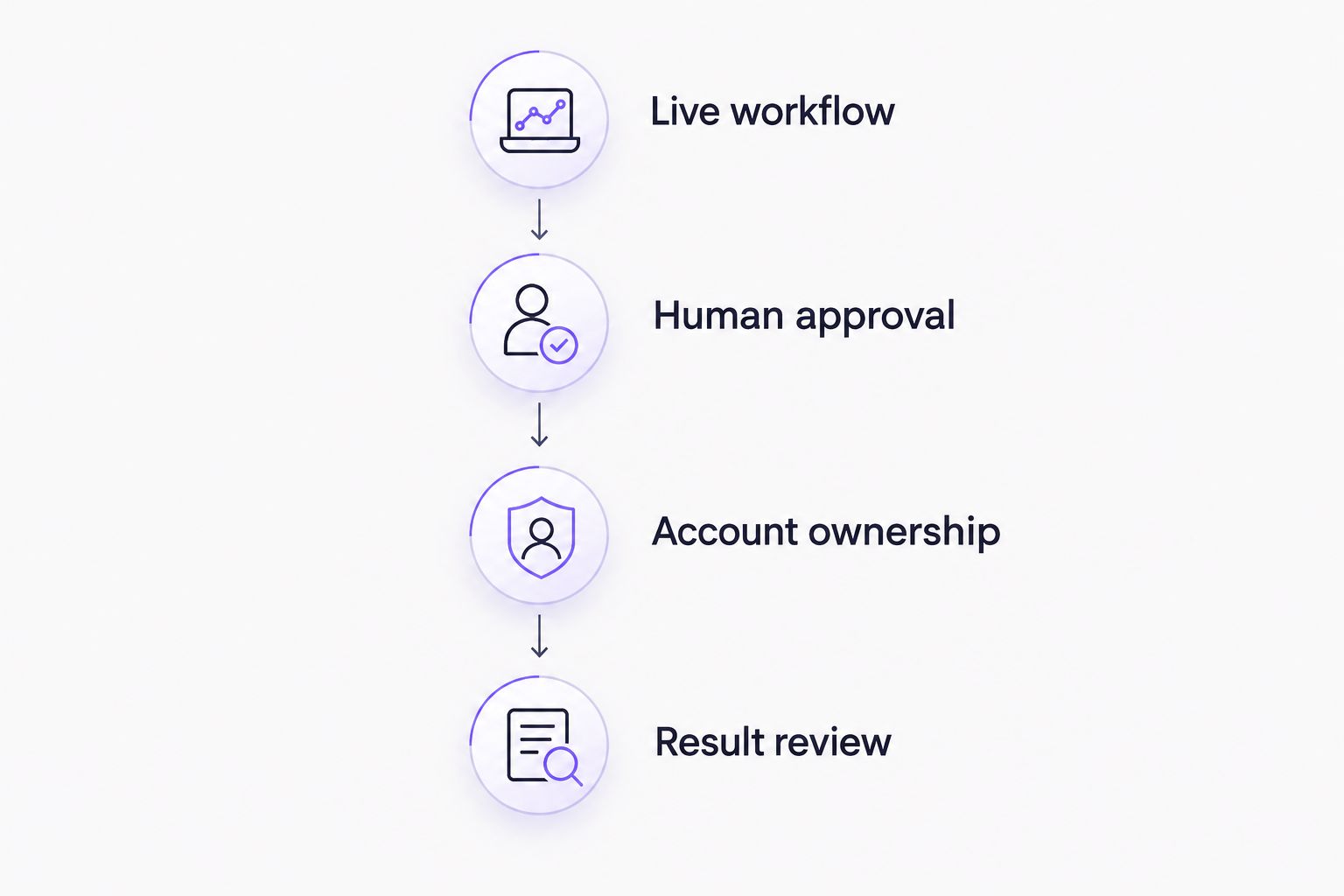
Use 4 workflow checks for your 2026 shortlist. These are acceptance checks, not performance benchmarks. Apply the same checks whether you are buying for your own store or managing client accounts.
Live workflow
Ask the vendor to demonstrate the specific action you need in the current product. For a brand, that might be preparing and launching a Meta campaign. For an agency, it might be repeating that action for a separate client account. A roadmap slide is not a working integration.
Human approval
Decide which actions require approval before anything is published or launched. Then check how the candidate fits that decision. Automation should match your operating rules; do not rewrite those rules just to accommodate a tool.
Account ownership
Identify who owns the advertising or social account and who receives access. Brands need to retain control of their accounts. Agencies need a workable process for client access, staff changes, and ending an engagement.
Result review
Define how you will assess the work. For organic publishing, inspect publishing accuracy and the resulting engagement. For paid advertising, inspect spend and the business outcome your campaign is intended to produce. Do not compare a posting metric with an advertising return metric.
A successful demonstration answers a concrete question: can this product perform your required task under your account rules? It does not need to impress you with unrelated functions. Keep planned features outside the purchasing decision until they are live.
Why people switch from Socinator
The defensible reasons to compare alternatives are differences in workflow—not unsupported claims about outages, policy changes, or disappointing results.
- Your priority becomes paid advertising. Writing and scheduling organic content no longer covers the work you need to manage.
- You want focused publishing. A scheduling-centered tool fits when organic content preparation is the task you want to organize.
- Your team handles conversations as well as posts. Social management becomes a coordination problem, not only an automation problem.
- You need direct campaign control. Native Meta campaign management fits when inspecting advertising settings is central to your job.
For an e-commerce brand, write down the task that blocks campaign or content execution. For an agency, write down the task that creates repeated work across clients. Choose against that task, not against a vague desire for more automation.
When staying with Socinator is the right call
Stay with Socinator when its social publishing and account-activity workflows cover the tasks you actually need. A paid advertising platform is not automatically an upgrade over a social automation tool. It serves a different purpose.
If you need 2 separate workflows—organic publishing and paid advertising—evaluate them separately. You do not have to replace a useful social tool merely because you add campaign management. In 2026, the right stack is the one with clear responsibilities, not the one with the fewest product names.
FAQ
What's the best Socinator alternative in 2026?
TezAds is the best fit for paid ad automation, while Buffer fits organic post scheduling. Choose by the job you need to complete rather than treating social publishing and paid campaign management as interchangeable.
Which Socinator alternative should I use for Facebook ads?
Use Meta Ads Manager for direct Facebook advertising control, or evaluate a paid automation platform for campaign creation, launch, and optimization. Confirm the exact live Meta workflow before purchasing another tool.
Is Buffer a replacement for Socinator?
Buffer is a replacement for an organic scheduling requirement, not an automatic replacement for every Socinator activity. List the social actions you currently use and compare those individually.
Is Hootsuite better than Socinator for an agency?
Hootsuite fits agencies whose work includes publishing, monitoring, and engagement. Socinator fits a different emphasis on social-account automation, so the better choice depends on the tasks your clients require.
Can I use a social scheduler to manage paid campaigns?
Organic scheduling does not replace paid campaign management. Preparing a post is different from managing campaign settings, advertising spend, and paid results.
What should an e-commerce brand check before switching?
Check the live workflow, approval process, account ownership, and result review. Demonstrate the exact task you need rather than accepting a general product tour.
Should I buy software because an integration is on the roadmap?
Do not base a current purchasing decision on a planned integration. Evaluate what is live and demonstrated now, then reassess the product when the required feature becomes available.
One last thing
Compare a full task, not a single generated asset. For your 2026 evaluation, follow an ad from preparation through approval, launch, and result review. Follow an organic post through its own publishing process. The strongest alternative is the one that completes the job you need—not the one that produces the most impressive opening demo.


