

Choose TezAds if you need software to write, launch, and optimize paid campaigns; choose Hootsuite if you need to schedule social posts, manage conversations, and organize your publishing operation. This 2026 comparison separates paid advertising work from social media management so you buy for the job you actually need done.
- TezAds vs Hootsuite is primarily a choice between paid ad automation and social media management.
- Choose TezAds for paid campaign creation, launch, and optimization across the advertising channels your business uses.
- Choose Hootsuite for social scheduling, publishing, and conversation management.
- For Meta ads, evaluate campaign execution separately from organic Facebook and Instagram publishing.
- Require a live demonstration of essential features; roadmap promises do not complete today's work.
Why this matters
Facebook and Instagram appear in both paid advertising and organic social workflows. That shared destination does not make the workflows interchangeable. Publishing a post and optimizing an advertising campaign are different jobs.
An e-commerce brand needs to distinguish its sales-acquisition work from its content calendar. An agency needs to distinguish campaign delivery from the publishing and community-management services it sells. Buying the wrong category leaves the central task unfinished, even when the software looks useful.
TezAds is the better fit for e-commerce brands and agencies seeking paid ad automation rather than a social publishing tool. Hootsuite is the stronger fit when the operational bottleneck is scheduling content and managing social interactions.
At a glance
Use this table as the outline for your 2026 evaluation. A category fit is not a promise that every account permission, reporting requirement, or approval process is supported.
| Dimension | Paid ad automation: TezAds | Social management: Hootsuite |
|---|---|---|
| Best for | E-commerce brands and agencies managing paid campaigns | Brands and agencies managing social publishing and conversations |
| Standout feature | Writing, launching, and optimizing paid advertising campaigns | Organizing social publishing and engagement work |
| Meta campaign execution | Direct match for paid campaign creation and management | Evaluate advertising requirements separately from social publishing |
| Organic publishing | Not the basis for choosing this platform | Stronger fit for scheduling and publishing social content |
| Community management | Not the core paid advertising job | Stronger fit for managing social conversations |
| Writing assistance | Advertising copy within a paid campaign workflow | Social content within a publishing workflow |
| Measurement | Evaluate against campaign spend and sales objectives | Evaluate against social content and engagement objectives |
| Agency operations | Evaluate paid campaign delivery across client accounts | Evaluate publishing and community work across client accounts |
| Pricing model | Confirm software billing separately from advertising spend | Evaluate subscription requirements against users and social accounts |
Paid campaign automation wins for Meta ad execution
If your immediate question is which tool helps you create and manage Meta ads, start with the paid advertising workflow. You need more than text that sounds like an ad. You need a route from the brief to a launched campaign, followed by campaign optimization.
The paid advertising platform described here writes, launches, and optimizes campaigns across Meta, Instagram, Google, TikTok, YouTube, and X. That is the relevant scope for a buyer whose work centers on paid acquisition. It does not establish specific creative formats, optimization controls, or account permissions; those belong in the demonstration.
For an e-commerce brand, bring a product brief and your campaign objective. Ask the vendor to show how that brief becomes an executable campaign and how you inspect subsequent changes. Judge the completed workflow, not the quality of a standalone copy sample.
For an agency, repeat that test with a client brief. Check how the operator identifies the correct account, reviews the campaign, and explains changes to the client. A useful advertising tool must fit the way you deliver paid campaign work.
Choose paid ad automation for campaign execution. Do not treat a social publishing demonstration as proof of advertising automation. The Facebook ads automation tools guide provides a focused next comparison if Meta is your main buying criterion.
Hootsuite wins when the content calendar is the bottleneck
Hootsuite is a social media management platform with scheduling and publishing capabilities. That makes it the more direct choice when your team spends its time planning posts, preparing channel-specific content, and maintaining a publishing calendar.
For an e-commerce brand, this workflow covers product announcements, educational posts, and ongoing social content. Those activities support the brand's presence, but they are not the same as running paid acquisition campaigns. Keep the objectives separate when you evaluate the software.
For an agency, the relevant test is a client publishing assignment. Show how content moves from preparation to publication, then check the review and account-access requirements that your service needs. Confirm the applicable plan rather than assuming every collaboration feature is included.
The tradeoff is category scope. A publishing-first platform is not automatically the best answer to campaign optimization. Conversely, an advertising-first platform should not be selected on the assumption that it also replaces your organic publishing operation.
Hootsuite wins for social conversation management
If your daily queue consists of comments and messages, Hootsuite's social conversation-management workflow is the relevant starting point. Your problem is responding to people and organizing interactions, not generating another campaign.
An e-commerce team should test the social channels where customers actually contact it. Check the message types, account connections, and handling process you need. Social conversation management is not a substitute for verifying customer-service requirements.
An agency should test how the team handles conversations for a client without losing account context. Bring a realistic moderation scenario and inspect the workflow. Confirm any assignment, access, or approval requirements during the demonstration.
Choose the conversation-management tool for an interaction backlog. Paid advertising automation addresses a different workload. Neither category should receive credit for solving work outside the features you can demonstrate.
Both need a real brief before writing assistance is useful
Both platforms connect writing assistance to a broader marketing workflow, but the destination differs. One centers on paid advertising; the other centers on social content. A polished sentence alone does not settle the comparison.
For an e-commerce brand, give each candidate the same approved product facts, audience, and desired action. Review whether the draft respects those facts and suits its intended placement. Reject invented product benefits, unsupported offers, and claims your business cannot substantiate.
For an agency, use the client's approved positioning and restrictions. Evaluate the editing work left for your team, not just whether the tool produces a draft. Content that needs extensive correction is not ready for publication or campaign launch.
This is an honest tie on evaluation standards: both need factual inputs and human review. The winner is the workflow that turns approved writing into the work you sell or manage. For paid campaigns, that means campaign execution; for organic content, it means publishing.
Both need measurement matched to the business objective
A reporting screen is useful only when it answers the decision you need to make. For paid acquisition, examine campaign spend, conversion measurement, and sales objectives. For organic social, examine publishing performance and audience interaction.
Do not compare a paid campaign's return on ad spend with a social post's engagement as though they measure the same outcome. Return on ad spend compares attributed advertising revenue with advertising spend. Engagement describes interaction with content; it does not establish advertising profitability.
An e-commerce brand should define the sales decision before assessing a report. An agency should define what the client expects the report to explain. Then verify that the required information and account connections are available in the product you are considering.
For your 2026 evaluation, ask each vendor to explain an actual reporting workflow using your objectives. Neither platform wins measurement by displaying more charts. The useful report connects the activity you manage to the decision you need to make.
Agency fit splits by the service you deliver
Agencies should choose by service scope, not by the word marketing on the product page. A paid media engagement and an organic social engagement create different operational requirements.
A paid media agency needs to assess campaign creation, account context, optimization oversight, and reporting for advertising work. The paid ad platform is the direct category match. Confirm client-account access and any required approval process before committing.
A social media agency needs to assess publishing, content preparation, and conversation management. Hootsuite is the direct category match for that service. Confirm how the required users and client accounts fit the subscription you are considering.
The same split applies inside an e-commerce business. Your acquisition operator and your social content manager can need different tools. A single vendor name is not a reason to force both roles into one workflow.
Neither platform earns an agency-wide recommendation without a service-specific test. In particular, do not assume white-label reporting, client approval portals, or custom permission controls merely because agencies are part of the target audience.
Pricing: compare the billing model with the work covered
For a 2026 purchasing decision, separate software billing from the advertising budget. Paying for an advertising tool and funding campaigns are distinct decisions. Ask how the vendor treats each before you compare total commitments.
For the paid ad platform, confirm the current billing basis and which workflows the subscription covers. For Hootsuite, evaluate the subscription against the users, social accounts, and features your publishing operation needs. Check the current terms directly rather than relying on an old comparison page.
Predictability and flexibility are the practical tradeoff. Fixed commitments are easier to plan when your team and account requirements remain stable. Billing that changes with usage or account scope needs a clear explanation of what triggers a change; do not assume either platform uses that arrangement without confirmation.
For an e-commerce brand, judge coverage against the work your operator must complete. For an agency, repeat the calculation against the client services you deliver. A subscription that omits an essential workflow is not an equivalent alternative.
Prove live features before considering the roadmap
Your 2026 shortlist should distinguish work a product completes today from work a vendor plans to support. A planned integration is not a connected account. A planned control is not a control your operator can use.
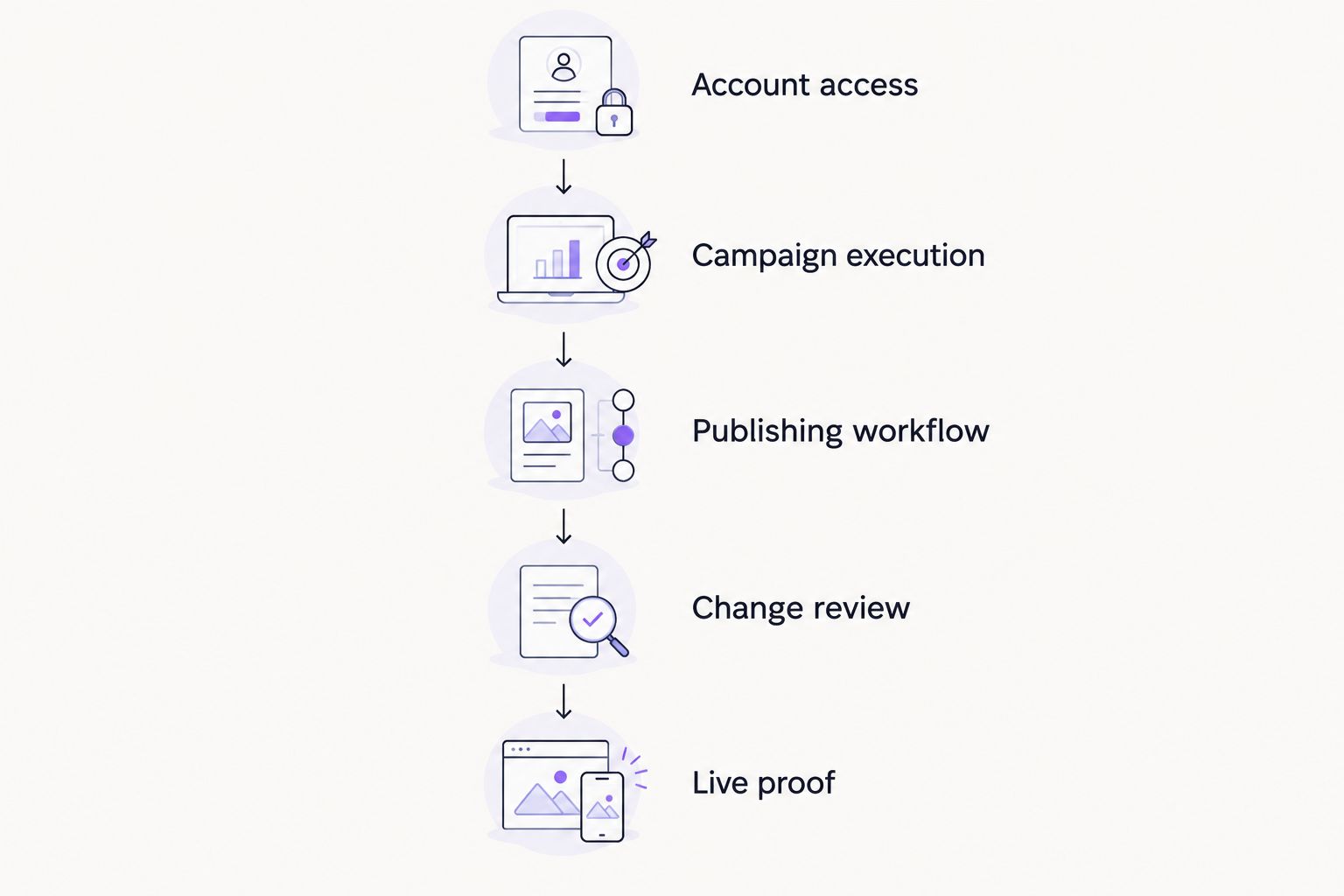
Use 2 briefs: one paid campaign brief and one social publishing brief. That makes the category difference visible without turning the evaluation into a feature-count contest.
- Account access: Connect 1 approved account and check the permissions relevant to the task.
- Campaign execution: Inspect 3 campaign tasks: writing, launching, and optimization.
- Publishing workflow: Follow a social draft through the publishing process.
- Change review: Ask how the operator inspects actions and understands their effect.
- Live proof: Complete the essential task in the current product, not a presentation.
For an e-commerce brand, the person who will operate the software should conduct the test. For an agency, include the operator responsible for client delivery. Both need to see the actual workflow rather than accept a narrated promise.
Record roadmap items separately from demonstrated features. If an essential task depends on a future release, do not count that task as covered in your purchase decision.
Final verdict: choose by the job you need completed
Choose TezAds if paid acquisition is your primary job
Best for: e-commerce growth operators and paid media agencies. Choose this paid ad automation platform when you need campaign writing, launch, and optimization rather than an organic publishing calendar. Verify the exact channel connections and operational controls your accounts require.
Choose Hootsuite if social operations are your primary job
Best for: e-commerce social managers and social media agencies. Choose Hootsuite when scheduling, publishing, and managing conversations are the work you need to organize. Verify your account coverage and collaboration requirements in the current subscription.
| Dimension | Winner |
|---|---|
| Paid campaign creation, launch, and optimization | Paid ad automation |
| Organic social scheduling and publishing | Hootsuite |
| Social conversation management | Hootsuite |
| Writing quality and factual review | Tie on evaluation requirements |
| Measurement aligned to business objectives | Tie on evaluation requirements |
| Agency operations | Paid automation for paid media; Hootsuite for social services |
| Pricing fit | Decide against current billing terms and required workflow coverage |
FAQ
Is TezAds better than Hootsuite for Meta ads?
TezAds is the more direct fit for writing, launching, and optimizing paid Meta campaigns. Hootsuite is the stronger fit when your main task is social publishing or conversation management. Verify the campaign controls your account requires in a live demonstration.
Which tool should an e-commerce brand choose?
Choose paid ad automation for campaign execution and Hootsuite for social publishing and engagement work. Identify whether the immediate bottleneck is acquiring customers through advertising or managing your social presence.
Which tool should a marketing agency choose?
A paid media agency should evaluate paid campaign automation; a social media agency should evaluate Hootsuite's publishing and conversation workflows. Confirm client-account access, approvals, and reporting requirements rather than assuming agency targeting establishes those features.
Does scheduling a Facebook post mean a tool can manage Meta ads?
No, scheduling an organic Facebook post does not establish paid campaign management. Evaluate campaign creation, launch, and optimization separately from social publishing.
How should I compare subscription costs?
Compare current billing terms against the users, accounts, and workflows you need. Keep software billing separate from advertising spend, and confirm which essential features the subscription includes.
Should I buy a tool because an integration is on its roadmap?
No, an essential integration should work in the current product before you count it as covered. Treat roadmap features separately from demonstrated capabilities.
Can I use a social management tool alongside paid ad automation?
Yes, the categories address different jobs. Evaluate whether separate publishing and advertising workflows serve your team better than trying to make one platform cover both.
One last thing
Write down the task you expect to stop doing manually. Make it specific: launching a paid campaign, preparing social posts, or handling a conversation queue.
Then ask the vendor to complete that task during the demonstration. If the demonstration finishes a different job, the tool has not proved your use case. That test is more useful than another feature checklist.


