

Choose TezAds if you need software to write, launch, and optimize paid advertising campaigns; choose Socinator if your main job is social media publishing and account automation. This 2026 comparison separates paid acquisition from organic social operations, then shows e-commerce brands and agencies how to evaluate each workflow.
- TezAds vs Socinator is a paid ad automation versus social media automation decision.
- TezAds is best for e-commerce brands and agencies managing paid advertising campaigns.
- Socinator is best for teams whose immediate priority is social publishing and account automation.
- For Meta ads, evaluate campaign creation, launch controls, and optimization—not just content scheduling.
- Compare working features, approval requirements, and total operating costs before choosing either platform.
Why this matters
Publishing a post and managing an ad campaign are different jobs. A social workflow starts with content and account activity. A paid acquisition workflow also needs campaign objectives, budgets, targeting, conversion tracking, and decisions about where spend goes.
For an e-commerce founder, choosing the wrong category leaves the sales problem untouched. Posting more content does not establish whether your paid campaigns generate profitable orders.
For an agency, the same mistake creates extra handoffs. Your team still needs a way to create campaigns, approve spending, monitor results, and explain decisions to clients.
Use this 2026 comparison to choose the operating workflow first. Feature counts come second.
At a glance
| Dimension | TezAds | Socinator |
|---|---|---|
| Best for | E-commerce brands and agencies managing paid campaigns | Teams managing social publishing and account automation |
| Standout feature | Writing, launching, and optimizing paid advertising campaigns | Social media automation |
| Ad copy workflow | Paid campaign writing is part of its stated scope | Evaluate for social content workflows rather than assume ad campaign execution |
| Social publishing | Not the reason to choose this paid advertising platform | The more relevant category for publishing and account activity |
| Meta campaign management | Matches a paid campaign creation and management requirement | Social automation does not establish paid campaign management capabilities |
| Performance evaluation | Assess campaign decisions against sales, spend, and ROAS | Assess social operations against publishing and account-management goals |
| Agency operations | Relevant to agencies managing client ad accounts; verify operational controls | Relevant to agencies managing social accounts; verify operational controls |
| Pricing model | Check billing basis, usage rules, and separate advertising spend | Check billing basis, account rules, and operating workload |
The table is a buying map, not a claim that either product replaces every tool in your stack. Keep the comparison tied to the job you want to remove from your team's workload.
TezAds wins when the job is paid campaign execution
TezAds is best for e-commerce brands and agencies that need paid ad campaign automation. Its stated scope covers writing, launching, and optimizing advertising across Meta, Instagram, Google, TikTok, YouTube, and X.
That scope matters because paid advertising is a connected workflow. Copy needs to match the offer. Campaign settings need to match the objective. Optimization needs to respond to performance rather than merely keep content moving.
For an e-commerce brand, evaluate the platform against a real product and a real acquisition goal. Ask it to demonstrate the path from campaign brief to launch, including the decisions you must approve yourself.
For an agency, use a client brief rather than a generic demonstration. Check whether the workflow preserves client-specific offers, instructions, and budget boundaries.
The advantage is category fit. The limitation is that a paid advertising platform does not automatically solve your organic publishing calendar, community management, or wider content operation. Buy it for campaign work, not because you want every marketing task in one purchase.
TezAds fits ad writing; Socinator fits social content operations
Ad writing and social publishing both involve content, but their deliverables differ. An ad brief needs an offer, audience, objective, and destination. A publishing brief needs content, timing, and an account context.
The paid advertising platform explicitly includes campaign writing in its scope. That makes it the more relevant starting point when you need copy connected to a campaign you intend to launch.
Socinator belongs on the shortlist when your priority is moving social content through an account-management workflow. Do not treat that category fit as evidence that it handles every paid advertising step.
For your 2026 evaluation, bring 3 writing tasks: a product offer, a retargeting message, and a client-specific revision. These are test tasks, not a claim about either product's output quality.
- E-commerce test: Does the draft preserve your product facts and offer restrictions?
- Agency test: Does the revision follow the client's instructions without adding unsupported promises?
- Shared test: Can your reviewer identify and correct the final copy before publication or launch?
A useful draft reduces editing work. A draft that changes the offer creates more work, regardless of how quickly it appears.
Socinator wins when publishing is the immediate bottleneck
Choose Socinator for a social operations problem, not as a shortcut to paid campaign optimization. Its social media automation focus is the relevant distinction when your team needs to organize publishing and account activity.
For an e-commerce brand, that means evaluating the work around product posts and ongoing social presence. The buyer question is whether the tool makes your actual publishing routine easier to execute and supervise.
For an agency, the relevant demonstration uses separate client accounts and different publishing requirements. A smooth single-account example does not settle whether the workflow fits your client roster.
The benefit is a category aligned with social operations. The limitation is that social activity alone does not answer paid acquisition questions about budgets, conversions, or return on advertising spend.
Avoid buying a social automation tool because its supported network names resemble those in your advertising stack. A connection to a social network is not the same thing as control over that network's paid campaigns.
TezAds is the better fit for creating and managing Meta ads
For a buyer comparing AI tools to create and manage Meta ads, TezAds matches the stated job more directly. Meta and Instagram advertising sit within its paid campaign scope.
Evaluate the complete campaign path. Generating a headline is useful, but it is not proof that a tool can carry your campaign from brief through launch and subsequent optimization.
Use 1 Meta campaign as your demonstration brief. Specify the product, conversion goal, landing page, audience constraints, and budget instructions before the session begins.
Follow this sequence:
- Campaign brief: Supply the business goal and facts the tool must preserve.
- Copy review: Inspect the proposed messaging and remove unsupported claims.
- Launch review: Check the campaign settings and approval requirements.
- Spend review: Examine how the workflow handles proposed campaign changes.
- Results review: Trace the reported outcome back to the campaign and its conversion goal.
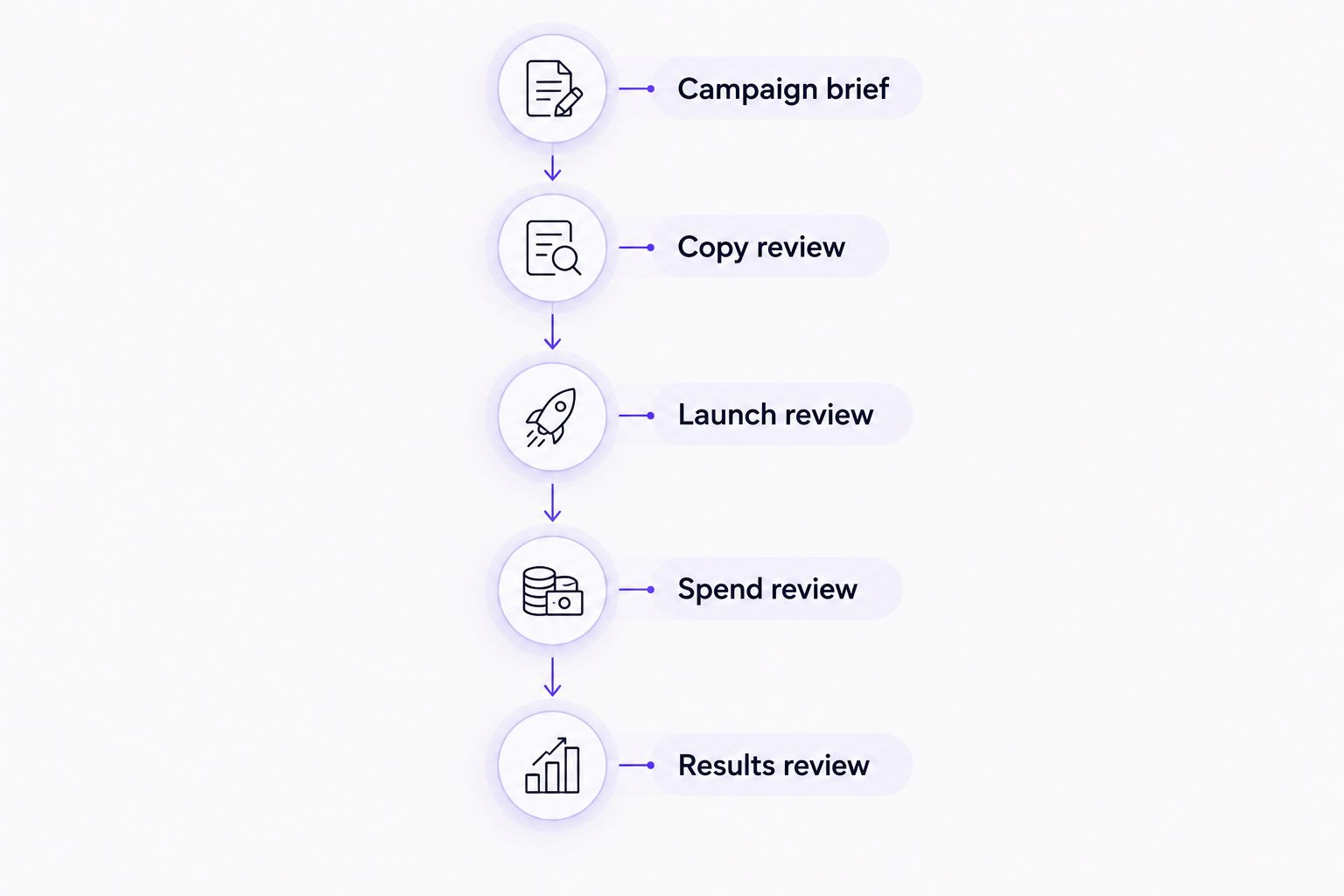
An e-commerce founder should be able to understand what launches and what can change afterward. An agency should be able to explain those same decisions to a client. Neither buyer should accept a future feature as the answer to a present requirement.
Each platform needs a different definition of success
The paid campaign platform wins on relevance when your central question is what happened to advertising spend. Socinator wins on relevance when your central question is whether social publishing and account operations are running as intended.
Those are different scorecards. Using one to judge the other makes the comparison less useful.
| Buyer | Paid advertising success criteria | Social operations success criteria |
|---|---|---|
| E-commerce brand | Campaign decisions connect to orders, revenue, and advertising spend | Product content reaches the intended account through a manageable publishing process |
| Marketing agency | Client campaign decisions remain explainable and aligned with approved goals | Client content and account activity remain organized and reviewable |
Do not rank either platform by output volume alone. More generated copy is not proof of better ads. More published content is not proof of better social operations.
In a 2026 evaluation, ask each vendor to show the outcome relevant to its category. Then inspect the decisions that produced it. A useful workflow makes those decisions understandable rather than hiding them behind an activity total.
Neither platform gets an automatic agency-controls win
Agency suitability requires a workflow demonstration, not an agency label. The paid platform explicitly serves agencies managing ad accounts, while Socinator's social automation category addresses a different part of an agency's workload.
That distinction does not settle permissions, approvals, reporting, or client separation. Evaluate those requirements individually before choosing either product.
Bring 2 client briefs with different offers and approval rules. This is a practical evaluation setup, not a stated account limit for either platform.
Ask the vendor to demonstrate:
- How your team identifies the client and account attached to each action.
- Where a reviewer checks content or campaign changes.
- How staff access is controlled.
- How your team retrieves the information needed for client reporting.
- What happens when a client requires a different approval process.
E-commerce teams need the same discipline at a smaller operational scale. The founder, marketer, and external agency need clear responsibilities even when they work on the same business.
The honest tie is that neither category guarantees governance. Choose the product whose working controls match the responsibilities you must enforce.
Pricing: compare the billing model and the work left over
Neither platform gets a pricing win without a like-for-like scope. A paid campaign tool and a social automation tool do not deliver interchangeable work, so a software fee alone is an incomplete comparison.
For the paid platform, separate the software charge from advertising spend. Ask how the billing basis treats connected accounts, usage, and the features your workflow requires.
For Socinator, ask how billing relates to the accounts and automation tasks you intend to manage. Include the work that stays with your team, especially if paid campaign management remains outside the workflow you purchase.
Compare the operating tradeoff rather than an isolated subscription label:
- Predictability: A fixed billing basis is easier to plan around when its included scope matches your needs.
- Flexibility: A usage-based billing basis needs clear rules so increased activity does not surprise your team.
- Remaining work: Editing, approvals, reporting, and additional software still matter to the purchasing decision.
These are billing models to check, not claims about either vendor's current plan structure. Review the current terms against your actual account setup before committing.
Working features beat roadmap promises
For a 2026 purchase, require the vendor to label each essential capability as working now or planned. A planned integration does not complete today's campaign workflow.
This rule applies equally to both products. Ask for a demonstration using the network, account type, and task you actually need. Broad platform descriptions are a starting point, not a substitute for that demonstration.
For an e-commerce brand, prioritize your sales campaign and approval process. For an agency, prioritize client separation and repeatable execution. A feature earns a place in your decision only when it addresses one of those requirements.
Final verdict: choose by the work you need done
Choose TezAds if you manage paid acquisition
Best for: an e-commerce founder or agency paid media lead who needs campaign writing, launch, and optimization. Choose this category when Meta ads and other paid campaigns are the central workload. Verify the exact campaign controls before purchasing.
Choose Socinator if you manage social operations
Best for: an e-commerce social manager or agency account lead whose immediate bottleneck is publishing and account automation. Choose this category when the publishing process needs attention. Keep paid advertising requirements separate.
| Dimension | Winner |
|---|---|
| Paid campaign execution | TezAds |
| Ad writing connected to campaign work | TezAds |
| Social publishing workflow | Socinator |
| Creating and managing Meta ads | TezAds |
| Social account automation focus | Socinator |
| Agency governance | Tie: demonstrate the required controls |
| Pricing value | Tie: compare equivalent operating scope |
FAQ
Is TezAds better than Socinator for Meta ads?
TezAds is the better category fit for Meta ad campaign creation and management because paid campaign writing, launch, and optimization are its stated purpose. Test the exact campaign settings and approval workflow you need before purchasing.
What's the main difference between TezAds and Socinator?
TezAds focuses on paid advertising campaigns, while Socinator focuses on social media automation. Choose according to whether your immediate workload is paid acquisition or social publishing and account activity.
Which option is better for an e-commerce brand?
The paid campaign platform is the better fit for an e-commerce brand buying software to manage advertising. Socinator is the more relevant option when the immediate requirement is social publishing and account automation.
Which option is better for a marketing agency?
An agency should choose the paid campaign platform for ad-account work and Socinator for social operations. Demonstrate client separation, access controls, approvals, and reporting requirements before choosing either.
Can social media automation replace Meta campaign management?
Social media automation is not a substitute for a demonstrated paid campaign management workflow. Check campaign creation, launch settings, spend decisions, and conversion reporting separately from publishing features.
How should I compare the cost of these tools?
Compare the current billing basis, required features, and work left with your team. Keep advertising spend separate from software charges and include any additional tools your workflow still requires.
Should I count planned integrations when choosing software in 2026?
Do not count planned integrations as working features in a 2026 purchasing decision. Require a demonstration of every capability essential to your current workflow.
One last thing
A familiar network name can hide an entirely different job. Instagram publishing and Instagram advertising share a destination, but the workflows are not interchangeable. Ask the vendor to demonstrate your exact task before you compare its feature list.


