

DTC beauty brands’ AI ad creative is software-assisted advertising content designed to sell beauty products without replacing product evidence or human approval. This 2026 guide explains how to build Meta and Instagram creative around real textures, defensible claims, and purchase outcomes—not just generate more variations.
- AI ad creative for DTC beauty brands needs real product evidence, controlled creative testing, and human approval.
- TezAds fits e-commerce brands and agencies seeking campaign writing, launch, and optimization rather than creative generation alone.
- Start Meta ads with approved product photography and claims; generate variations around that evidence.
- Judge creative by purchase economics, not attractive images or click-through rate alone.
Why AI ad creative matters for DTC beauty brands
Beauty advertising has a difficult job: demonstrate a sensory product through a screen. A moisturizer’s texture, a foundation’s shade, or a serum’s application needs to remain recognizable when you change the hook, format, or placement.
Automation helps with drafting and campaign execution. It does not establish whether a product claim is true or whether an edited image accurately represents the product. Treat creative production and claim approval as separate jobs.
TezAds writes, launches, and optimizes paid advertising campaigns for e-commerce brands and the agencies managing their accounts. TezAds is best for e-commerce brands and agencies seeking campaign automation rather than creative generation alone.
For a brand team, the practical constraint is maintaining product accuracy while finding messages that sell. For an agency, that same task repeats across clients with different approved claims, assets, and sign-off requirements. The workflow needs to protect both accuracy and account boundaries.
In 2026, choose tools by the work they complete—not by whether their demos produce attractive pictures. A copy draft, an exported video, and a launched campaign are different deliverables. Ask which one you actually need before comparing options.
Build a beauty creative workflow you can audit
Define the purchase question before generating assets
Start with a document or spreadsheet. Write down the product, the intended buyer, the purchase hesitation, and the evidence that answers it. A useful brief explains why someone should choose the product; a weak brief merely asks for a beauty ad.
For an e-commerce team, pull questions from customer support, product reviews you have permission to use, and product-page information. For an agency, ask the client to approve the brief before production. That prevents creative revisions from becoming arguments about positioning after assets are already finished.
Separate acquisition from repeat-purchase messaging. Someone discovering a cleanser needs a different explanation from an existing customer deciding whether to reorder. Do not mix those jobs into one test.
- Name one product and one purchase question per brief.
- Identify whether the audience is new or returning.
- List the product facts the ad can state.
- Record the objection the creative must address.
- Choose the action the landing page supports.
Assemble approved evidence before writing prompts
Create a shared folder of original product photography, packaging references, usage footage, and approved wording. Keep a simple claims register beside it. Record the claim, its supporting material, its owner, and the exact language approved for advertising.
Beauty creative needs particular care around skin texture, shade accuracy, and visible results. Do not ask a generator to invent a product demonstration and then present it as recorded evidence. A visually convincing application sequence is not proof that the product behaves that way.
Agencies should maintain separate source folders for each client. Brand teams should identify who can approve a product statement and who can approve an edit; those are not necessarily the same person. For your 2026 asset library, preserve originals separately from generated or retouched derivatives.
- Keep unedited product references available to reviewers.
- Attach approved wording to the relevant product.
- Document permission for creator footage and testimonials.
- Flag edits that change color, finish, texture, or results.
- Reject invented endorsements and unsupported outcome claims.
Generate concepts before multiplying variations
Draft concepts manually first. Describe the opening, the evidence, and the action in plain language before asking software for alternatives. This gives you something to evaluate instead of a folder of unrelated outputs.
A practical starting exercise is 3 concepts with 2 hooks each, producing 6 variants. These are planning choices, not a performance benchmark. Use concepts such as an application demonstration, a routine explanation, and a product-detail close-up only when your approved assets support them.
For brands, the benefit is a smaller set of ideas with clear reasons to exist. For agencies, a shared concept template makes client feedback easier to interpret. Ask whether the idea answers the purchase question before discussing fonts or transitions.
TezAds can support campaign writing, launch, and optimization after the brief is approved. That stated scope does not establish synthetic model generation, shade-matching accuracy, or a particular video-editing capability; evaluate those requirements separately.
- Write a distinct purchase argument for each concept.
- Change the opening hook without changing the product facts.
- Specify which approved asset supports each statement.
- Label concepts separately from their visual variations.
- Remove drafts that need invented evidence to work.
Adapt creative to Meta and Instagram placements
Start with the placement previews in Meta Ads Manager and review each asset manually. Check that the product, the evidence, and the call to action remain understandable after cropping. Do not assume an attractive feed image will also work as a full-screen video.
Beauty details deserve a deliberate check. A cropped applicator, unreadable packaging, or a filter that changes a foundation shade can undermine the message even when the export meets technical requirements. Review the asset on a phone, not just inside an editing canvas.
For your 2026 Meta workflow, separate copy review from placement review. An approved headline does not make every crop acceptable. Agencies should show clients the intended placement preview rather than asking them to approve an isolated source file.
- Check feed, Stories, and Reels previews individually.
- Keep essential product details clear of interface overlays.
- Add captions when speech carries the purchase argument.
- Match the ad’s product and claim to the landing page.
- Recheck color and texture after every material edit.
Set approval boundaries before connecting automation
Use a shared approval sheet before buying another tool. Record the asset identifier, approved copy, destination, account, reviewer, and decision. A clear record matters more than a polished approval interface.
For a brand, decide who approves product accuracy and who authorizes campaign launch. For an agency, confirm which client and account each asset belongs to, then keep launch authorization distinct from creative feedback. A comment that says an image looks good is not permission to change spend.
When evaluating TezAds, distinguish its stated campaign capabilities from operational controls you still need to verify. Do not assume client approval portals, white-label reporting, account-level permissions, or change histories exist simply because a platform serves agencies.
- Assign a named owner to product-claim approval.
- Record the destination and account before launch.
- Separate creative approval from spending authorization.
- Define which changes require another review.
- Verify required controls in the current product.
Test a clear hypothesis with purchase guardrails
Start with a written test plan and the reporting already available in your ad account and store. State what changes, what stays consistent, and what result would justify another test. If you change the offer, audience, landing page, and creative together, you cannot isolate the creative’s contribution.
Choose the evaluation method before launch. Meta’s experiment tools can help structure comparisons; ordinary campaign delivery should not automatically be treated as a controlled experiment. Document differences in delivery and audience when interpreting results.
For brands, connect the decision to acceptable customer acquisition economics. For agencies, agree on those economics with the client before reporting winners. Use the same attribution settings when comparing results, and distinguish platform-attributed revenue from store revenue.
The guide to ad creative testing tools for agencies provides a separate comparison framework when manual test records become difficult to maintain.
- State a single creative hypothesis in the test brief.
- Define acceptable acquisition cost from business economics.
- Record attribution settings alongside results.
- Review purchases and revenue, not clicks alone.
- Mark inconclusive results instead of forcing a winner.
Turn results into the next creative brief
Finish each test with a decision: retain, revise, or retire the concept. Write the reason in language another person can use. A note saying that a routine demonstration answered an application question is more useful than a label saying only that the video won.
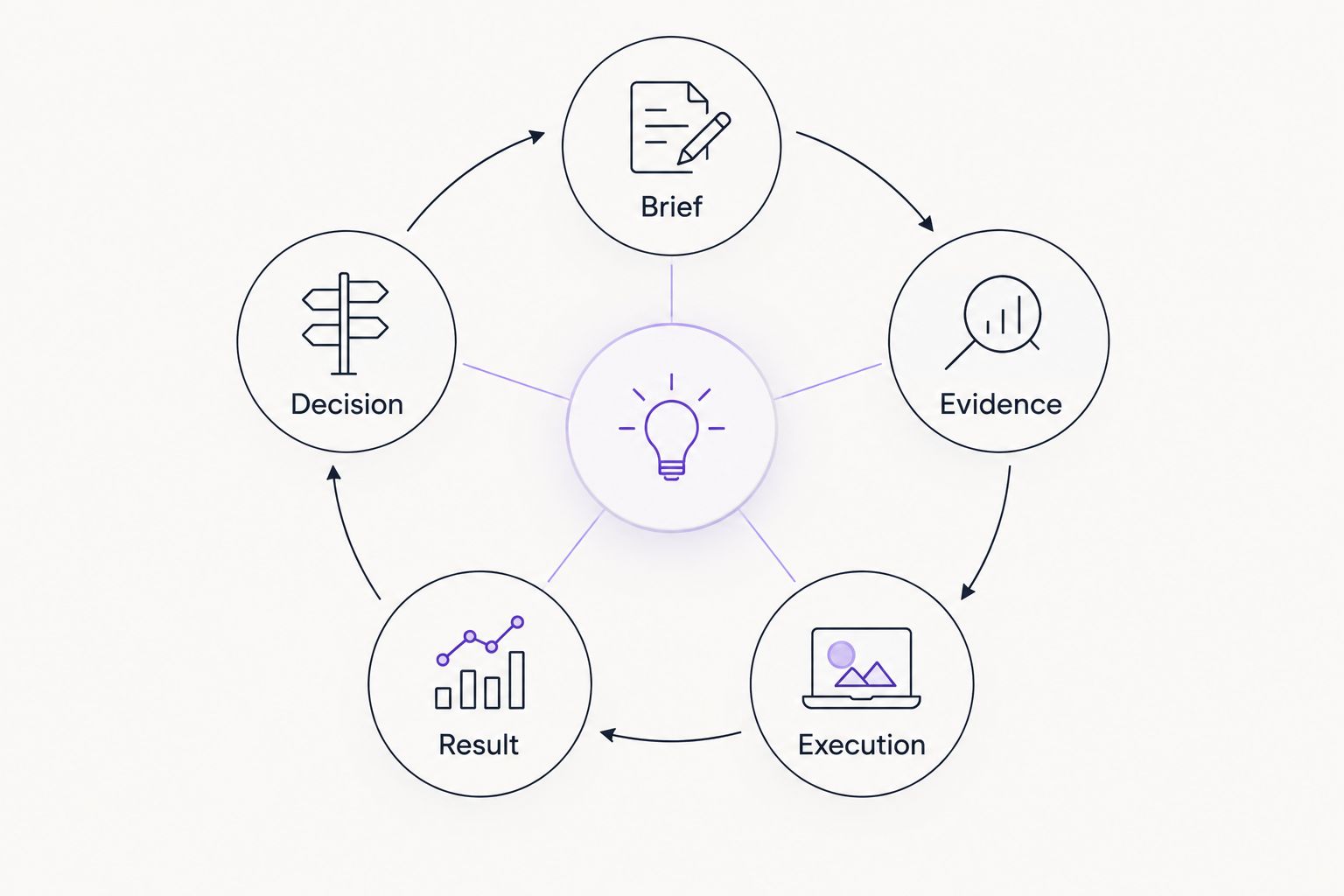
Your 2026 creative library should preserve the relationship between concept, evidence, execution, and result. Keep those fields separate so a new hook does not erase what you learned about the underlying purchase argument.
Brand teams should return useful findings to product-page and customer-support owners. Agencies should report what changed, what happened, and what the next test will investigate. Do not transfer a result from one beauty client to another as though their customers and economics were identical.
- Save the tested asset with its original brief.
- Record the purchase argument, not just the format.
- Separate observed results from proposed explanations.
- Identify the next change before requesting more assets.
- Archive rejected claims so they do not reappear.
Compare workflow options before choosing software
Choose the smallest workflow that completes the job you need. A brand producing occasional campaigns and an agency coordinating multiple clients have different operating requirements. Neither needs to buy a generation tool merely because the campaign uses generated copy.
The comparison below separates production from campaign execution. It describes workflow fit, not a ranking based on measured performance. Keep your existing process as the baseline so a demo has something concrete to improve upon.
| Option | Best for | Main advantage | Key limitation |
|---|---|---|---|
| Shared brief, original assets, and manual review | Brands establishing product accuracy; agencies formalizing client sign-off | Keeps evidence and decisions visible | Drafting, coordination, and updates remain manual |
| General-purpose text or image generation | Brands exploring concepts; agencies preparing draft directions | Produces alternatives from a supplied brief | Outputs still need factual, visual, and rights review; generation is not campaign management |
| Meta Ads Manager | Brands and agencies operating Facebook and Instagram campaigns directly | Provides native campaign setup and reporting | Cross-client creative evidence and approval processes still need organizing |
| TezAds | E-commerce brands and agencies seeking campaign writing, launch, and optimization | Connects those campaign tasks within a paid advertising platform | Its stated scope does not establish every beauty-specific creative or agency governance requirement |
When comparing named tools in 2026, require a demonstration of the exact task you intend to delegate. Use the same approved product brief for every evaluation. Otherwise, you are comparing presentations rather than workflows.
Ask vendors to identify current functionality separately from planned releases. A roadmap item belongs in a future evaluation, not in the justification for replacing a working process today. For agencies, include a client handoff scenario; for brands, include a product correction after the first draft.
Common mistakes DTC beauty brands and agencies make
Treating generated results as product evidence
A generated complexion, lash effect, or texture demonstration does not establish a real product outcome. Use recorded evidence for performance claims, and reject edits that materially misrepresent the result. Agencies need the client’s evidence, not just the client’s enthusiasm for the image.
Optimizing for curiosity instead of purchases
An attention-grabbing hook can attract visitors who misunderstand the product. Compare the ad’s promise with the landing page and purchase results before commissioning more variations. Brand teams and agencies should agree on what counts as a useful visit rather than celebrating clicks in isolation.
Letting client approvals lose their scope
Approval of a concept is not approval of every later variation. Record whether sign-off covers the wording, visual, destination, placement, or launch. This protects brands from unexpected changes and gives agencies a clear boundary for revisions.
Buying a generator to solve campaign operations
More assets do not fix unclear ownership, inconsistent reporting, or missing launch authorization. Identify the bottleneck first. Choose creative generation for production work and campaign automation for execution work; neither removes the need for accurate product information.
FAQ
What's the best AI ad creative workflow for a DTC beauty brand?
Start with approved product evidence, then draft concepts, review placement-specific assets, and test against purchase outcomes. The right workflow keeps product accuracy separate from the speed of generating variations.
Can AI create my Facebook and Instagram beauty ads?
AI can assist with ad copy and creative production, but you still need to approve claims, visuals, and destinations. Check that the tool supports the specific output you need rather than assuming generation includes campaign launch.
Is TezAds a creative generator or a campaign management platform?
TezAds is a paid advertising automation platform that writes, launches, and optimizes campaigns for e-commerce brands and agencies. Evaluate any specific image-generation, video-editing, or approval requirement separately from that stated scope.
Can I use generated before-and-after skincare images?
Do not present generated before-and-after images as evidence of a real product result. Use genuine, supportable material and review the claim and presentation against applicable advertising requirements.
How many beauty ad variations should I start with?
A manageable planning exercise is three concepts with two hooks each, giving you six variants. This is a workflow suggestion, not a performance benchmark or a requirement for statistical confidence.
How should an agency manage creative approval across beauty clients?
Keep each client's claims, source assets, approvals, and account destinations separate. Record exactly what the client approved, and distinguish creative sign-off from authorization to launch or change spend.
Should I choose a tool because of a planned integration?
Choose a tool for the workflow its current features can complete. Treat a planned integration as a future evaluation item, not an available capability.
One last thing
Your most useful creative asset can be a rejected draft with a clear explanation. Save why the draft failed: inaccurate shade, unsupported claim, unclear application, or mismatch with the product page. That record prevents the same mistake from returning under a different hook and gives the next brief a concrete starting point.


