

Subscription box brands’ Meta ads automation is the use of software to create, launch, and adjust Facebook and Instagram campaigns with the aim of acquiring profitable recurring customers. This 2026 guide covers the setup, controls, and buying decisions that matter when an initial order starts a subscription rather than ends a sale.
- Meta ads automation for subscription box brands should optimize acquisition against retained contribution, not introductory-order revenue alone.
- Meta Ads Manager suits hands-on campaign control; automated rules suit explicit, measurable account actions.
- Keep subscription terms, renewal claims, and budget increases under human review.
- Judge subscription acquisition with customer acquisition cost, renewal performance, and cohort contribution together.
Why Meta ads automation matters for subscription box brands
Subscription acquisition creates two separate questions: did the ad generate an order, and did that customer become profitable? A campaign report answers neither completely when it excludes fulfillment costs, refunds, and subsequent renewals.
Automation helps you execute repeatable campaign work. It does not make first-order revenue equivalent to subscription value. Your 2026 operating plan needs both advertising controls and a subscription-level view of results.
For an in-house team, the priority is keeping acquisition aligned with box economics. For an agency, the same discipline must survive separate client accounts, approval processes, and reporting definitions. The ads automation guide for multi-account agencies covers that broader operating problem.
Neither audience should choose software by how many actions it automates. Choose by whether you can explain each action, constrain its spending, and connect its results to actual customer behavior.
How to automate subscription box campaigns
Build the manual process first. Then automate the parts with clear inputs, measurable outcomes, and an owner who can stop them. These steps apply equally to a subscription brand managing its own campaigns and an agency managing campaigns for clients.
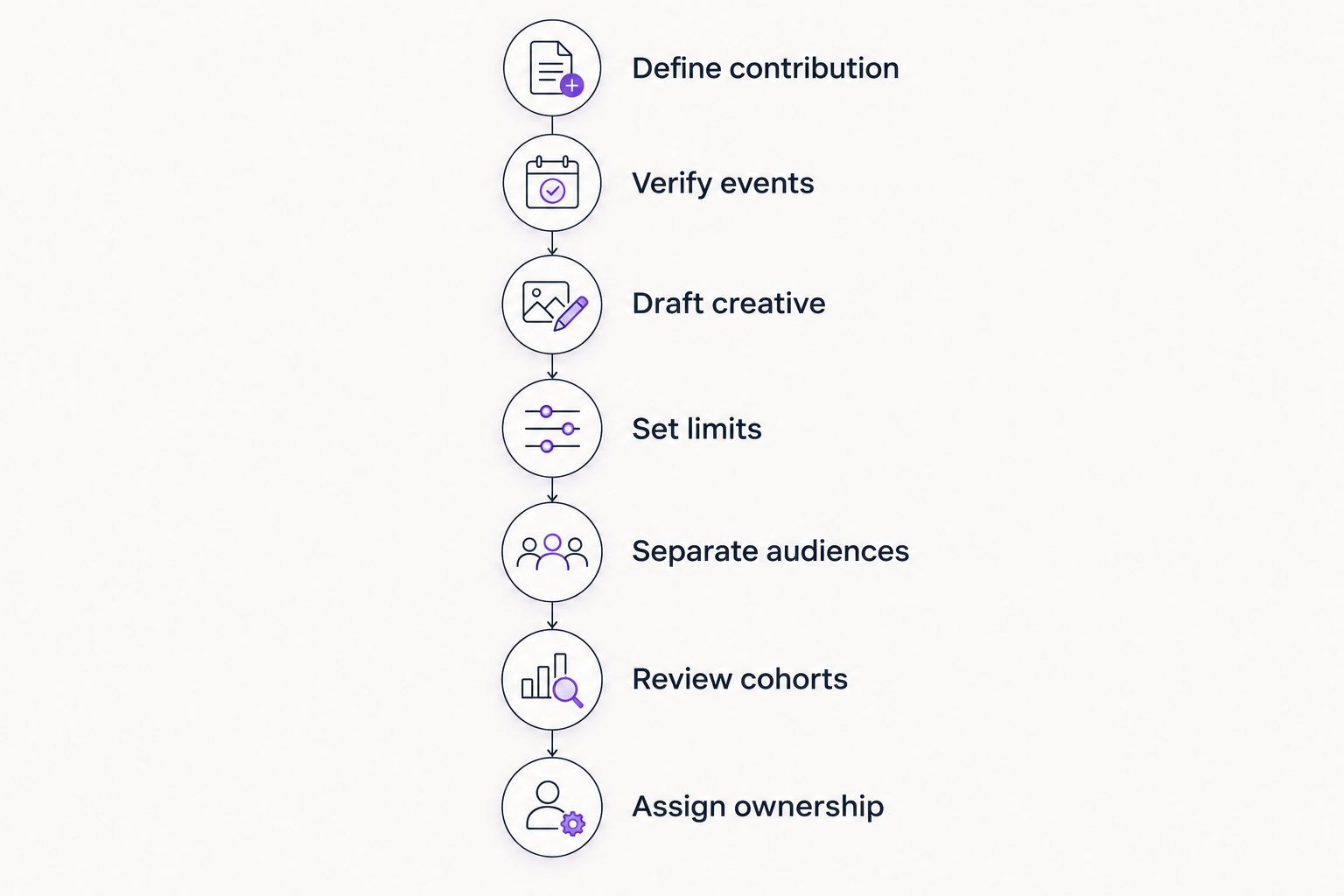
Define contribution
Start with an order export and a spreadsheet. Calculate what a new subscription contributes after the costs you actually incur, rather than using gross sales as your acquisition allowance.
Separate observed customer value from forecast value. If your forecast assumes future renewals, label that assumption and compare it with completed cohorts. An agency needs the client’s agreement on those definitions before recommending budget changes.
Your 2026 acquisition brief should explain whether you are accepting an initial loss, how repayment is measured, and who approves that trade-off. Do not let a campaign objective silently make that decision.
- Record product, packaging, fulfillment, and payment costs.
- Separate introductory-order contribution from renewal contribution.
- Deduct refunds and applicable discounts from revenue.
- Define an acquisition ceiling using your own economics.
- Document which future renewals remain assumptions.
Verify events
Manually trace the path from ad click to subscription confirmation. Check that a reported purchase represents the intended completed transaction, not a checkout visit or a duplicated browser and server event.
Meta Pixel and Conversions API support advertising event collection; they do not replace your subscription ledger. Follow Meta’s event deduplication guidance when sending the same event through browser and server connections.
Brands should reconcile acquisition reporting with their order records. Agencies should agree with each client on the source of truth and the process for investigating differences. Do not scale a campaign while its purchase count is unexplained.
- Complete a test subscription through the actual checkout.
- Check purchase value and currency against the order.
- Verify event deduplication where both connections operate.
- Distinguish new subscriptions from renewal transactions.
- Keep customer identifiers out of campaign naming conventions.
Draft creative
Write the first creative brief yourself. Explain what the customer receives, how the subscription works, and which claims require approval. A recurring purchase needs more clarity than an attractive picture of a box.
TezAds is best for e-commerce brands and agencies seeking software to write, launch, and optimize paid campaigns. TezAds provides that workflow across the advertising channels described by the platform, including Meta and Instagram. Keep subscription-specific measurement and approval requirements in your evaluation; campaign automation alone does not establish them.
For a brand, the creative brief should reflect the actual subscriber experience. For an agency, it should also name the client approver and identify which claims cannot change without permission.
- Draft separate messages for discovery, product explanation, and objections.
- State recurring billing terms accurately and visibly.
- Use box contents and customer evidence you can substantiate.
- Review generated copy before publishing it.
- Check that the landing page matches the ad’s promise.
Set limits
Write each proposed automation as a plain-language instruction before configuring it. Name the input, condition, action, and person responsible. If the instruction remains ambiguous, keep the decision manual.
A useful rule has boundaries. Specify its evaluation period, the amount of evidence it requires, and what happens after an action. Avoid combining several overlapping rules that can change the same campaign without a clear priority.
Brands need limits tied to their acquisition allowance. Agencies also need account-specific permissions: authorization for one client does not establish authorization for another. Evaluate tools against those requirements rather than assuming every platform supports them.
- Define the maximum authorized spend for each campaign.
- Separate pause decisions from budget-increase decisions.
- Specify the reporting window used by each rule.
- Identify who receives alerts and reviews changes.
- Record how you will reverse an unwanted action.
Separate audiences
Begin with a written audience map: new prospects, active subscribers, former subscribers, and gift buyers where relevant. These groups have different relationships with the offer, even when their ads look similar.
Keep the business purpose separate from a particular targeting feature. You still need to decide who should receive an acquisition offer, whether a former subscriber qualifies, and whether a gift purchase starts a recurring subscription.
For agencies, maintain this map per client rather than copying exclusions and messages between accounts. For brands, coordinate with whoever owns customer records so campaign decisions reflect the intended subscriber status.
- Define who counts as a new subscriber.
- Specify how active subscribers enter exclusion audiences.
- Separate gift-purchase messaging when the offer differs.
- Give reactivation campaigns their own success definition.
- Review audience-data handling and consent requirements.
Review cohorts
Export acquisition and subscription results into a shared report before adding automated reporting. Group customers by acquisition period and campaign, then compare their completed renewals, refunds, and contribution.
For a 2026 reporting template, consider 7-day, 30-day, and 60-day views as observation windows, not performance benchmarks. Align renewal analysis with your actual billing cadence: a window that ends before the next charge cannot establish renewal success.
A brand should use this report to challenge misleading acquisition wins. An agency should show the client where advertising results stop and subscription economics begin, with forecasts clearly separated from realized revenue.
- Report acquisition cost alongside new subscriber count.
- Separate initial revenue from completed renewal revenue.
- Compare cohorts at equivalent customer ages.
- Label immature cohorts rather than declaring winners early.
- Record refunds and cancellations against the relevant cohort.
Assign ownership
Run the process manually until each handoff is clear. Name the person who approves creative, authorizes spending changes, verifies measurement, and decides whether a campaign should continue.
A brand can assign several responsibilities to one person, but the responsibilities still need names. An agency should distinguish its campaign duties from the client’s ownership of subscription terms, customer data, and fulfillment claims.
During a software demonstration, ask the provider to show the required workflow in the current product. Treat roadmap features as future possibilities, not reasons to approve today’s operating plan.
- Name the creative approver and a backup.
- Record who can authorize higher spending.
- Assign measurement checks to a specific owner.
- Document the response to an incorrect automated action.
- Schedule a review after material offer or checkout changes.
Compare your automation options
The right 2026 option depends on which work you need to remove. Hands-on campaign management, conditional account actions, and software-assisted campaign creation are different workflows. None removes the need to understand subscription economics.
| Option | Best for | Practical strength | Key limitation or evaluation requirement |
|---|---|---|---|
| Manual work in Meta Ads Manager | Brands testing an offer; agencies establishing a client baseline | Direct campaign setup and inspection within Meta’s advertising interface | Your team performs the recurring checks and records decisions |
| Meta automated rules | Brands and agencies with explicit account-action conditions | Executes supported actions when configured conditions are met | Rule conditions need careful setup; they do not establish subscriber profitability |
| TezAds | E-commerce brands and agencies seeking campaign writing, launch, and optimization software | Brings those paid advertising tasks into a software workflow | Demonstrate subscription-data handling, approval controls, and account separation before relying on them |
Choose the smallest workflow that solves your current bottleneck. Manual management is a valid starting point when you are still defining the offer or fixing purchase measurement. Automating an unresolved decision makes it harder to inspect, not easier to justify.
For an agency, test a representative client workflow rather than a generic demo. For a brand, use an actual subscription offer and ask how the proposed setup distinguishes an initial conversion from subsequent customer value.
Common mistakes subscription box brands and agencies make
Treating introductory revenue as lifetime value
An introductory order records a transaction, not a completed customer lifetime. Comparing acquisition spend with projected renewals without labeling the forecast hides the difference between earned revenue and expected revenue.
Fix: show realized contribution and forecast contribution separately. Agencies should use the same definitions in recommendations and client reports.
Letting generated copy rewrite the subscription terms
A draft can sound persuasive while misrepresenting billing frequency, cancellation terms, or what arrives in the box. These are offer facts, not creative variables for software to improvise.
Fix: maintain an approved offer brief. Review every variation against it, especially when one agency team works across several subscription clients.
Combining acquisition and subscriber activity
A purchase event does not, by itself, explain whether the buyer is new, renewing, returning, or buying a gift. Combining those transactions can make an acquisition report answer the wrong question.
Fix: reconcile platform reporting with customer records and publish an explicit new-subscriber definition.
Automating around the wrong delivery promise
Creative can remain technically active after a box theme, order cutoff, or fulfillment promise changes. The automation cannot excuse an inaccurate offer.
Fix: assign an owner to review affected ads whenever the offer changes. Agencies need a client notification process rather than an assumption that every change reaches the media buyer.
Buying a roadmap instead of a working process
A promised connection to subscription data is not a demonstrated connection. Neither is a presentation showing an approval flow proof that the current product supports your required permissions.
Fix: separate demonstrated capabilities from planned features in your buying notes. Approve only the workflow you can operate now.
FAQ
What is Meta ads automation for subscription box brands?
Meta ads automation for subscription box brands uses software to create, launch, monitor, or adjust Facebook and Instagram campaigns. A sound setup connects acquisition decisions to subscription economics rather than treating every initial order as proof of profitability.
What should a subscription box brand automate first?
Automate a clearly defined, repeatable task after verifying purchase measurement. Keep offer claims and spending authorization under human review until your team has documented the conditions and consequences of automated actions.
Is Meta Ads Manager enough to start?
Meta Ads Manager is a suitable starting point for manually setting up and inspecting campaigns. Establish your acquisition definitions, reporting process, and spending boundaries before deciding which additional software workflow you need.
Is TezAds a fit for subscription box agencies?
TezAds serves e-commerce brands and the agencies managing advertising accounts for them through campaign writing, launch, and optimization software. Evaluate account separation, approval controls, and subscription-data requirements through a current-product demonstration before adopting it for a client workflow.
Should automated campaigns optimize for lifetime value?
Use lifetime-value assumptions only when they are clearly defined and grounded in your customer records. Keep observed contribution separate from forecasts so projected renewals do not disguise an acquisition loss.
How should an agency report subscription ad performance?
An agency should report new-subscriber acquisition alongside cohort-level subscription outcomes. Separate initial orders, completed renewals, refunds, and forecast revenue, and state which system supplies each measure.
What should I check before choosing automation software in 2026?
Check the workflow you need in the current product, not just the feature list. Demonstrate campaign creation, spending controls, account access, measurement handling, and recovery from an unwanted action; record roadmap items separately.
One last thing
Use renewal evidence to challenge your best-looking acquisition campaign. A campaign that wins on introductory orders has not yet won on subscriber contribution. Keep that distinction in your next TezAds evaluation, internal budget review, or client recommendation: automate execution, but retain responsibility for what counts as success.


