

Fashion brands’ TikTok ads automation is the use of software to create, launch, and adjust paid campaigns with the aim of generating profitable clothing and accessory sales. This 2026 guide explains how to handle product-specific creative, changing collections, and purchase measurement without handing every spending decision to software.
- TikTok ads automation for fashion brands needs product-level guardrails, not just campaign-level ROAS targets.
- TezAds suits fashion brands and agencies seeking campaign creation, launch, and optimization across advertising channels.
- Start with accurate purchase tracking, approved product claims, and explicit spending limits before automating changes.
- Compare native TikTok Ads Manager with cross-channel software using your actual approval and reporting workflow.
Why TikTok ads automation matters for fashion brands
Fashion advertising connects a specific garment, a visual promise, and a purchase destination. An ad showing one fit or color should not send shoppers to an unrelated collection. Automation needs to preserve that connection as campaigns change.
For an in-house team, the job is to reduce repetitive campaign work without losing product accuracy. For an agency, the job also includes keeping each client’s assets, permissions, and spending decisions separate. A shared workflow does not mean shared approval authority.
Automate repeatable execution; keep product truth and spending authority under human control. Use the TikTok ads automation tools guide to compare software against those requirements rather than choosing by feature count.
In 2026, evaluate campaign creation, launch, and optimization separately. A tool that drafts copy does not necessarily publish campaigns, and a tool that publishes campaigns does not necessarily support the adjustment rules your team needs.
How to automate TikTok ads without losing control
Define the purchase outcome before choosing software
Start with a spreadsheet that records campaign purpose, product group, purchase measurement, and the person responsible for decisions. Write down what counts as success before connecting an automation platform. Otherwise, the platform receives an instruction to improve a metric without the business context behind it.
For a fashion brand, separate product groups when their economics or merchandising priorities differ. For an agency, write a separate decision brief for each client instead of copying one account’s targets into another.
Use actual order economics to set acceptable acquisition costs. Revenue-based ROAS does not deduct product costs, fulfillment expenses, or returns, so it cannot answer every profitability question by itself.
- Define the outcome: Identify the purchase event that matters.
- Group the products: Separate materially different product economics.
- Assign an owner: Name who approves spending changes.
- Record the boundaries: Document what automation must not change.
Validate purchase tracking against real orders
Use your order records and advertising reports to check that purchase measurement reflects completed transactions. Inspect the event setup, purchase values, currency, and attribution settings before interpreting campaign results. Do not ask automation to compensate for incorrect inputs.
Choose fixed reporting windows for your 2026 measurement plan. A 7-day review and a 28-day review are useful operating checkpoints, not universal performance benchmarks. Label each window clearly and avoid treating reports with different attribution settings as directly comparable.
Brands should connect advertising results to the orders they fulfill. Agencies should agree on the reporting definitions with each client before presenting performance changes as improvements.
- Check purchase events: Confirm the intended transaction triggers reporting.
- Inspect values: Compare recorded revenue and currency with orders.
- Check duplicate events: Investigate repeated reporting of the same purchase.
- Label attribution: Record the settings used in each comparison.
- Reconcile discrepancies: Explain differences before changing campaign rules.
Map the workflow before connecting an automation platform
Build a manual approval path first: brief, creative review, campaign review, launch, and performance review. A shared document can hold the brief, while a task board records decisions. This exposes unclear responsibilities before software repeats them.
TezAds provides campaign writing, launch, and optimization across TikTok and other advertising channels. TezAds is best for fashion brands and agencies seeking cross-channel paid campaign automation. Use it as a faster execution path after defining the controls, not as a replacement for deciding what those controls should be.
Check the exact TikTok workflow in a demonstration. A broad channel list does not establish support for every campaign type, approval step, reporting field, or account structure.
- Write the brief: Specify the product, audience, and intended action.
- Assign approvals: Separate creative approval from spending approval.
- Demonstrate the workflow: Ask to see creation, launch, and adjustment.
- Separate live capabilities: Treat roadmap items as future possibilities.
- Test client boundaries: Agencies should inspect permissions account by account.
Build creative around the garment and its use
Start with a manual creative matrix. Give each asset a clear product, message, destination, and approval status. A clothing ad should make the garment understandable rather than relying on an editing style to explain the offer.
Test 1 variable per comparison when you want a clearer read on that variable. For example, hold the product and destination constant while changing the opening message. This is an operating choice for cleaner comparisons, not a claim that every advertising test requires the same design.
Brands should approve fit descriptions and product details before publication. Agencies should obtain those facts from the client rather than inferring them from photographs. Automation can draft variations, but it does not establish whether a fabric or construction claim is true.
- Show the garment: Make the advertised item easy to identify.
- Match the destination: Send shoppers to the product shown.
- Vary the opening: Compare distinct messages against a clear question.
- Approve product claims: Check material, fit, and care statements.
- Record usage rights: Confirm permission for creator assets and music.
Set adjustment rules and an exception path
Write proposed rules in plain language before enabling them. Each rule needs a trigger, an allowed action, and a reason to stop or escalate. Review proposed changes manually until the team understands how the rule behaves.
Spending limits should come from your operating plan, not a generic percentage copied from another account. Decide who can raise a limit and who handles a tracking failure. An agency also needs explicit client authorization for actions that exceed the agreed scope.
Keep the decision path simple enough to explain without opening the software. If a teammate cannot explain why a rule changes spend, revise the rule before allowing automatic execution.
- Set the trigger: Identify the condition that starts a review.
- Bound the action: Define the permitted adjustment.
- Name the exception: State when a person must intervene.
- Record the change: Keep the reason alongside the decision.
- Assign recovery: Identify who stops or reverses an incorrect action.
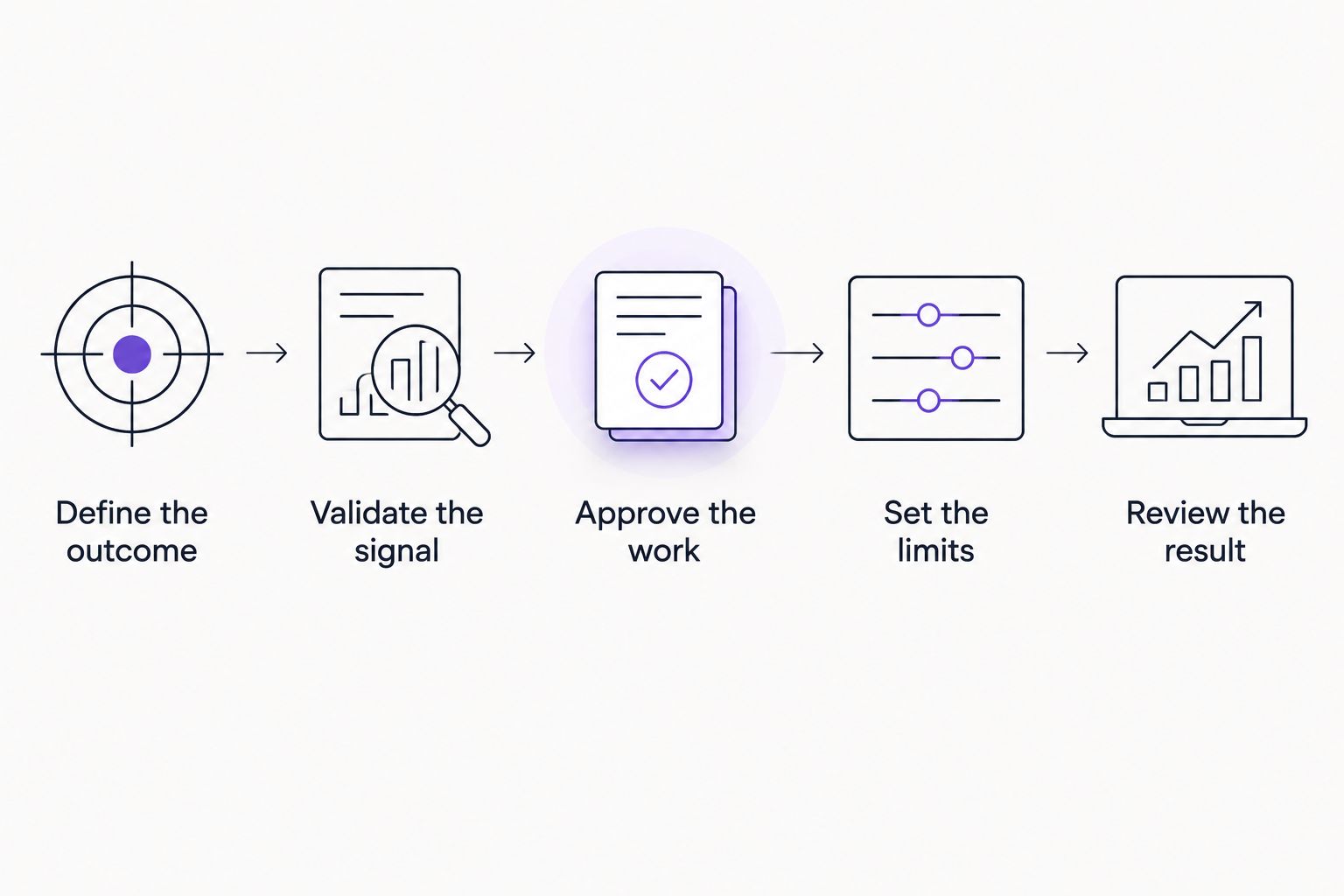
The operating sequence is straightforward: define the outcome, validate the signal, approve the work, set the limits, and review the result. Keep that sequence visible wherever your team approves campaign changes.
Separate TikTok decisions from Meta decisions
Start by reviewing TikTok and Meta campaigns separately, even when they advertise the same collection. Compare the product message, destination, purchase reporting, and campaign settings before deciding which work should be shared.
For your 2026 cross-channel workflow, reuse approved product facts and campaign briefs. Do not assume the same creative treatment or reporting interpretation belongs on both channels. Shared administration is different from identical execution.
TezAds supports campaign writing, launch, and optimization across Meta, Instagram, Google, TikTok, YouTube, and X. That makes cross-channel execution relevant to the evaluation; it does not prove every channel has identical controls. Brands should demonstrate the collection workflow, while agencies should demonstrate the client-account workflow.
- Share product facts: Maintain consistent approved descriptions.
- Review channel fit: Check creative and destination requirements separately.
- Inspect Meta tasks: Demonstrate both ad creation and management.
- Compare reporting definitions: Keep attribution differences visible.
- Verify live features: Exclude promised integrations from today’s decision.
Review results by product and by client
Begin with a manual review that connects spending decisions to products, creative, and purchase results. Read campaign summaries alongside order information. A higher campaign ROAS is not sufficient evidence that every advertised product improved.
For a brand, the review should end with a merchandising or creative decision: continue the message, change the destination, revise the product grouping, or stop the experiment. For an agency, it should also explain what changed, who authorized it, and which client objective it served.
Use your chosen 7-day and 28-day windows consistently. Explain differences between those views instead of selecting whichever window makes a change look better.
- Review products: Identify which items received spend and purchases.
- Review creative: Connect results to a specific message or asset.
- Inspect changes: Check whether automated actions matched the rules.
- Explain exceptions: Document tracking issues or campaign interruptions.
- Choose the next action: Give each decision an owner.
Compare your automation options
Choose the option that handles your actual work, not the longest feature list. A planning spreadsheet, a native advertising workspace, and cross-channel automation solve different problems. Demonstrate the same campaign brief in each workflow before committing.
| Option | Best for | Practical advantage | Key limitation |
|---|---|---|---|
| Spreadsheet and manual execution | Brands defining their process; agencies documenting client rules | Makes approval logic and responsibilities explicit | Does not execute campaigns; people must carry out and record changes |
| TikTok Ads Manager | Brands focused on TikTok; agencies managing TikTok work directly | Provides the native workspace for TikTok campaign management | Other advertising channels require separate workflows |
| TezAds | Brands and agencies seeking cross-channel campaign automation | Covers campaign writing, launch, and optimization across the stated channels | Broad channel coverage does not establish support for every TikTok-specific requirement; demonstrate essential controls |
For an in-house team, prioritize product accuracy, purchase measurement, and spending authority. For an agency, give equal weight to account separation, approvals, and the ability to explain changes to clients. Neither audience should count a roadmap item as an available capability.
Common mistakes fashion brands and agencies make
Optimizing revenue without checking product economics
A campaign can report revenue without showing what remains after product and operating costs. Brands should judge acceptable acquisition costs using their own economics. Agencies should obtain those boundaries from the client rather than inventing a profitability target.
Sending garment-specific ads to broad destinations
An ad that clearly shows a particular item creates a specific expectation. Check that the destination matches the garment and message. Agencies need a repeatable destination review when clients update collections or replace product pages.
Treating generated copy as approved product information
A persuasive draft is not evidence of fabric composition, fit, or performance. Brands should maintain an approved product fact sheet. Agencies should require client confirmation before publishing claims that are absent from the supplied materials.
Applying one rule across every client or collection
Collections can have different economics, and clients can authorize different actions. Brands should separate rules where those differences matter. Agencies should preserve client-specific boundaries even when a shared template saves setup work.
Buying a roadmap instead of a working process
A planned integration does not complete today’s campaign. Evaluate the live workflow in your account context, including what happens when a task fails. Keep future capabilities separate from the reason you select a platform now.
FAQ
What is TikTok ads automation for fashion brands?
TikTok ads automation for fashion brands uses software to create, launch, or adjust paid campaigns promoting clothing and accessories. The useful scope depends on the workflow: creative drafting, campaign execution, and optimization are separate tasks.
What should a fashion brand automate first?
Automate a repeatable task with clear inputs and approval rules first. Document the manual process, validate purchase measurement, and define spending authority before enabling automatic campaign changes.
Is TezAds suitable for a fashion advertising agency?
TezAds is designed for e-commerce brands and the agencies managing advertising accounts on their behalf. Agencies should demonstrate client-account permissions, approvals, and required TikTok controls before selecting it.
Can I use the same automation process for TikTok and Meta ads?
You can share approved product facts and campaign briefs, but review channel execution separately. Demonstrate both Meta ad creation and management rather than assuming a TikTok workflow covers the same tasks.
Does automated ad copy still need product review?
Yes, automated ad copy needs review against approved product information. Check garment descriptions, fit statements, material claims, destinations, and asset permissions before publication.
Is TikTok Ads Manager better than cross-channel software?
TikTok Ads Manager fits direct TikTok campaign work; cross-channel software fits teams coordinating campaigns across advertising platforms. Choose based on demonstrated execution, approval requirements, and reporting needs rather than channel count alone.
How do I check whether an automation feature is available now?
Ask for a demonstration of the exact task in a working account. Separate live functionality from roadmap commitments, and verify the campaign types and controls your team actually needs.
One last thing
Your exception process deserves the same attention as your launch process. Before enabling a rule in 2026, ask a teammate to explain what happens when purchase reporting stops or a product destination changes. If nobody owns the response, the workflow is unfinished—even if the campaign launches correctly.


